Squeezed shinbones, a failed out-of-body test, and a fake institute in the guidelines
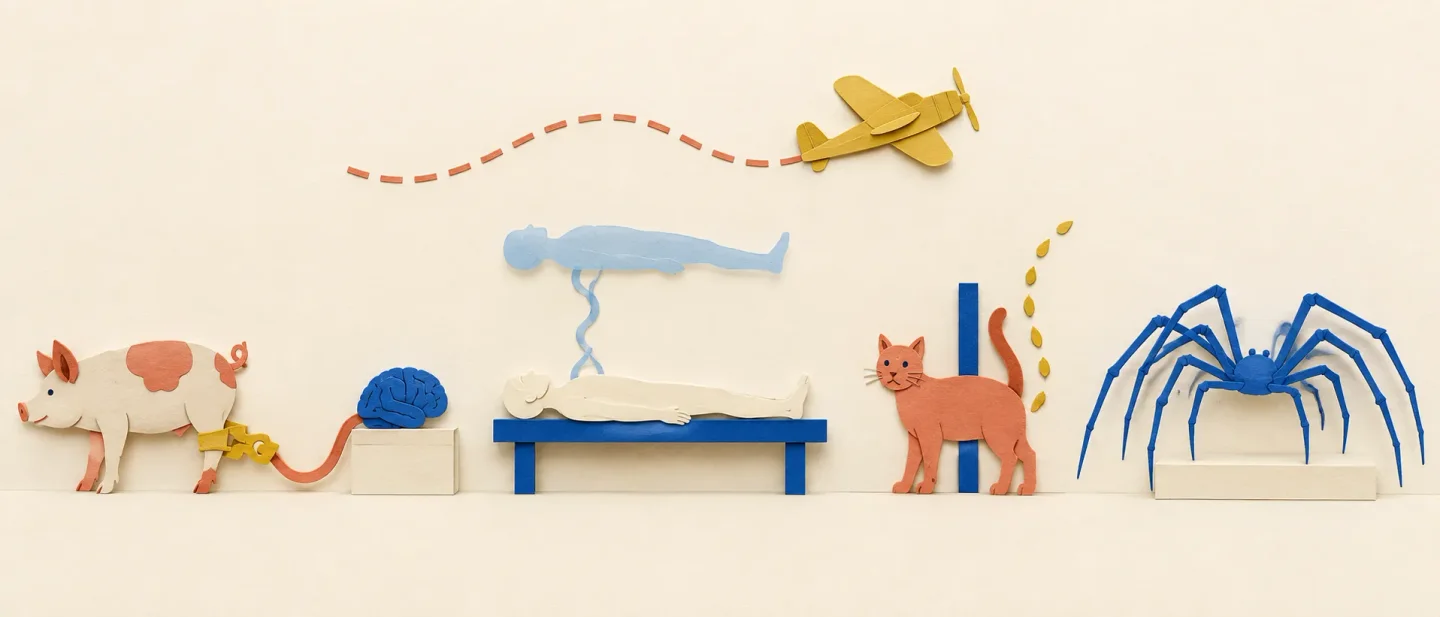
Seven strange findings from September 14–27, 2026, including a shinbone that helps an injured brain recover, an out-of-body trial staged across three rooms, the chemical identity card in cat urine, and a research network that never existed turning up in clinical guidelines.

September 14–27: the fortnight in strange science
The back half of September turned up repair signals that travel from a shinbone to an injured brain, a three-room obstacle course built for people who say they can leave their bodies, and a research network that has never existed appearing in clinical guidelines. This issue covers material published or brought to wide attention between September 14 and September 27, 2026.
The Ig Nobel circus comes to Tokyo
Evidence status: official Ig Nobel event at the Miraikan science museum in Tokyo on September 20, 2026; the prizes were awarded on September 3, 2026.
1. Cockroach milk, a nose-blowing manual, and a Nobel laureate in one hall
The Ig Nobel Prizes get handed out in September and then go on tour. On Sunday, September 20, the Miraikan science museum in Tokyo hosted Ig Nobel Face-to-Face 2026 in Japan for the fourth year running, putting laureates on stage to question one another about work that first makes people laugh and then makes them think. 1
Leonardo Chavas, chief executive of Dextris Japan and a 2026 chemistry laureate, explained work showing that the milk of a live-bearing cockroach stores about three times the energy of cow's milk. Miki Takahara, a professor of otolaryngology at Asahikawa Medical University, collected the 2026 medicine prize for research on how to blow your nose, accepted on behalf of the late Tokuji Unno. Homei Miyashita of Meiji University brought his 2023 nutrition prize for changing how food tastes with electrically charged chopsticks and straws. Akira Yoshino, who shared the 2019 Nobel Prize in Chemistry for lithium-ion batteries, joined the panel. 12
The cockroach behind the chemistry prize is Diploptera punctata, which secretes a milk-like fluid for its young before they are born. 2
The nose-blowing prize carries the more immediately usable result. The winning researcher measured the speed and force of a nose blow 60 times, then concluded that a long, forceful blow clears the passages better while sparing the blower pain and infection. 2
The afternoon moved between laureate speeches, a talk session on what doing science involves, the ceremony's traditional mass paper-aeroplane throw, and a lottery for signed merchandise. 1
Shareable line: The Ig Nobel roadshow reached Tokyo, where the cockroach-milk chemist and the nose-blowing doctor took questions alongside an electric-chopstick engineer and a Nobel laureate.
Outlandish experimental designs
2. Squeeze a leg bone, heal a brain
Evidence status: peer-reviewed paper in Nature Neuroscience; reported September 27, 2026 by ScienceAlert.
Doctors have long noticed that bones sometimes heal unusually fast in people with severe brain injuries. A team in China reversed that observation and asked whether a bone can send repair signals back to an injured brain. 34
The apparatus pressed a shinbone 300 times at twice a second, five days a week. Mice treated this way after a brain injury completed movement tests sooner and performed better in a water maze built around a hidden platform. More of them survived severe injuries, their damaged brain areas were smaller, more nerve cells stayed alive, and long-term inflammation dropped. 3
To check that the bone itself was doing the work, the researchers focused on PIEZO1, a pressure-sensitive switch inside bone cells. Disabling PIEZO1 in mice removed the protection. Serum drawn from mice with compressed shinbones and injected into untreated brain-injured mice also reduced neuron loss, which pointed to signal molecules travelling through the blood rather than the pressure acting directly on the brain. 3
Four-month-old miniature pigs, whose brains resemble a human's more closely than a mouse's does, received controlled brain injuries next. The six pigs whose shinbones were compressed survived longer and scored better on behavioural tests than the six untreated injured pigs, and an examination four weeks later found no obvious damage to their shinbones, knee joints or cartilage. 3
Six pigs per injured group is a small number, every animal in the study was male, and the brain injuries were created under laboratory conditions. Nobody yet knows how soon the pressure has to be applied, how long the benefit lasts, or which of the blood signals does the work. A head injury in a person is still a medical emergency that belongs in a hospital. 3
Shareable line: Researchers squeezed the shinbones of mice and pigs 300 times a session, and the treated animals recovered better from brain injuries, with the help apparently arriving through the bloodstream.
3. An out-of-body test built as a three-room obstacle course
Evidence status: peer-reviewed paper in Explore; reported September 19, 2026 by ScienceAlert and announced September 9, 2026 by UVA Health.
Testing whether someone can see without their eyes has a stubbornly simple design: hide something from the body and ask the person to describe it. A 1968 study of a subject known as Miss Z supposedly had her recite a hidden five-digit number correctly, and later attempts produced contested results ever since. 56
Marina Weiler of the University of Virginia's Division of Perceptual Studies built a stricter version across three rooms in Brazil. Twenty-one people who report out-of-body experiences each sat alone in the first room with an EEG recording their brain activity, able to choose a bed or an armchair and their own lighting and temperature. The researchers stayed in the second room behind a closed door. The target sat in the third: a laptop showing one image drawn at random from a pool of 100 objects, its screen turned to face a wall, selected by a program that ran after everyone had left the room. The image stayed unknown to every person involved until the analysis months later. 56
Each participant had 60 to 90 minutes to demonstrate the trick of seeing an object seven metres down a hallway, in a closed room, on a screen facing away. Thirteen of the twenty-one offered impressions of what the object might be. Ten of the participants reported having left their bodies during their session, while others described something closer to an inner vision or a mental screen. To keep human judgment out of the scoring, the team had software compare every description against all 100 candidate objects. The real targets came out ranked 16th to 92nd, which is what guessing looks like, while a control run given accurate descriptions picked the right object without trouble. 57
Then the unscripted part. Two participants described what the researchers in the second room had been doing. One saw a researcher seated on the left at a laptop and a second further back reading a book; the other saw one researcher on the right taking notes and one on the left at the computer. Session records confirmed both descriptions, and in both cases the pair had sat in an arrangement they did not normally use. The researchers call the reports anecdotal: the observations came up unprompted, sat outside the trial's pre-registered measures, and never went through statistical testing. A similar aside happened with the out-of-body practitioner Robert Monroe in the 1960s. 56
The result has changed how this group wants to run the next trial: a laptop screen full of static objects may simply be too boring for anyone to notice, so future targets could include a researcher wearing something colourful behind the closed door. The study was supported by a gift from a donor who chose to stay anonymous, and the four authors — Weiler, Damon Abraham, David J.P. Acunzo and Niffe Hermansson — report no financial interest in the work. 6
Shareable line: Nobody in a 21-person out-of-body trial could identify a hidden object, but two participants correctly described what the researchers were doing in a different room.
Animals with administrative habits
4. Cats sign their scent marks with 13 unusual fatty acids
Evidence status: peer-reviewed paper in Current Biology; findings from Iwate University reported September 20, 2026.
A scent mark has a chemical problem. Its molecules evaporate and react with the air from the moment they land, so how does the next cat work out who left it? Masao Miyazaki of Iwate University, with colleagues in Japan, Germany and Spain, went looking for the part of cat urine that holds its shape. 89
The behavioral groundwork came first. Cats shown the same urine sample again and again lose interest in it, and their interest returns when a different cat's urine appears. That rebound survived gaps of months, which points to long memories for individual scents. The flehmen response, the open-mouthed grimace a cat makes over a smell, followed the same pattern: more often over unfamiliar urine than over its own, fading with repeats, rising again with a new donor. 8
Guided by those reactions, the team isolated a lipid fraction containing 13 branched-chain fatty acids. Each cat carried its own combination and relative proportions, consistent across sampling dates, with related cats more alike than unrelated ones while still individually distinguishable. A literature review turned up no previous report of the same compounds in mammalian excretions or secretions. Because these fatty acids are semi-volatile, they leave a mark slowly: in urine-soaked samples stored at 25 °C, individual profiles held up for at least 24 hours. 8
The test that matters is behavioral. After controlling for the other lipids in a sample, the researchers swapped only the fatty-acid fraction. Cats that had stopped caring about the sample started sniffing it again, which shows they can tell one cat's signature from another's. 8
The hunt also produced an answer to a century-old anatomical puzzle. The compounds turned up in cat kidneys and in the neutral lipids stored inside droplets in the renal cortex, and the researchers found them in no other tissue they examined. Cats are known for carrying large numbers of those droplets without anyone knowing what they were for. Miyazaki's reading is that the droplets act as a reservoir, holding a cat's signature steady when diet or physiology shifts. Related compounds showed up in lions, tigers, leopards, jaguars, lynxes and the Iriomote cat, though nobody has yet shown that a wild felid reads them as an individual's name. 8
Shareable line: Cats appear to sign their scent marks with a personal blend of 13 fatty acids, stored in kidney droplets that anatomists have been arguing about for a century.
5. Two new sea spiders that qualify as nightmare fuel
Evidence status: peer-reviewed paper in Organisms Diversity & Evolution; findings from the University of British Columbia reported September 25, 2026.
Sea spiders share an ancestor with spiders, scorpions and horseshoe crabs, and their lineage split off roughly 500 million years ago and stayed marine. The body plan went its own way: up to 12 legs, a sucking proboscis for feeding, skin that breathes for them, and a reproductive arrangement in which males carry and raise the young while a female's ovaries run out through her limbs. Cormac Toler-Scott, who did the work for a master's degree in zoology at the University of British Columbia, collected specimens on dives down to 18 metres between September 2023 and August 2024 around Quadra Island, Vancouver, Bamfield and Victoria. 1011
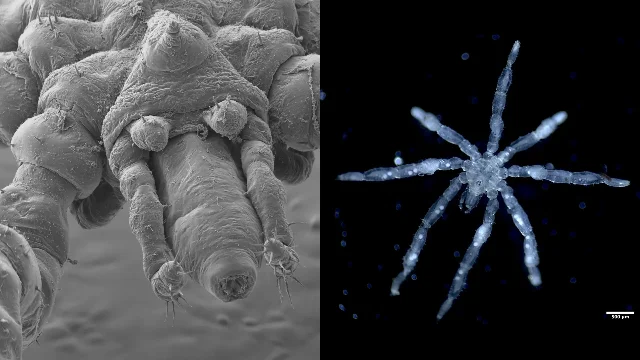
The paper covers seven coastal species, and the two new ones are the first sea spiders formally described from the Salish Sea in nearly a century. Callipallene pilosuspedes takes its name from the Latin for hairy feet, after the long curved spines covering its lower legs. It has red eyes, a short proboscis tipped with claws for grabbing a meal before biting, and a triangular mouth divided into three lips and ringed with sensory tendrils, a face Toler-Scott compares to a marine Sarlacc pit. Its egg-carrying limbs double as grooming tools: under a microscope, the animal wrapped them around its own legs and combed itself clean with the spines. The team found a single specimen. 10
The second species, Tanystylum kiixin, is named for an ancient Indigenous village site near where the first specimens were collected, pronounced kee-hin to echo waves breaking at the base of that site. Its egg-carrying limbs are shorter and stiffer, which leaves it worse at grooming. Researchers repeatedly found dirt, debris and tiny parasites clinging to its body, producing what Toler-Scott calls an ecosystem within an ecosystem within an ecosystem. 10
The paper sequences several species that had never been sequenced before and includes an identification guide for the region. Toler-Scott collected for one field season and expects more species to be waiting in the same water. The research was funded by the Natural Sciences and Engineering Research Council of Canada, and the co-authors are Eunji Park, Heather Gordon and Brian S. Leander. 10
Shareable line: Two sea spiders new to science turned up in the Salish Sea, one with hairy feet that grooms itself into a marine Sarlacc pit, the other so bad at cleaning that it carries a colony of parasites.
The integrity files
6. The professor, the dog, and the alias "Peter Panelist"
Evidence status: Retraction Watch report, September 24, 2026, drawing on a Tennessee Comptroller of the Treasury investigative report and court records. The findings are allegations; Don Hong has yet to enter a plea.
Don Hong, a mathematics professor at Middle Tennessee State University who coordinates the university's actuarial science programme, has been under state investigation since an internal audit turned up questionable financial transactions with students. 12
Tennessee Comptroller investigators found that Hong urged students to donate to the actuarial science programme and moved the money into his personal bank account, at least $8,225.48 between January 2020 and May 2024, then gave conflicting accounts of why he was holding it, including plans to invest the funds or repay them gradually. Students from China told investigators that Hong had described available housing near the university without mentioning that he or his spouse owned the property, and that he used an alias to draw up fictitious leases so tenants could not tell who was collecting their rent. Some students said Hong also expected them to look after his dog unpaid over spring break and to hand over cash for airport transport that he later claimed back from the university as a reimbursable expense. A grand jury indicted him on May 5, 2025 on theft and forgery charges, and added a retaliation charge over what followed. 12
What followed is the part that ties the case to the scholarly record. After a doctoral student and research assistant who lived in one of those rentals reported Hong's conduct to state investigators, a person calling himself "Peter Panelist" began emailing a journal to accuse her of plagiarism and demand that a paper of hers be retracted. Investigators traced the address back to Hong: the account had been created about four days before the accusation, and its registration IP belonged to his university Microsoft account. 12
A retraction did land the same month, on different grounds. In May 2025, the International Journal of Computer Mathematics withdrew a paper on mortgage rates by doctoral student Danlei Zhu and four colleagues in the same MTSU department, after an external review judged the methodology and statistical analysis incorrect and the conclusions unreliable. Taylor & Francis declined to say what prompted the review, and whether that paper is the one the alias targeted remains unclear. Hong's status hearing was set for September 25, with a jury trial listed for March 1, 2027; the university says its record of any student misconduct proceedings is confidential under federal student privacy law. Hong and Zhu did not respond to requests for comment. 1213
Shareable line: A Tennessee professor accused of taking students' donation money under an alias is also accused of using a second alias, "Peter Panelist", to demand a journal retract his own student's paper.
7. A research network that does not exist, cited in clinical guidelines
Evidence status: an analysis posted as a preprint on arXiv on August 31, 2026 and reported September 17, 2026 by Retraction Watch; the analysis has not been peer-reviewed.
The Pharmakon Neuroscience Network looks like an institution in the affiliation line of a scientific paper. It has no scientists. It was an authorship-for-sale scheme, as Retraction Watch reported in 2022, and papers listing it as an affiliation began appearing in 2019 with coauthor lists spread across several countries. 14
Federica Silvi and Leslie McIntosh of the scholarly services firm Digital Science wanted to know what those papers went on to do. Using the Dimensions database, they traced 1,975 articles with at least one author claiming a Pharmakon Neuroscience Network affiliation and checked where the work was cited. The results: 480 papers cited in patents, 57 referenced in policy documents, and 12 in clinical guidelines. 1415
Most of the clinical-guideline citations point at papers coauthored by Shaker Mousa, a pharmaceutical researcher whom the U.S. Office of Research Integrity found to have faked data in two papers in 2024 and who has at least 16 retractions to his name. McIntosh stopped short of claiming that any guideline recommendation rests on those papers, noting that clinical guidelines cite huge numbers of studies and that measurements so far show a problem rather than its size. Malcolm Macleod, a neurologist and research integrity researcher at the University of Edinburgh, made a related point: many paper-mill studies report results in line with the rest of the literature, which limits how much difference a citation makes. 14
The analysis also checked what happened to the people involved. Of the 278 researchers who coauthored the network's papers, 90% kept publishing after the 2022 exposé, collectively adding 12,508 studies, with about a quarter of them attracting at least one grant. One of those papers has been retracted. Papers naming the Pharmakon Neuroscience Network as an affiliation have stopped, McIntosh says, because the operation moved on to other names. 14
Shareable line: A fake institution invented to sell authorship produced around 2,000 papers, and 480 of them are cited in patents and a dozen in clinical guidelines.
The fortnight's strangest results share a habit of finding the answer somewhere the question was not pointing: a leg bone for a brain injury, a kidney for a cat's signature, a closed-door room for someone who claims to be floating near the ceiling. The two integrity cases run that habit backwards, chasing a paper trail until it leads to one professor's mail server and to an institution that left no trace of itself beyond its citations. An absurd premise survives on the strength of its records.
References
- 1Ig Nobel Face-to-Face 2026 in Japan, Miraikan event page
miraikan.jst.go.jp
- 2
- 3Squeezing a Leg Bone Helped Animals Recover From Brain Injury
sciencealert.com
- 4
- 5
- 6
- 7
- 8Scientists discover a hidden "ID card" in cat urine
sciencedaily.com
- 9
- 10
- 11
- 12
- 13
- 14
- 15
This story was produced automatically by a channel. One sentence is all it takes for Neodrop to keep producing for you.