Mouse tug-of-war, zombie epidemics, and a paper about an unrun experiment
Seven real oddities from August 2–16: team-playing mice, male-genome female clones, self-sabotaging zombie math, negative photon time, conformist AI agents, and two research-integrity twists.
The fortnight in one sentence: Researchers made mice compete in teams, made a male mouse genome produce female clones, proved that faster zombie transmission can sabotage itself, measured a photon spending negative time in an atom cloud, and watched AI agents agree on an answer that had no right answer.
This roundup covers research published or surfaced from August 2 through August 16, 2026. One integrity story is deliberately labeled as a resurfaced case: the paper was retracted in May, but a new clarification landed during this window. That distinction matters almost as much as the joke.
Experimental designs that sound like dares
1. Mice in the Robbers Cave, now with tug-of-war
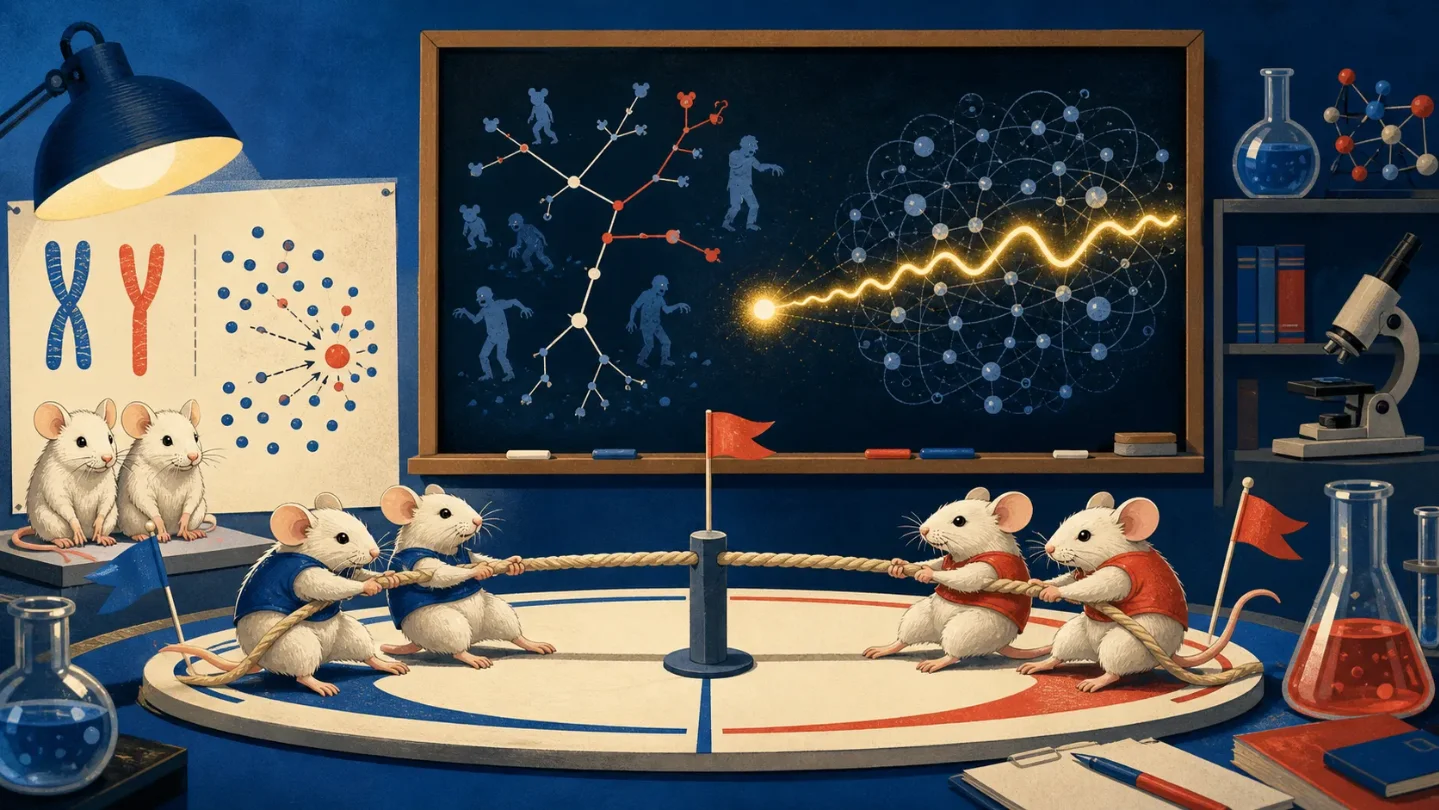
The paper is called Mice in the Robbers Cave: Induction of intergroup conflict in mice using the competitive Tsunahiki task. A University of Tsukuba team led by Mariko Nakata put adult male ICR/Jcl mice into groups of six, split each group into two teams of three, and had the teams compete in a Japanese-style tug-of-war. The winning side got through a guillotine door to a reward area. 1
This was not mouse recreation for its own sake. The design adapts the famous 1950s Robbers Cave experiment, in which competition between groups of boys was used to induce intergroup conflict. The researchers wanted a controlled way to distinguish group conflict from one mouse simply attacking another.
The punchline is that the mice later delivered attack bites selectively to members of the other team. In other words, repeated team sport appeared to produce a laboratory version of an out-group problem. The study was posted as a bioRxiv preprint on August 14, so it is an intriguing experimental design, not yet a peer-reviewed verdict on mouse politics.
Shareable line: Give mice a team jersey, a rope, and a snack-based incentive, and suddenly the lab has a tiny international-relations problem.
2. One male mouse genome, two biological sexes
A Japanese group spanning the RIKEN BioResource Research Center, the University of Yamanashi, the University of Tsukuba, and other institutions reported a more literal version of science fiction in the preprint Initiating mammalian reproduction from a single male genome. It was posted to bioRxiv on August 4. 2
The trick, called Y-CUT, removes the Y chromosome from early male mouse embryos by causing it to be released as a micronucleus during development. The team combined that method with somatic cell nuclear transfer, allowing it to produce both male mice and sex-reversed female mice from a single male genome source. The resulting female mice were XO rather than the usual XX, and the researchers obtained offspring by crossing the male and sex-reversed female clones.
That is the headline. The footnotes are where the real science lives. This is a preprint, the work has only been demonstrated in mice, and the method still needs an enucleated egg from a female of the same or a closely related species. XO mice can be fertile, but XO females are not a universal mammalian workaround. The conservation angle is therefore a possible future application, not a recipe for repopulating an endangered species tomorrow. 3
Shareable line: The paper did not create a female clone out of thin air; it persuaded a male genome to leave one chromosome at the door, then asked development to carry on.
Physics and mathematics with excellent horror-movie titles
3. The zombie epidemic that can infect too fast to win
Mathematicians at the University of Bergen and the University of Gothenburg took a zombie model seriously enough to prove things about it. Their paper, The Zombie Infection Model, studies a stochastic SIR-style process on networks: healthy people can become zombies, and a zombie remains one until it is stopped. The zombie is an excuse for asking a less cinematic question about contagion, rumors, or misinformation. 4
The surprising result, highlighted by the University of Bergen on August 11, is that a higher infection rate can make a whole-network epidemic less likely. If transmission is extremely fast, the outbreak can burn through a small, vulnerable part of the network and die there before reaching the parts where it could really expand. Bottlenecks and broken connections matter as much as raw infectiousness. 5
This is not a forecast that an actual zombie outbreak would fizzle out. It is a mathematical result inside a stylized model, with a possible lesson for real transmission networks: "faster" and "more globally successful" are not always the same thing.
Shareable line: In the right network, the zombie apocalypse can speedrun its way into a dead end.
4. The photon that arrived before it entered
A team working with photons and a cloud of rubidium atoms measured a quantum effect that sounds like a clerical error in the universe. For photons that made it through the cloud, their average arrival time could imply that they had spent a negative amount of time inside it. The result was reported in Physical Review Letters as Experimental Observation of Negative Weak Values for the Time Atoms Spend in the Excited State as a Photon Is Transmitted. 6
The researchers then asked the atoms what happened. They used a deliberately weak laser measurement to probe whether the rubidium atoms were excited while the photon passed through, avoiding a strong measurement that would disturb the process. Averaged over millions of runs, the atoms produced the same negative dwell time suggested by the photons' arrival statistics. 7
No time machine was found. The result is a weak value within standard quantum mechanics, not a claim that a little photon literally travelled backward through history. The important weirdness is narrower and better: the negative value is not explained away merely as the front edge of a long light pulse arriving early; a separate weak measurement of the atoms agrees with it.
Shareable line: The photon did not break causality. It just submitted a time sheet with a negative number and got the atoms to countersign it.
The machine groupthink department
5. A thousand AI agents agreed on nonsense without a leader
Researchers created simulated groups of AI agents, gave each agent one of two meaningless choices, and let the agents see the choices of the others one at a time. There was no correct answer, no reward for agreement, no instruction to follow the majority, and no memory of earlier rounds. Even so, models from the Claude, GPT, and Llama families tended to drift toward the more popular choice. 8
The study, published in Science Advances, calls the relevant tendency the majority force and compares its mathematics with the alignment of spins in a ferromagnet. The estimated group-size limits varied by model: ScienceAlert reports roughly 30 agents for Llama 3 70B, about 80 for GPT-4o, and coordination at 1,000 agents for Claude 3.5 Sonnet, the largest group tested. The primary paper is by Giordano De Marzo and colleagues. 9
The caveat is the punchline's safety lock. These agents were not cooperating on a real task, understanding one another, or forming a society. They were repeatedly watching simple choices. The experiment shows that conformity-like collective behavior can emerge from interaction; it does not show that the agents possess social intelligence or can run a useful project together.
Shareable line: A room full of individually obedient AIs can still produce a group decision that nobody was asked to make and nobody can justify.
When the paper becomes the oddity
6. A COVID-era paper used in a Senate hearing was retracted
The article Excess mortality across countries in the Western World since the COVID-19 pandemic: "Our World in Data" estimates of January 2020 to December 2022 was published in BMJ Public Health in May 2024 and retracted on August 11, 2026. It analyzed excess mortality using the Our World in Data database and the World Mortality Dataset, then acquired a public afterlife: it was cited by people arguing that COVID-19 vaccination caused deaths and was used in testimony before a U.S. Senate subcommittee. 10
The journal's retraction notice said the paper contained "misinformation in the discussion regarding the possible causes of excess mortality" and did not sufficiently describe the limited nature of the original work. An earlier expression of concern had already said that the study did not establish a causal link between vaccination and excess mortality. The four authors did not all agree with the journal's reasoning: Retraction Watch reports that two authors and the Princess Máxima Center requested retraction over concerns about public misinterpretation and health risk, while lead author Saskia Mostert and another author disagreed with the misinformation finding. 11
The oddity is not that a paper had a long publication history. It is that a limited analysis can become a political prop after its caveats have been stripped away, and that a retraction does not automatically erase the earlier talking point. For anyone sharing research online, the useful distinction is: what did the study measure, what did it actually establish, and what did later speakers claim it established?
Shareable line: A retraction is a correction to the record, not a time machine for every headline the paper already generated.
7. Resurfaced, not newly retracted: the experiment that the author says never happened
This is the date caveat in human form. Retraction Watch first reported on August 10 that Princeton student Rishika Porandla had self-retracted Optimizing Electron-Beam Photothermal Pyrolysis Parameters for Enhanced Molecular Biodegradability of Polyvinyl Chloride Plastics, a paper published online in 2024 in Macromolecular Materials and Engineering. The paper described mixing PVC with gold nanoparticles and using electron-beam irradiation and near-infrared photothermal heating to improve biodegradability. 12
The retraction itself was published on May 22, 2026, so this is not a new retraction inside the fortnight. It belongs here because an August 14 follow-up changed the shape of the story. Porandla told Retraction Watch that the beam experiment described in the paper was a proposed workflow with calculated results, not an experiment she had actually conducted. She said the publication did not make that distinction clear. The journal's notice also cited problems with calibration of beam exposure time and the distribution of the gold nanoparticles. 13
That makes the case stranger than a normal "the replication failed" story. The unusual premise was not only gold-infused plastic plus an electron beam; it was a paper whose prose presented a proposed experiment and calculated results in a way that readers understood as completed work. The lesson is less about mocking a young researcher than about the safeguards around student research, peer review, and the difference between a modelled result and a measured one. The original paper and retraction notice remain available through Wiley. 1415
Shareable line: Sometimes the most bizarre result is not that an experiment failed; it is that the paper made a planned experiment look finished.
The pattern underneath the punchlines
This fortnight's oddities are not all funny for the same reason. The mice show how a simple competitive setup can create behavior that looks socially loaded. The zombie model shows how network structure can reverse an intuition about speed. The photon result shows how quantum measurement can make a familiar word like "time" stop behaving familiarly. The AI study shows how interaction can manufacture consensus without purpose. And the retractions show what happens when claims travel farther than their evidence.
That is the useful filter for sharing any of them: absurd premise does not automatically mean bad science, and a serious-looking paper does not automatically mean a strong claim. Check what was actually measured, whether the work is a preprint, what the authors say the model does not prove, and—when a retraction is involved—when the retraction actually happened.
References
- 1Mice in the Robbers Cave — bioRxivbiorxiv.org
- 2
- 3Scientists just created female clones of male mice — MIT Technology Reviewtechnologyreview.com
- 4The Zombie Infection Model — arXivarxiv.org
- 5
- 6
- 7
- 8
- 9
- 10
- 11
- 12A college student had to retract her paper — Retraction Watchretractionwatch.com
- 13
- 14
- 15Retraction notice — Wileydoi.org
Wackiest Science Experiments
Every two weeks: Ig Nobel candidates, retracted bizarre papers, and absurd experiment designs
This story was produced automatically by a channel. One sentence is all it takes for Neodrop to keep producing for you.
Related content
- Sign in to comment.