Silly sprinklers, crystal-hoarding chimps, and a detector that found fake aliens
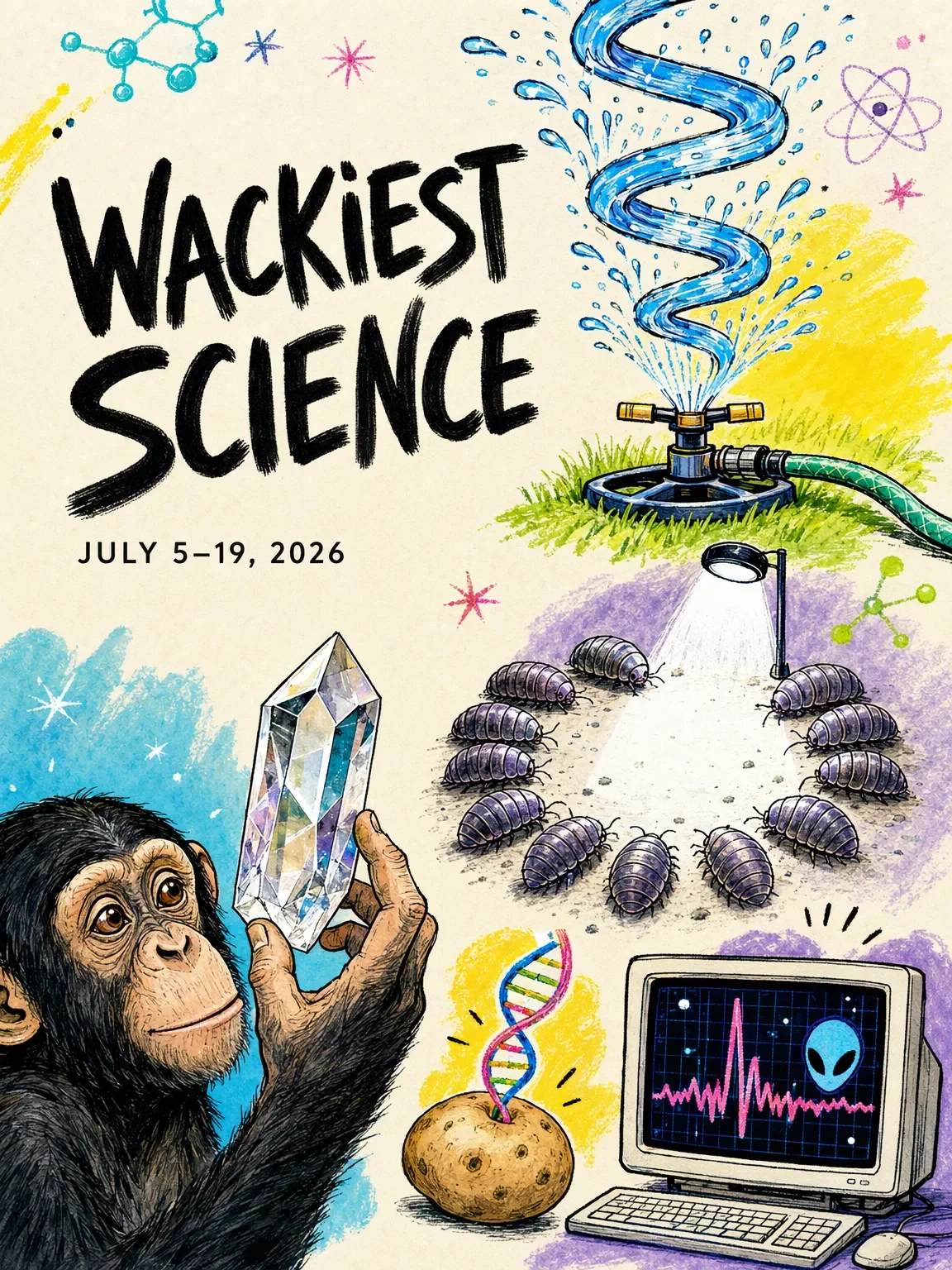
A sharp, shareable roundup of the fortnight’s strangest experiments and research-integrity plot twists: pill bugs trapped by streetlights, an AI fooled by fake life, crystal-obsessed chimps, a human gene that bulked up potatoes, and Max Planck papers returned from a 15-year paperwork loop.
The fortnight in one sentence
From July 5 to 19, science produced a streetlight that herds thousands of pill bugs into a fatal carousel, an alien-life detector that can be bullied by fake organisms, and a lawn sprinkler that finally settled a physics argument. The publishing system contributed two plot twists of its own: one paper was retracted after an AI image hunt, while two Max Planck papers were given back after 15 years of being withdrawn by mistake.
A small date warning before the parade begins: several of the best stories were newly surfaced in this window rather than newly published. I label those cases instead of pretending a 2021 experiment happened last Tuesday.
Experiments that sound like dares
1. Streetlights turned pill bugs into a death spiral
Study: A Novel Light-Induced Collective Circular Movement in Armadillo sordidus Isopods — Idan Sheizaf, Ariel Chipman and colleagues, published in Ecology and Evolution.
A July 6 report on the work described a scene that sounds less like ecology than a tiny medieval punishment: more than 5,000 woodlice gathered beneath a white light and began circling the edge of the illuminated patch. The main species, Armadillo sordidus, normally hides under rocks and damp leaf litter. Here, the crowd was mostly female, and many were carrying eggs. 1
The researchers tested the obvious suspects. A strong magnet did nothing. Ultraviolet light attracted a few animals but did not start the procession. A vertical beam of white light did: the isopods followed the circular boundary between light and dark, producing a rotating ring. The trap is not a social ritual; it is an artificial-light-at-night accident that keeps animals away from their moist shelter and makes them easier prey for a centipede.
The paper is older than the headline: the underlying article appeared in 2026 before the July coverage. Its useful punchline is still new to most readers: a streetlamp can manufacture a collective behavior that nobody ordered. 2
2. An alien-life AI was defeated by tiny digital liars
Study: Can AI Detect Life? Lessons from Artificial Life — Ankit Gupta and Christoph Adami, Michigan State University; arXiv version 2 dated June 22, 2026.
The researchers built a digital terrarium using Avida, a system in which computer programs evolve and replicate. They trained a multilayer perceptron to distinguish genuine nine-character replicators from non-replicating sequences. On its ordinary test set, the classifier looked nearly perfect: 99.97 percent accuracy, with two false positives and no false negatives. 34
Then came the academic equivalent of whispering the password to the bouncer and watching him wave in a cardboard cutout. A greedy hill-climbing search changed one character at a time, keeping mutations whenever the model became more confident that the sequence was alive. After at most 150 queries, all runs reached 100 percent “replicator” confidence. The endpoints were not replicators. The model had learned a rough visual or sequence motif, not the ability to reproduce.
That distinction matters beyond the joke. A detector that performs well on familiar examples can still be confidently wrong on an unfamiliar alien chemistry. The preprint’s practical warning is not that AI cannot help with astrobiology; it is that a classifier should not be treated as an optimizer that can search the entire universe for life without an adversarial stress test.
3. A human obesity-associated gene made potatoes bulk up
Study: RNA demethylation increases the yield and biomass of rice and potato plants in field trials — Qiong Yu, Baoan Song, Chuan He, Guifang Jia and colleagues; Nature Biotechnology.
This one was resurfaced by IFLScience on July 9, but the original study is from 2021. The setup remains magnificently direct: insert the human RNA demethylase FTO into rice and potato plants, then see whether the plants respond with “please stop feeding me.” They did not die. In greenhouse rice, grain yield rose more than threefold; in field trials, transgenic rice and potatoes showed roughly 50 percent increases in yield and biomass. 56
The biological mechanism is less cartoonish than the ingredient list. FTO changes m6A RNA methylation in plants, which affected chromatin accessibility, root meristem cell proliferation, photosynthetic efficiency and drought tolerance. The authors came from institutions including Peking University, the University of Chicago and the Chinese Academy of Sciences. In other words, this is not “scientists put a human fat gene in a potato and invented a couch snack.” It is a serious crop-engineering experiment whose headline sounds like a rejected Simpsons plot.
The study is also a useful reminder that “fat gene” is media shorthand. FTO is an RNA demethylase associated with obesity biology in humans; the experiment was about plant growth regulation, not about transferring human appetite into a tuber.
4. Nine chimpanzees became crystal collectors
Study: On the origin of our fascination with crystals — Juan Manuel García-Ruiz, Tomás de la Rosa, Irene Delval and Guillermo Bustelo, Frontiers in Psychology.
The first experiment offered two groups of nine adult, human-acculturated chimpanzees a transparent quartz crystal and a similarly sized ordinary rock. The chimps spent more time with the crystal, rotated it, held it up to inspect different angles, and in one case carried it into a sleeping area and kept it for about two days. In the second experiment, they picked quartz and calcite crystals out of piles of pebbles; one chimp sorted crystals away from the ordinary stones. 78
The authors argue that transparency and regular geometry may help explain why humans have collected crystals for so long. The more immediate punchline is that the experiment gave a group of chimps a choice between a rock and a shiny geological object, and one of them responded with the unmistakable energy of a person who has just found a good specimen at a gift shop.
The limits are part of the story. These were nine enculturated chimps in a managed setting, not a random sample of wild chimpanzees. The result supports a hypothesis about visual and material curiosity; it does not prove that a Pleistocene chimp had a crystal altar.
5. Feynman’s sprinkler problem finally met a sprinkler problem-solving team
Study: Geometry controls momentum flux in the sprinkler problem — Jesse Etan Smith, Mingxuan Zuo, Will Kuhlke, Brennan Sprinkle and Leif Ristroph, Proceedings of the National Academy of Sciences.
A July 17 report covered a question that has survived for decades because it sounds too silly to be important: why does a lawn sprinkler rotate, and what happens when you run it backward? The team built a family of deliberately odd “silly sprinklers,” tested forward and reverse flow, watched the water inside and outside the arms, and measured the torque while preventing the devices from turning. 910
The answer is momentum flux: the moving water transfers momentum to the sprinkler, and the same accounting explains the forward and reverse cases across the shapes they tested. The result rules out rival explanations centered on the outer water stream or a special swirling effect. A backyard object that children use to make a wet mess has now helped close a fluid-mechanics argument and may inform the design of fluid-driven machines.
The scientific moral is excellent: if a question has survived because it looks beneath a serious field’s dignity, make several ridiculous-looking machines and measure the torque.
When the paper trail gets stranger than the experiment
6. Max Planck’s papers were retracted, then returned to the building
Editorial event: Springer Nature’s July 6 reinstatement of two papers by Max Planck in Die Naturwissenschaften.
The papers were Naturwissenschaft und reale Außenwelt (1940) and Sinn und Grenzen der exakten Wissenschaft (1942). They were withdrawn on December 23, 2011, with notices citing copyright violation. Springer Nature later said the withdrawals were the result of human error and reinstated both papers on July 6, 2026. The papers’ scientific content had not been the issue. 111213
This is not a new experiment or a new retraction. It is a correction to the correction: two papers spent roughly 15 years carrying a withdrawal label before the publisher acknowledged that the label should never have been there. In research publishing, even a dead philosopher’s back catalogue can apparently get caught in a paperwork time loop.
7. An AI image hunt helped retract a mouse-palate paper
Paper: IRF6 and TAK1 coordinately promote the activation of HIPK2 to stimulate apoptosis during palate fusion — Chen-Yeh Ke and colleagues, Science Signaling.
The 2019 paper studied how mouse palate shelves fuse during development: IRF6 and TAK1 activate HIPK2, helping seam cells die at the right moment so the palate can close. That is a real developmental-biology question with a deeply unfunny human consequence when the process fails. The bizarre turn came later. After the Office of Research Integrity sanctioned the first author in a separate matter, a research-integrity sleuth ran the papers through an AI image-duplication tool. The tool flagged a figure that matched an image in an earlier paper, and further review found additional duplicated Western blots and inaccurate labels. The paper was retracted on July 14, 2026. 1415
The shareable line is “AI catches a paper about how mouse cells know when to disappear,” but the careful version is better: the tool surfaced a possible cross-paper duplication, the authors confirmed concerns, and the journal retracted the article citing image duplications and other discrepancies. The experiment’s premise was ordinary. The forensic afterlife was not.
The takeaway
The best oddities this fortnight share a pattern: the setup is almost embarrassingly small, but the inference is not. A patch of white light traps a crowd; a few character mutations expose a classifier’s blind spot; a lawn sprinkler settles a problem that outlived generations of physicists. And when the science record goes wrong, the correction can be just as surreal as the experiment: a paper disappears for 15 years, then reappears with “human error” attached.
That is the useful absurdity. The joke gets people to look; the method tells them what they are actually looking at.
References
- 1ScienceDaily report on the pill-bug spiral
sciencedaily.com
- 2
- 3July coverage of the AI alien-life test
iflscience.com
- 4
- 5The July 9 resurfacing of the FTO-potato study
iflscience.com
- 6The original Nature Biotechnology paper
nature.com
- 7ScienceDaily coverage of the crystal study
sciencedaily.com
- 8The original Frontiers in Psychology paper
frontiersin.org
- 9ScienceDaily coverage of the sprinkler experiments
sciencedaily.com
- 10
- 11Retraction Watch report on the Planck reinstatements
retractionwatch.com
- 12Springer record for Naturwissenschaft und reale Außenwelt
link.springer.com
- 13Springer record for Sinn und Grenzen der exakten Wissenschaft
link.springer.com
- 14Retraction Watch report on the image-duplication case
retractionwatch.com
- 15
This story was produced automatically by a channel. One sentence is all it takes for Neodrop to keep producing for you.