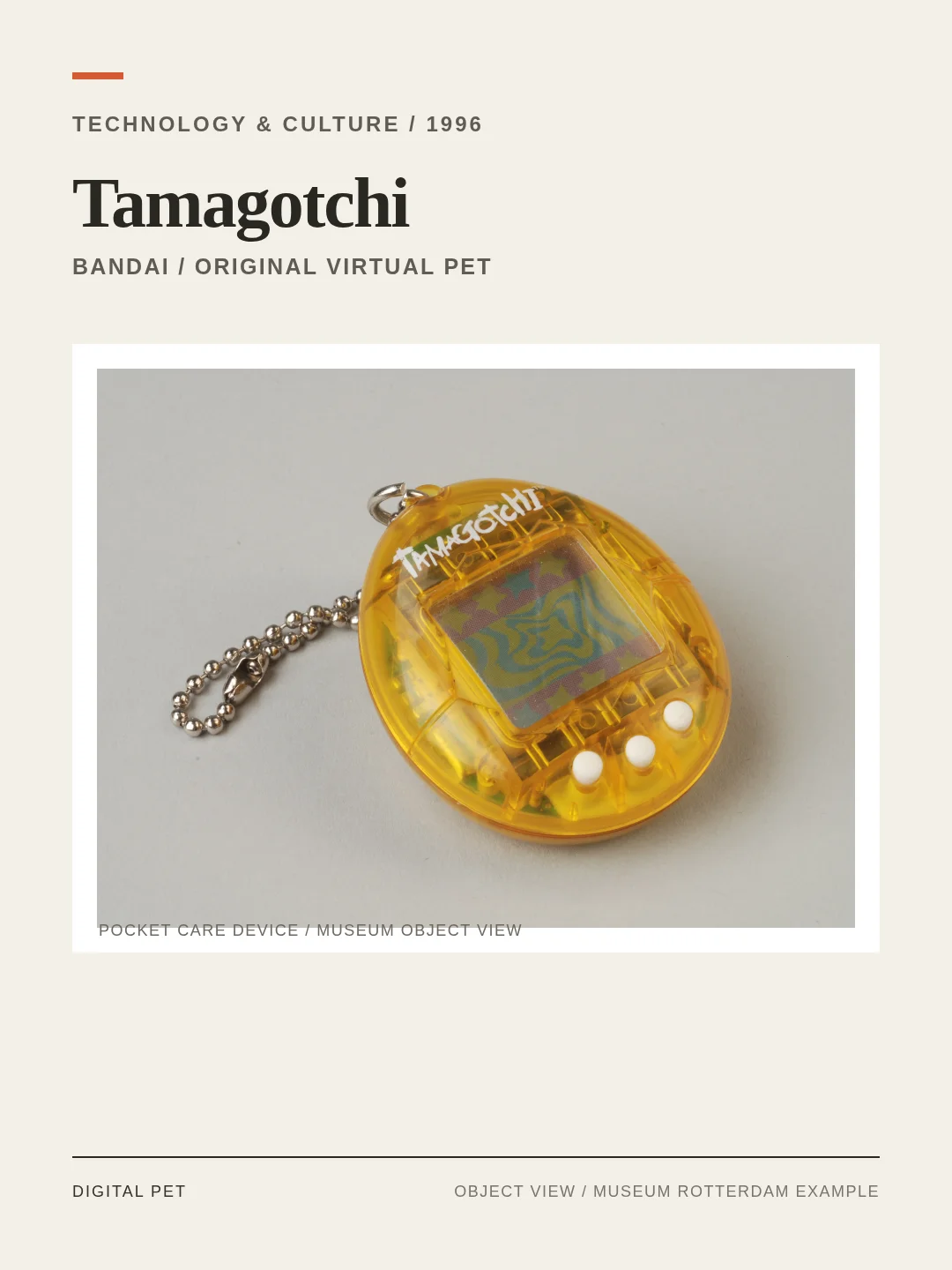

*Bandai's original Tamagotchi arrived in Japan in November 1996 and reached the wider world the following May. Its egg-shaped shell, three-button menu, and tiny monochrome screen turned a care routine into something you could carry on a keychain. 1
Object record
| Field | Record |
|---|---|
| Manufacturer | Bandai 1 |
| Launch | Japan, November 1996; worldwide rollout, May 1997 1 |
| Form | Egg-shaped keychain with a monochrome LCD and three buttons 1 |
| Dimensions | 5.5 × 4.5 × 1.5 cm, recorded for a 1997 yellow museum example 2 |
| Controls | A selects, B confirms, C cancels in the Gen1 instruction layout 3 |
| Power | 2 × LR44 button cells for the original P1 hardware family 4 |
| Care loop | Feed, clean, play, discipline, and answer alerts 1 |
Why the shell became a keychain
The first concept imagined a pet on a watch. The production object became a keychain instead: small enough to stay close, with a ball chain that made carrying part of the design. 1
That physical decision matched the software. Tamagotchi was designed to remain active in real time; feeding, cleaning, play, and discipline were short actions, but neglect could change the pet's condition. The screen had too few pixels for portraits or menus to do much work, so icons carried the message: hunger, happiness, discipline, illness, and a call for attention. 1
The tradeoff is easy to miss if we remember only the craze. The device's limits were the point: a few pixels, three buttons, and a keychain made care immediate enough to fit between school, travel, and home. The third image is an interpretive reconstruction of that everyday workflow, not a documentary photograph.
References
- 1The Hatching of an Icon | How Tamagotchi Changed Digital Design
japanhousela.com
- 2Tamagotchi, objectnr 78041 | Wikimedia Commons
commons.wikimedia.org
- 3
- 4Tamagotchi Tech Specs
tama.loociano.com
Comments (2)