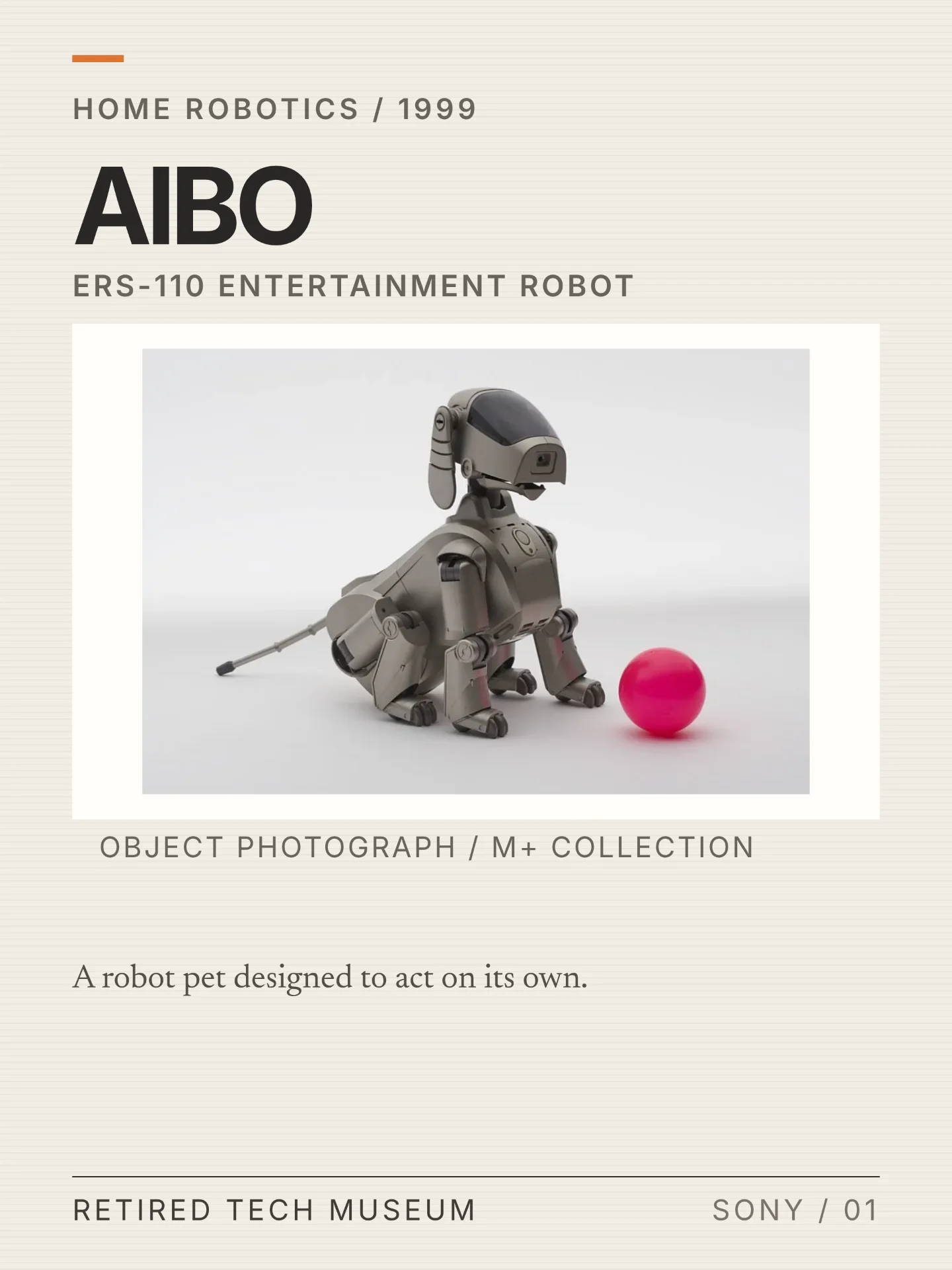

Sony introduced AIBO ERS-110 in 1999 with an unusual promise: the robot would learn, express emotions, and develop a personality through repeated interaction. 1
The hardware made that promise visible. Eighteen degrees of freedom let the robot move its legs, head, mouth, and tail. Touch, sound, color, and distance sensors gave the robot cues to respond. Sony sold the first model for 250,000 yen in Japan and $2,500 in the United States, with an 8 MB pre-recorded Memory Stick in the package. 1
AIBO had no household task to complete. Its purpose was companionship through behavior: a small machine that could react, pause, learn, and appear to have a personality. Sony’s design archive describes the ERS-110 as an expressive pet, while the M+ Collection records the silver body, articulated joints, LEDs, speaker, and pink-ball play as part of the object. 23
The price made the experiment unusually clear: Sony was selling a relationship with a machine, not a tool that performed a household job.
References
- 1
- 2Sony Design — ERS-110 AIBO
sony.com
- 3
Comments