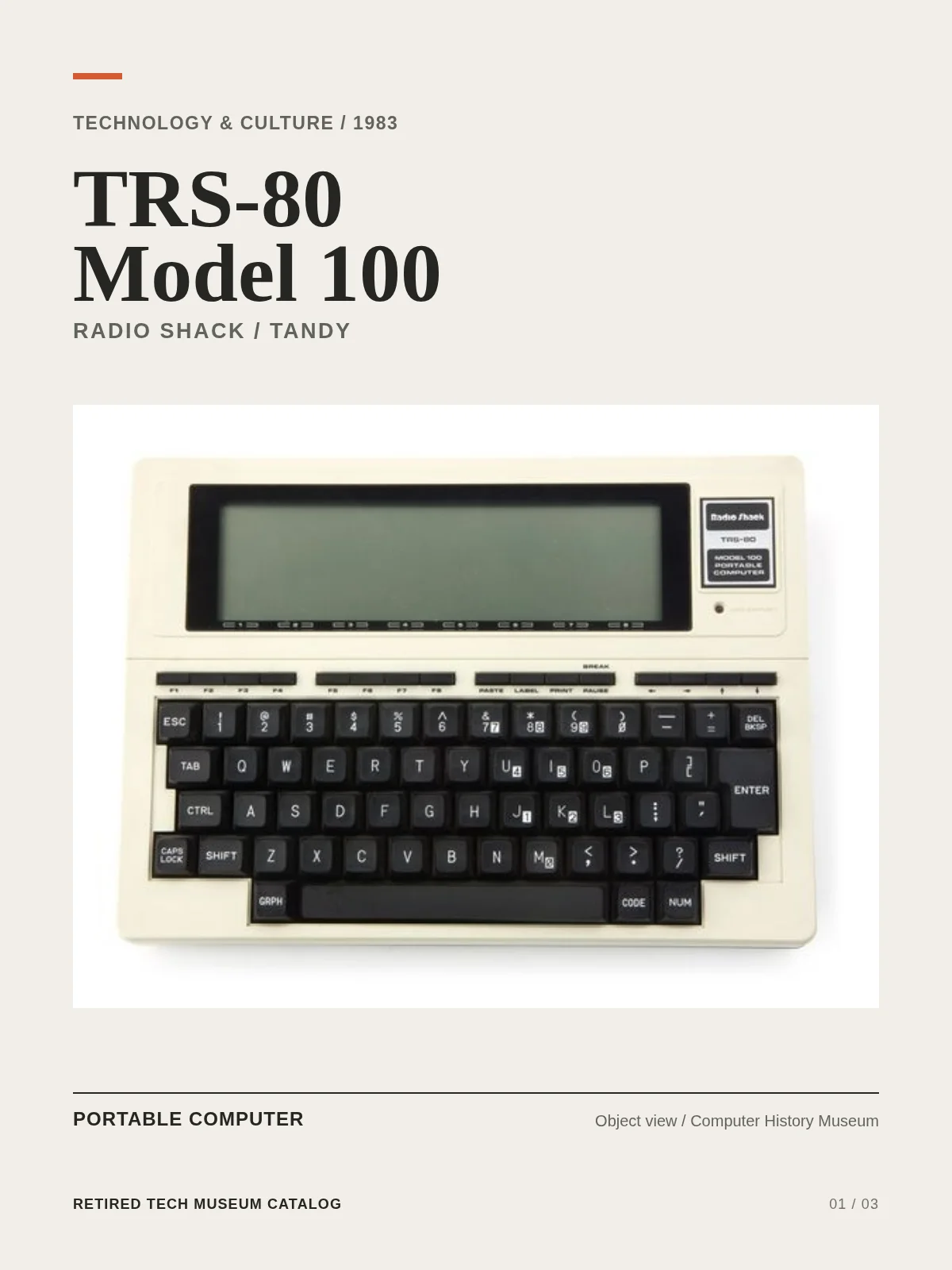

The TRS-80 Model 100 made a portable computer look less like a reduced desktop and more like a working notebook: a flat cream case, full-size keyboard, reflective LCD, battery power, and a built-in modem. Tandy sold it through Radio Shack after acquiring the Kyocera platform originally released in Japan as the Kyotronic 85. 1
Object record
- Introduced: 1983. 2
- Display: 8 lines by 40 characters, 240 by 64 pixels, and not backlit. 1
- Processor: 8-bit Intel 80C85 CMOS at 2.4 MHz; 32K ROM with 8K, 16K, 24K, or 32K static RAM options. 1
- Communications: North American models included a 300-baud modem, plus serial and parallel ports, cassette audio, and barcode input. 1
- Power and size: Four AA cells or an external adapter; up to 20 hours on alkaline batteries; 300 x 215 x 50 mm and about 1.4 kg with batteries. 1
Why it traveled
The modem changed the job description. The Computer History Museum describes the Model 100 as a rugged machine beloved by journalists, with a 20-hour battery claim and more than six million units sold. 2 MOHAI preserves one concrete example: its donor was a wire-service journalist who carried the computer while reporting on world events. 3
The first card uses the Computer History Museum's product photograph. The third card is an interpretive reconstruction of that traveling workflow, not a documentary photograph.
References
- 1TRS-80 Model 100 Portable Computer
computinghistory.org.uk
- 2Radio Shack TRS-80 Model 100
computerhistory.org
- 3
Comments