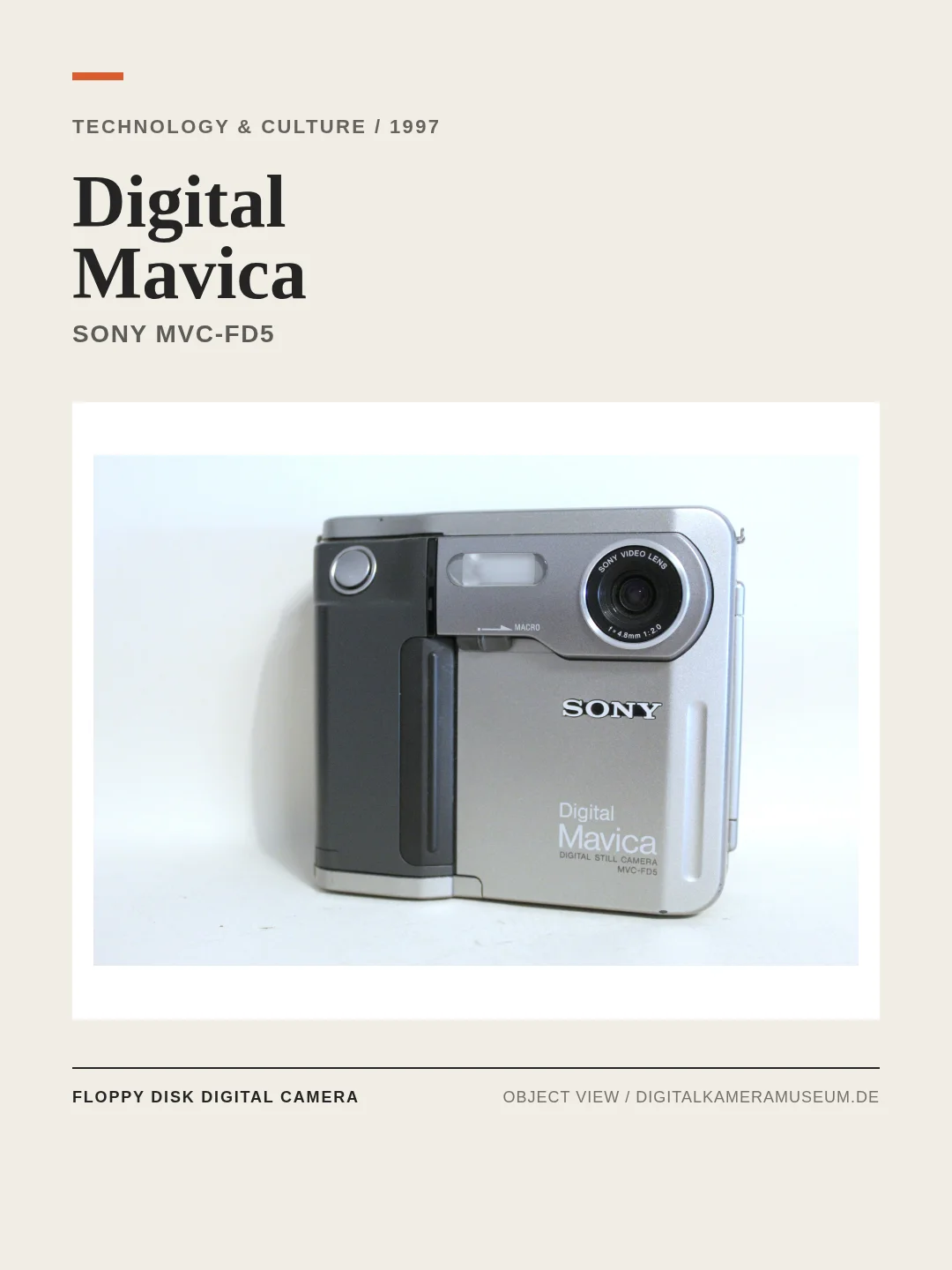

The 1997 Sony Digital Mavica MVC-FD5 put a floppy drive where a film compartment or memory card would normally sit. Sony's own history describes the MVC-FD5 and MVC-FD7 as the products that made 3.5-inch floppy disks the recording medium for Digital Mavica, with JPEG files that could be read by a PC without special software. 1
Object record
- Introduced: 1997. 2
- Imager and display: 0.38MP 1/4-inch CCD, 640 x 480 output, and a 2.5-inch TFT screen. 2
- Lens: 4.8mm fixed-focus lens at f/2.0; shutter range 1/60 to 1/4,000 second. 2
- Storage: standard 3.5-inch floppy diskette. The contemporary advantage was legibility: the disk could go straight into a period PC, while JPEG files avoided a special conversion step. 1
- Body: 127 x 114 x 63.5 mm and about 500 g; the museum record lists a lithium-ion battery. 2
Why the body became a box
Sony chose a familiar computer medium over a smaller camera. The disk drive made the MVC-FD5 thick and square, but it also made the image file physically portable: eject the disk, carry it to a computer, and open it there. Cameralabs describes the same tradeoff in practical terms, including a typical 20 to 40 images per 1.44MB disk and a workflow in which a photographer could hand a disk directly to an office art desk. 3
The first two cards use collection photography from DigitalKameramuseum.de. The office scene is an interpretive reconstruction, not a documentary photograph.
References
- 1
- 2Sony MVC-FD5
digitalkameramuseum.de
- 3Sony Mavica MVC FD5 retro review
cameralabs.com
Comments