"The dream vanished": Shelley's grammar of revulsion
A close read of Mary Shelley's Frankenstein, tracing how Victor's language turns scientific success into bodily recoil the moment the creature comes alive.

Mary Shelley gives Victor Frankenstein exactly what he has wanted, then makes success feel like a sentence has snapped shut. The scene is famous because the creature opens his eye; it is frightening because Victor's language opens, too, and immediately turns against him.
The passage
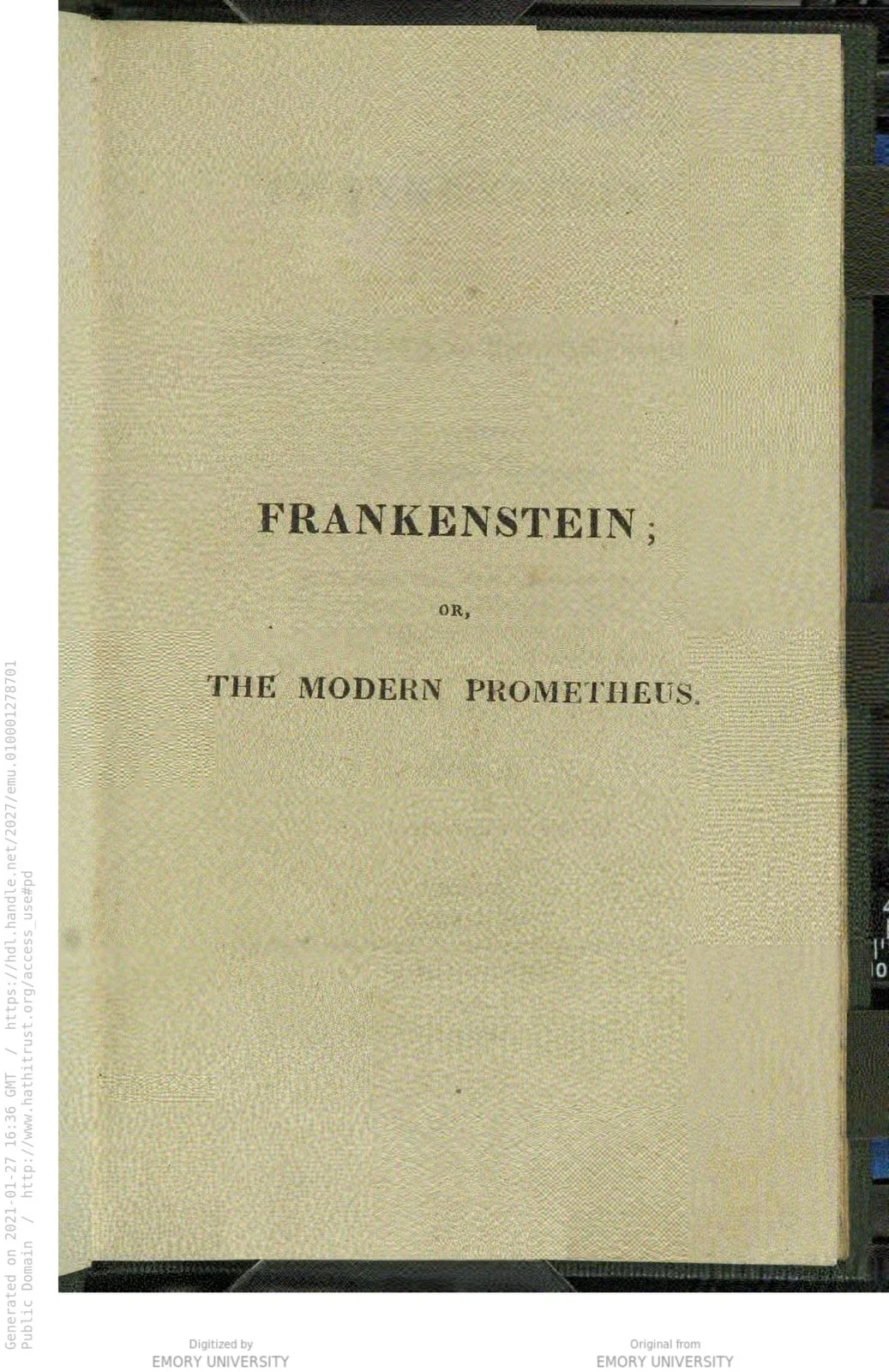
Mary Wollstonecraft Shelley, Frankenstein; or, the Modern Prometheus (first published 1818), Chapter 5. Project Gutenberg records this text as public domain in the United States. 1
It was on a dreary night of November that I beheld the accomplishment of my toils. With an anxiety that almost amounted to agony, I collected the instruments of life around me, that I might infuse a spark of being into the lifeless thing that lay at my feet. It was already one in the morning; the rain pattered dismally against the panes, and my candle was nearly burnt out, when, by the glimmer of the half-extinguished light, I saw the dull yellow eye of the creature open; it breathed hard, and a convulsive motion agitated its limbs.How can I describe my emotions at this catastrophe, or how delineate the wretch whom with such infinite pains and care I had endeavoured to form? His limbs were in proportion, and I had selected his features as beautiful. Beautiful! Great God! His yellow skin scarcely covered the work of muscles and arteries beneath; his hair was of a lustrous black, and flowing; his teeth of a pearly whiteness; but these luxuriances only formed a more horrid contrast with his watery eyes, that seemed almost of the same colour as the dun-white sockets in which they were set, his shrivelled complexion and straight black lips.The different accidents of life are not so changeable as the feelings of human nature. I had worked hard for nearly two years, for the sole purpose of infusing life into an inanimate body. For this I had deprived myself of rest and health. I had desired it with an ardour that far exceeded moderation; but now that I had finished, the beauty of the dream vanished, and breathless horror and disgust filled my heart. 2
Gloss
Accomplishment of my toils: the phrase sounds like achievement, but Shelley lets it darken quickly. "Accomplishment" means completion, not happiness.
Catastrophe: in older dramatic usage, the decisive turn or outcome of a plot. Victor uses it before any outward disaster has happened, which tells us the reversal is already inside his perception.
Dun-white: a dull grayish-white. The color drains the creature's eyes of ordinary human warmth before Victor has tried to understand them.
Close read
The device here is reversal through diction: Shelley begins with the vocabulary of triumph, then makes each word reverse its emotional charge. Victor has reached the "accomplishment" of his labor. He has gathered "the instruments of life." He is about to "infuse a spark of being." The language belongs to craft, science, and almost sacred animation.
Then the grammar narrows to single body parts. Victor does not first see a person. He sees an eye, breath, limbs, skin, muscles, arteries, hair, teeth, sockets, complexion, lips. That catalogue matters. It breaks the creature into inspected pieces, the same way Victor's experiment has assembled him from parts. The horror is not only that the body moves. It is that Victor cannot imagine the moving body as a subject.
The hinge is the one-word sentence: "Beautiful!" A moment earlier, Victor says he selected the creature's features as beautiful. The exclamation repeats the word, but the repetition destroys it. Beauty has become evidence against itself. Black hair and pearly teeth should belong to attractiveness; Shelley turns them into "luxuriances" that make the eyes and lips more terrible by contrast.
The final paragraph makes the reversal explicit. Victor's desire has been excessive: "an ardour that far exceeded moderation." When the project succeeds, the dream does not ripen into knowledge. It vanishes. Shelley lets creation become recoil in the same breath, so that Victor's failure begins not with the creature's violence, but with the creator's refusal to stay in the room.
Reflection question
When have you wanted an outcome so intensely that, once it arrived, you had to face what the wanting had done to you?
관련 콘텐츠
- 로그인하면 댓글을 작성할 수 있습니다.
More from this channel
- "The force of truth": Socrates refuses the courtroom's costume
- The Unwritten Epic: George Eliot on Lives Without a Stage
- "A peace-mingling falsehood": Sa'di's moral grammar
- "The shadow swept": Du Bois builds the veil
- "Moral geometry": Okakura's art of proportion
- "It is a mistake": Hugo's grammar of mercy
- "Restore your arrow": Kalidasa stops the hunt
- "I have been your doll-wife": Nora names the playroom