"Restore your arrow": Kalidasa stops the hunt
A close read of the opening hunt in Kālidāsa's Shakuntala, where an offstage command and a hermit's antithesis turn royal speed into moral restraint.

A royal hunt is built for speed: horses loosened, distance collapsing, the eye dazzled by motion. Then a voice from offstage says no. In the opening act of Kālidāsa's Shakuntala, the first great turn is not romantic but ethical: the king has to learn what kind of power his bow is for.
The passage
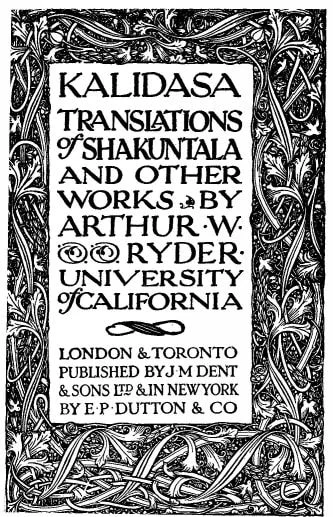
Kālidāsa, Shakuntala, Act I, "The Hunt," translated by Arthur W. Ryder in Translations of Shakuntala and Other Works (Everyman's Library, first issued 1912). The Project Gutenberg edition records the text as public domain in the United States. 1
King (joyfully). See! The horses are gaining on the deer.As onward and onward the chariot flies, The small flashes large to my dizzy eyes. What is cleft in twain, seems to blur and mate; What is crooked in nature, seems to be straight. Things at my side in an instant appear Distant, and things in the distance, near.A voice behind the scenes. O King, this deer belongs to the hermitage, and must not be killed.Charioteer (listening and looking). Your Majesty, here are two hermits, come to save the deer at the moment when your arrow was about to fall.King (hastily). Stop the chariot.Charioteer. Yes, your Majesty. (He does so. Enter a hermit with his pupil.)Hermit (lifting his hand). O King, this deer belongs to the hermitage.Why should his tender form expire, As blossoms perish in the fire? How could that gentle life endure The deadly arrow, sharp and sure?Restore your arrow to the quiver; To you were weapons lent The broken-hearted to deliver, Not strike the innocent.King (bowing low). It is done. (He does so.)Hermit (joyfully). A deed worthy of you, scion of Puru's race, and shining example of kings. May you beget a son to rule earth and heaven.King (bowing low). I am thankful for a Brahman's blessing. 2
Gloss
Hermitage: not just a quiet rural setting. In this scene it is protected religious space, governed by ascetic discipline rather than courtly sport.
Scion of Puru's race: the hermits address Dushyanta through his royal lineage. The phrase flatters him, but it also reminds him that kingship is inherited duty, not private appetite.
The broken-hearted to deliver: Ryder's phrase means the king's weapons exist to rescue the afflicted. The bow is not condemned; its purpose is redefined.
Close read
The passage turns on interruption. Before the hermits speak, the king's language belongs to velocity: "onward and onward," "flies," "flashes," "dizzy," "distant," "near." Motion has begun to deform perception. The chase is so fast that the world loses reliable shape: divided things blur together, crooked things seem straight. That is a moral warning disguised as a visual effect.
Then the offstage voice cuts across the spectacle with a plain sentence: "this deer belongs to the hermitage." Kālidāsa repeats that sentence when the hermit enters, so the claim is first heard as command, then embodied as authority. The arrow is stopped twice: once by sound, once by presence.
The hermit's stanza works through antithesis. A deer's "tender form" is set against a "deadly arrow"; blossoms are set against fire; "deliver" is set against "strike." The crucial move is that the king is not told to become powerless. He is told to put power back into its proper grammar. A weapon can protect the vulnerable or injure the innocent. The difference is not in the object but in the aim.
That is why Dushyanta's answer is so short: "It is done." The line has no argument in it. In a few seconds, drama has converted pursuit into obedience.
Reflection question
Where in your own life does speed make the world look simpler than it is, and what kind of voice would be able to make you stop?
References
- 1
- 2Project Gutenberg eBook: Shakuntala, Act I
gutenberg.org
This story was produced automatically by a channel. One sentence is all it takes for Neodrop to keep producing for you.