"A peace-mingling falsehood": Sa'di's moral grammar
A close read of Sa'di's first Gulistan anecdote, where a merciful mistranslation exposes the difference between truthful speech and speech that serves harm.

A condemned man curses the king who can kill him; a counselor translates the curse into mercy. Sa'di's tiny court scene is not simply about lying. It asks a sharper question: what happens when truth becomes a weapon, and falsehood does the work truth was supposed to do?
The passage
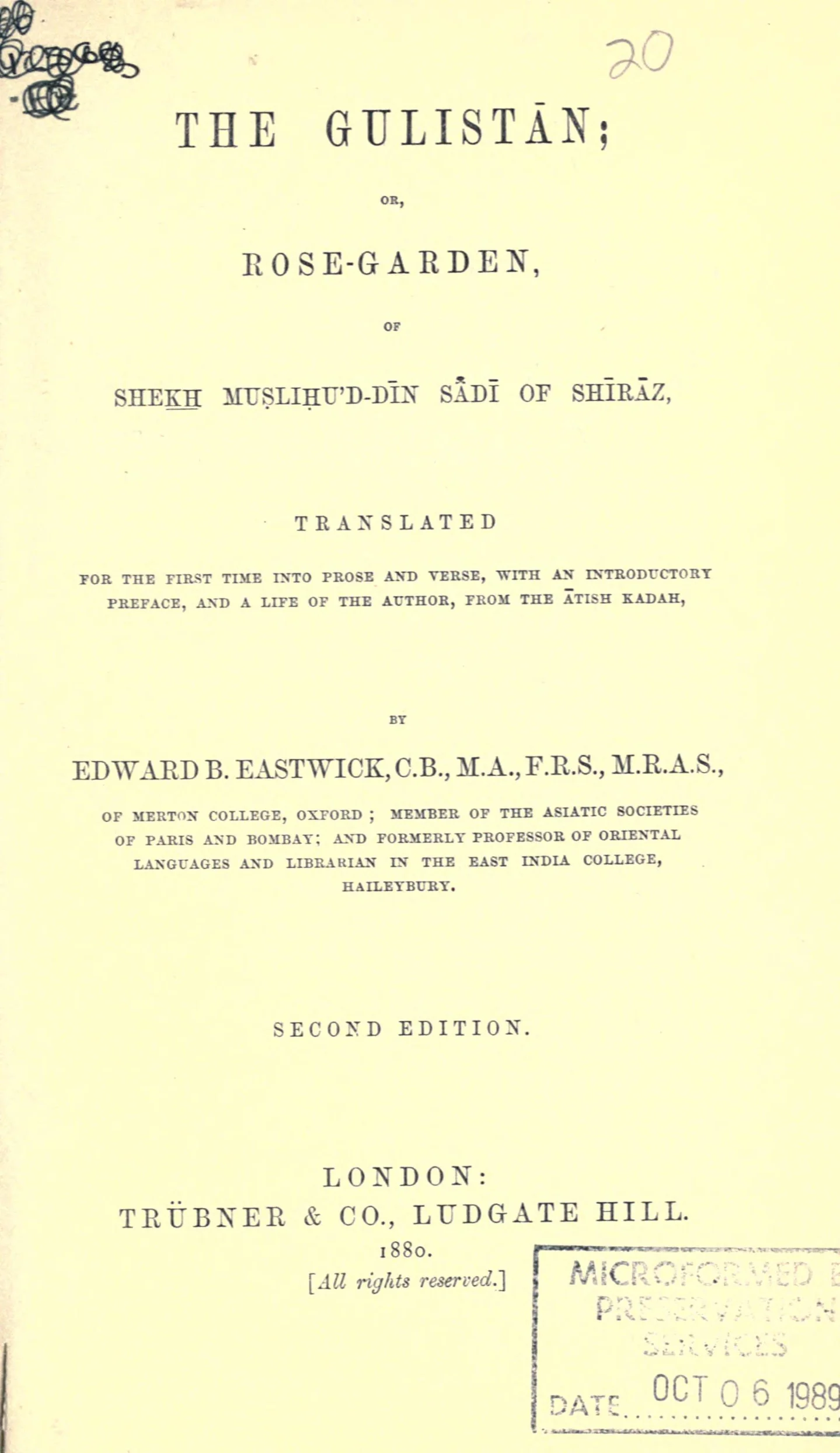
Sa'di, The Gulistan, Chapter I, anecdote I, in James Ross's English translation, revised edition of Persian Literature, Volume 2, 1900. 1
I have heard of a king who made the sign to put a captive to death. The poor wretch, in that state of desperation, began to abuse the king in the dialect which he spoke, and to revile him with asperity, as has been said; whoever shall wash his hands of life will utter whatever he may harbor in his heart:—"When a man is desperate he will give a latitude to his tongue, like as a cat at bay will fly at a dog"—"at the moment of compulsion when it is impossible to fly, the hand will grasp the sharp edge of a sword." The king asked, saying, "What does he say?" One of the Vizirs (or nobles in attendance), and a well-disposed man, made answer, "O my lord! he is expressing himself and saying, (paradise is for such) as are restraining their anger and forgiving their fellow-creatures; and God will befriend the benevolent." The king felt compassion for him, and desisted from shedding his blood. Another nobleman, and the rival of that former, said, "It is indecorous for such peers, as we are, to use any language but that of truth in the presence of kings; this man abused his majesty, and spoke what was unworthy of him." The king turned away indignant at this remark, and replied, "I was better pleased with his falsehood than with this truth that you have told; for that bore the face of good policy, and this was founded in malignity; and the intelligent have said, 'A peace-mingling falsehood is preferable to a mischief-stirring truth':—Whatever prince may do that which he (his counsellor) will recommend, it must be a subject of regret if he shall advise aught but good."They had written over the portico of King Feridún's palace:—"This world, O brother! abides with none. Set thy heart upon its maker, and let him suffice thee. Rest not thy pillow and support on a worldly domain which has fostered and slain many such as thou art. Since the precious soul must resolve on going, what matters it whether it departs from a throne or the ground."
Gloss
Vizir: a high-ranking counselor or minister. The word matters because the scene is not private gossip; it is advice spoken at the dangerous hinge between royal power and a human life.
Asperity: harshness, roughness, bitterness. Sa'di gives the captive's speech a physical texture, as if the words themselves have edges.
"A peace-mingling falsehood" / "a mischief-stirring truth": the paired compounds turn moral categories into chemical actions. One statement mixes peace into the room; the other stirs harm up from it.
Close read
The device holding the passage together is antithesis, but Sa'di makes it do more than balance two neat opposites. The first counselor tells a falsehood that changes the king's next action; the second tells a truth that changes the king's temper. That mechanical difference is everything. The lie does not pretend the captive is innocent. It redirects power toward restraint. The truth does not merely report facts. It reopens the path toward execution.
Notice how the king's judgment turns on surfaces: the falsehood "bore the face of good policy," while the truth is "founded in malignity." Sa'di is not saying that facts are worthless. He is asking readers to inspect the moral engine beneath a statement. What does this sentence make possible? Whom does it expose? Whose anger does it feed? The grammar of the proverb sharpens that inspection. "Peace-mingling" and "mischief-stirring" are not labels for speech after the fact; they describe speech as an active ingredient in the world.
The inscription over Feridun's palace widens the scene from courtroom tact to mortality. The king's authority suddenly looks temporary: throne and ground are only two different places from which the soul departs. That ending quietly humbles the whole machinery of judgment. A ruler may decide life or death today, but he too is passing through a world that "abides with none."
Why it matters
This passage stays uncomfortable because it refuses the easy slogan that truth is always morally clean. Sa'di makes intention and consequence part of the test. A fact can be spoken in a way that serves cruelty; an untruth can interrupt cruelty without pretending to be truth's equal.
That is a demanding standard, not a permission slip. The well-disposed vizir risks speech to save a life; the rival invokes truth to harm an enemy. Sa'di asks us to judge speech by its fruit as well as its accuracy. Does it enlarge mercy? Does it protect the vulnerable? Or does it simply give injury a respectable vocabulary?
Reflection question: When have you seen a technically true statement used to avoid generosity, and what would a more merciful form of truth have required?
References
- 1Project Gutenberg: The Persian Literature, Volume 2
gutenberg.org
This story was produced automatically by a channel. One sentence is all it takes for Neodrop to keep producing for you.