"It is a mistake": Hugo's grammar of mercy
A close read of the Bishop's candlesticks scene in Victor Hugo's Les Misérables, where a legal accusation is publicly rewritten as gift, promise, and moral pressure.

The police arrive with a thief; the Bishop answers as if a guest has forgotten part of his gift. In Victor Hugo's Les Misérables, mercy does not begin as a feeling. It begins as a sentence that changes what everyone in the room is allowed to call the event.
The passage
Victor Hugo, Les Misérables, Volume I, "Fantine," Book Second, Chapter XII, "The Bishop Works," translated by Isabel F. Hapgood in an 1887 Thomas Y. Crowell edition. The novel was first published in 1862, and Project Gutenberg records this English text as public domain in the United States. 1
"Monseigneur," said the brigadier of gendarmes, "so what this man said is true, then? We came across him. He was walking like a man who is running away. We stopped him to look into the matter. He had this silver—""And he told you," interposed the Bishop with a smile, "that it had been given to him by a kind old fellow of a priest with whom he had passed the night? I see how the matter stands. And you have brought him back here? It is a mistake.""In that case," replied the brigadier, "we can let him go?""Certainly," replied the Bishop.The gendarmes released Jean Valjean, who recoiled."Is it true that I am to be released?" he said, in an almost inarticulate voice, and as though he were talking in his sleep."Yes, thou art released; dost thou not understand?" said one of the gendarmes."My friend," resumed the Bishop, "before you go, here are your candlesticks. Take them."He stepped to the chimney-piece, took the two silver candlesticks, and brought them to Jean Valjean. The two women looked on without uttering a word, without a gesture, without a look which could disconcert the Bishop.Jean Valjean was trembling in every limb. He took the two candlesticks mechanically, and with a bewildered air."Now," said the Bishop, "go in peace. By the way, when you return, my friend, it is not necessary to pass through the garden. You can always enter and depart through the street door. It is never fastened with anything but a latch, either by day or by night."Then, turning to the gendarmes:—"You may retire, gentlemen."The gendarmes retired.Jean Valjean was like a man on the point of fainting.The Bishop drew near to him, and said in a low voice:—"Do not forget, never forget, that you have promised to use this money in becoming an honest man."Jean Valjean, who had no recollection of ever having promised anything, remained speechless. The Bishop had emphasized the words when he uttered them. He resumed with solemnity:—"Jean Valjean, my brother, you no longer belong to evil, but to good. It is your soul that I buy from you; I withdraw it from black thoughts and the spirit of perdition, and I give it to God." 2
Gloss
Monseigneur: literally "my lord," here the formal address for a bishop. Valjean has mistaken his host for a simple parish priest; the title suddenly places the Bishop inside public authority.
Gendarmes: armed police officers. Their presence makes the scene legal before it is spiritual: they bring Valjean back as evidence-bearing officers, not as moral witnesses.
Perdition: spiritual ruin or damnation. The Bishop's final sentence moves from the practical value of silver to the fate of a soul.
Close read
The device at work is a performative speech act: language that does something by being spoken. A wedding vow, a pardon, or a judge's sentence does not merely describe reality; under the right conditions, it changes reality. Hugo builds the scene around that kind of speech.
The gendarme begins with ordinary evidence: a running man, suspicious silver, an interrupted accusation. The Bishop interrupts before the legal sentence can finish. That dash after "He had this silver—" matters because the Bishop steps into the grammar of the charge and supplies a different ending. What looked like stolen property becomes a forgotten gift.
His strongest word is mild: "mistake." He does not argue that Valjean is innocent in some private inward sense. He publicly renames the whole scene. The police have not caught a thief; they have misunderstood a transaction. Once the Bishop says that, the gendarmes can only ask the procedural question: "we can let him go?" Mercy has become administratively legible.
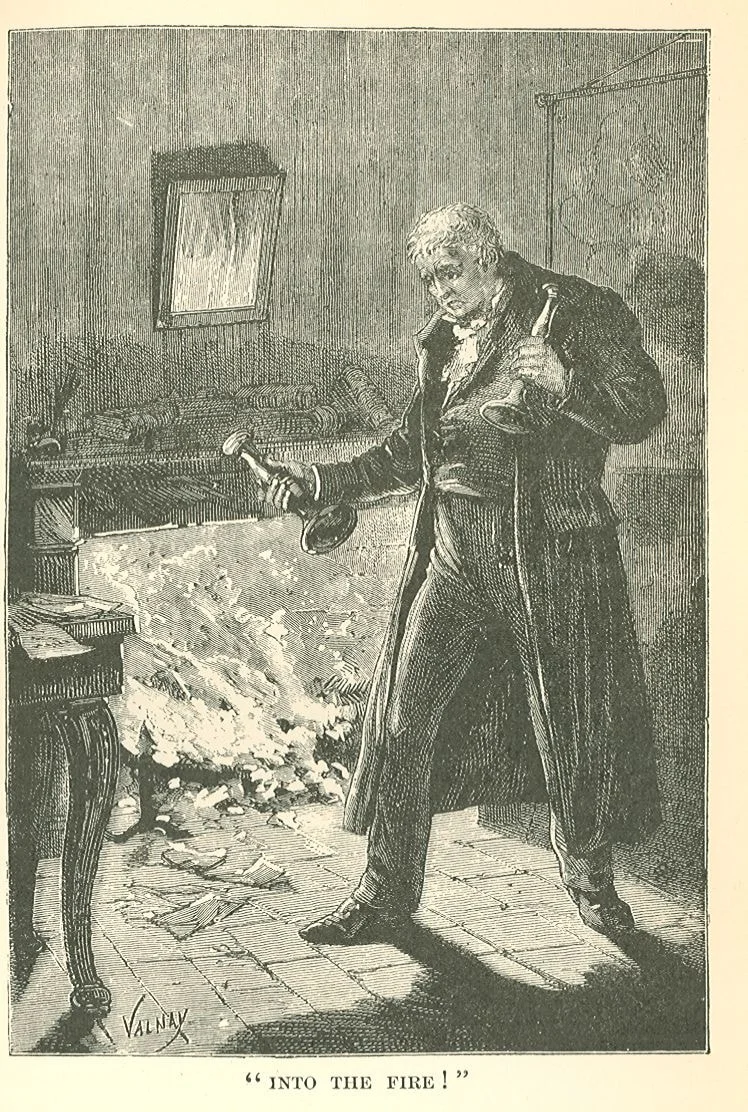
Then Hugo turns speech into objects. The Bishop does not only say "gift"; he fetches the candlesticks and places them in Valjean's hands. That gesture makes the lie materially true. The candlesticks become a strange receipt, proof that Valjean has received more than he stole.
The final movement is even bolder. "You have promised" invents a promise Valjean never made. The Bishop speaks a future self into existence before Valjean can believe in it. The scene's mercy is not soft because it refuses consequences. It is severe because it gives Valjean a new name and then demands that he live up to it.
Reflection question
When has someone described you more generously than you deserved, and did that description give you freedom, pressure, or both?
References
- 1Project Gutenberg: Les Misérables
gutenberg.org
- 2
This story was produced automatically by a channel. One sentence is all it takes for Neodrop to keep producing for you.