"Moral geometry": Okakura's art of proportion
A close read of Okakura Kakuzo's The Book of Tea, tracing how its opening turns a cup of tea into hygiene, economics, moral geometry, and a democratic discipline of taste.
Okakura begins with a cup small enough to hold in the hand and large enough to reorganize a civilization. In The Book of Tea, the daily object is not reduced to charm or etiquette. It becomes a measuring instrument for how much beauty, humility, and proportion a life can bear.
The passage
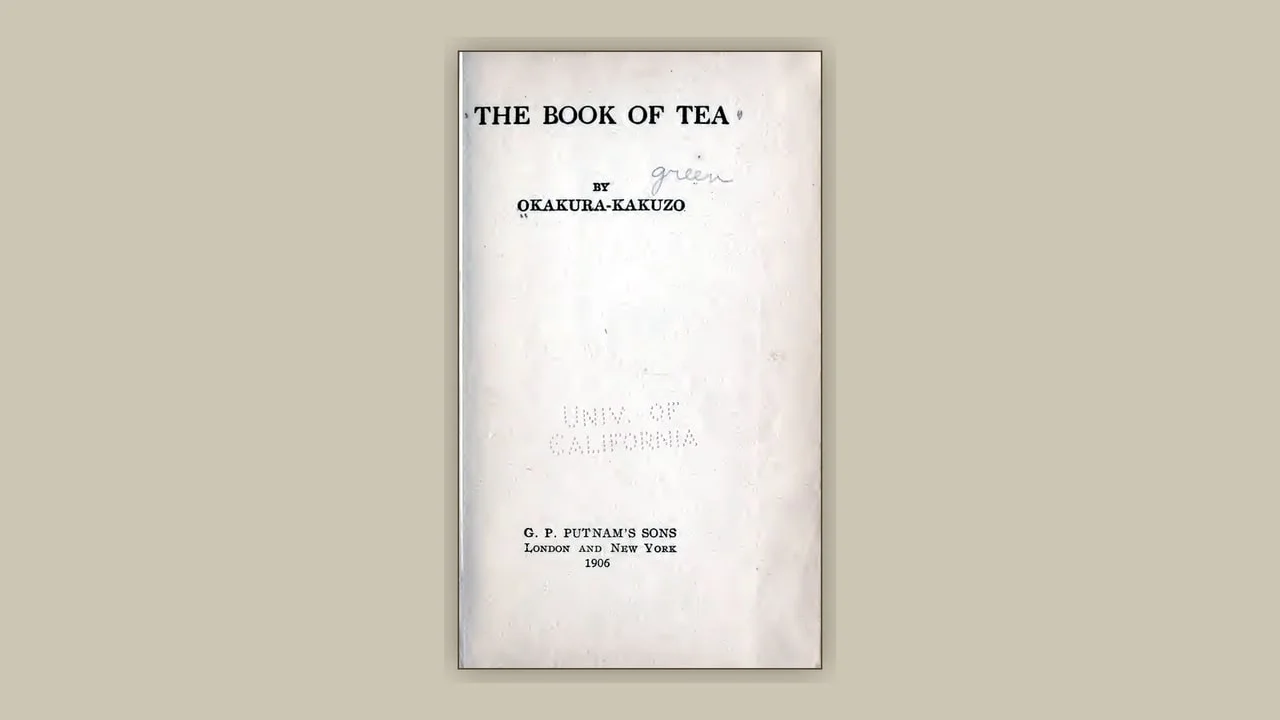
Kakuzo Okakura, The Book of Tea (1906), Chapter I, “The Cup of Humanity.” Okakura wrote the book in English for Western readers; Project Gutenberg records this text as public domain in the United States. 1
Tea began as a medicine and grew into a beverage. In China, in the eighth century, it entered the realm of poetry as one of the polite amusements. The fifteenth century saw Japan ennoble it into a religion of aestheticism—Teaism. Teaism is a cult founded on the adoration of the beautiful among the sordid facts of everyday existence. It inculcates purity and harmony, the mystery of mutual charity, the romanticism of the social order. It is essentially a worship of the Imperfect, as it is a tender attempt to accomplish something possible in this impossible thing we know as life.The Philosophy of Tea is not mere aestheticism in the ordinary acceptance of the term, for it expresses conjointly with ethics and religion our whole point of view about man and nature. It is hygiene, for it enforces cleanliness; it is economics, for it shows comfort in simplicity rather than in the complex and costly; it is moral geometry, inasmuch as it defines our sense of proportion to the universe. It represents the true spirit of Eastern democracy by making all its votaries aristocrats in taste.The long isolation of Japan from the rest of the world, so conducive to introspection, has been highly favourable to the development of Teaism. Our home and habits, costume and cuisine, porcelain, lacquer, painting—our very literature—all have been subject to its influence. No student of Japanese culture could ever ignore its presence. It has permeated the elegance of noble boudoirs, and entered the abode of the humble. Our peasants have learned to arrange flowers, our meanest labourer to offer his salutation to the rocks and waters. 2
Gloss
Teaism: Okakura’s name for the tea ceremony understood as an aesthetic and ethical discipline, not just a way of preparing a drink.
Worship of the Imperfect: not a taste for damage or failure, but a willingness to seek beauty inside limits. The phrase makes incompleteness feel like a condition of tenderness.
Moral geometry: a striking metaphor for proportion. Geometry measures relations among shapes; Okakura wants tea to measure relations among self, household, society, and universe.
Close read
The device here is definition by accretion: Okakura defines tea by adding layer after layer until the small object can carry a whole worldview. The first sentence is almost comically plain: “medicine” becomes “beverage.” Then the sentence-history accelerates. Tea enters poetry, then Japan “ennoble[s]” it into “a religion of aestheticism.” A plant has become a practice; a practice has become a philosophy.
The repeated “It is” clauses do the mechanical work. Each clause renames tea in a new register: hygiene, economics, moral geometry, democracy. That rhythm matters because it refuses to let tea remain decorative. If tea is hygiene, it touches the body. If economics, it touches material life. If moral geometry, it touches judgment. If democracy, it touches the social order.
Okakura also relies on antithesis, placing small against large and plain against cosmic. “Sordid facts” are answered by “adoration of the beautiful.” “Something possible” is set inside “this impossible thing we know as life.” The sentence does not pretend that beauty abolishes difficulty. Instead, beauty becomes a disciplined response to difficulty.
That is why “moral geometry” is the passage’s hinge. Geometry sounds cool and exact, but Okakura attaches it to taste, simplicity, and charity. The tea-cup trains proportion: not too much luxury, not too much abstraction, not too much self. A modest ritual becomes a way of asking whether our desires have found their proper scale.
Reflection question
What small daily ritual helps you recover a sense of proportion when life feels too large or too loud?
관련 콘텐츠
- 로그인하면 댓글을 작성할 수 있습니다.
More from this channel
- The Unwritten Epic: George Eliot on Lives Without a Stage
- "A peace-mingling falsehood": Sa'di's moral grammar
- "The shadow swept": Du Bois builds the veil
- "The dream vanished": Shelley's grammar of revulsion
- "It is a mistake": Hugo's grammar of mercy
- "Restore your arrow": Kalidasa stops the hunt
- "I have been your doll-wife": Nora names the playroom
- "A world of bad spirits": Equiano's grammar of terror