

When the highest bid loses: NYSE Euronext, 2011
13/6/2026 · 8:24

When the highest bid loses: NYSE Euronext, 2011

In February 2011, NYSE Euronext agreed to a $10 billion "merger of equals" with Deutsche Börse. Six weeks later, Nasdaq OMX and ICE arrived with $11.3 billion and a bear-hug letter. The NYSE board rejected them, the DOJ killed the Nasdaq bid in 45 days, and the EU Commission blocked the Deutsche Börse deal in February 2012. By late 2013, ICE — the losing hostile bidder — owned NYSE at $33.12 a share: 22% below what shareholders had turned down. A case study in regulatory topology, BATNA arithmetic, and patience as a competitive weapon.

In February 2011, the New York Stock Exchange and Deutsche Börse announced what they called a merger of equals — a $10 billion all-stock deal that would create the world's largest exchange group. 1 Six weeks later, a rival bidder arrived with $11.3 billion and a bear-hug letter. The NYSE board said no. The DOJ said no louder. The EU said no to everyone it could find. When the smoke cleared in late 2013, the exchange sat inside a company that had lost the original hostile bid — at a price $3.1 billion lower than the bid the board had rejected. 2
This is a case about what happens when regulatory jurisdiction becomes the deciding variable in a bidding war.
Cargando vista previa del enlace…

The parties and their opening positions

PartyStated objectiveBATNAHidden preferenceKey leverage
NYSE Euronext (Niederauer)Create the world's premier global exchange groupRemain independentPreserve the NYSE brand and his own CEO roleBoard unanimously committed to DB deal
Deutsche Börse (Francioni)Capture $400M+ annual synergies; lead global derivatives consolidationContinue as Europe's dominant exchangeAssume structural control (60% ownership, 10/17 board seats) 3Friendlier deal, regulatory certainty
Nasdaq OMX (Greifeld)Acquire NYSE's U.S. equities and listings businessesWatch NYSE merge with DBWin the NYSE franchise; prove Nasdaq's global ambitions after failed LSE bid 4Higher price; shareholder activism potential
ICE (Sprecher)Acquire NYSE's Liffe derivatives exchangeGrow organicallyFull control of NYSE — including the brand and floorPartnership with Nasdaq; later, patience
DOJ Antitrust (Varney)Prevent monopoly in U.S. equity marketsLitigateBlock any deal combining the only two U.S. listing venuesPreemptive threat — no court needed
EU Commission (Almunia)Prevent derivatives quasi-monopolyBlockPreserve competition in European ETD markets447-page blocking decision authority

Act I: A "merger of equals" and its structural trap

On February 9, 2011, Deutsche Börse and NYSE Euronext confirmed they were in advanced discussions. 3 A week later, the terms were signed: each NYSE share would exchange for 0.47 Deutsche Börse shares, valuing NYSE at roughly $10 billion — a 10% premium over NYSE's pre-announcement price. 1 Deutsche Börse shareholders would own 60% of the combined company and hold 10 of 17 board seats. Reto Francioni would become chairman; Duncan Niederauer would stay as CEO.
The "merger of equals" framing was doing real work here — and not in the way the press release intended. Niederauer had to sell a deal where his shareholders received a 10% premium while ceding majority ownership and board control to the other side. The branding helped. So did the governance headline: Niederauer would run the combined entity day-to-day, even as Francioni would chair the board from Frankfurt.

The structural trap in "merger of equals" framing

The DaimlerChrysler playbook — where "merger of equals" masked a de facto German takeover — had already sensitized markets to the premium-suppression risk buried in equal-ownership framing. In the DB-NYSE case, the same framing created a specific vulnerability: any rival who came in with more cash could immediately reframe the NYSE board as having accepted less money than shareholders deserved. That is precisely what Nasdaq and ICE did six weeks later.
There is a second trap embedded in "merger of equals" language. It implies both sides bring equivalent value — which invites scrutiny of whether that's actually true. NYSE's U.S. listing franchise (roughly $14 trillion in listed market value at the time) 5 dwarfed Nasdaq's ($4 trillion). The pricing reflected this — NYSE shareholders got 40%, not 50%. Greifeld would later use that math against the board.

Act II: The bear hug

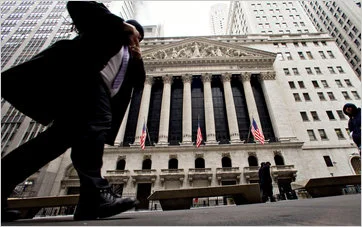
NYSE building exterior with American flags, Manhattan, 2011
NYSE's 11 Wall Street headquarters — the trophy at the center of a three-way bidding war. 6
On April 1, 2011, Nasdaq OMX and IntercontinentalExchange jointly announced an unsolicited $11.3 billion bid for NYSE Euronext — $42.50 per share, consisting of $14.24 cash plus 0.4069 Nasdaq shares plus 0.1436 ICE shares. 6 That was a 19% premium over NYSE's prior-day closing price and a 27% premium over its pre-Deutsche Börse announcement level. 7
The deal structure split the target: Nasdaq would take NYSE's equities and listings businesses; ICE would take Liffe, NYSE's London-based derivatives exchange. The combined entity would keep both the NYSE trading floor and the Nasdaq electronic platform under the name "Nasdaq NYSE Euronext."

How the bear hug worked

A bear-hug letter — a public announcement of an unsolicited bid, typically framed as an open letter to the target's board — is designed to do something the target board cannot easily prevent: make shareholders aware that a higher bid exists before the board can bury the proposal in committee. Greifeld and Sprecher knew the NYSE board would refuse to meet. The goal was never to get a meeting; it was to create shareholder pressure that would force the board's hand.
Bob Greifeld was explicit about the strategic logic: "The bid today is entirely consistent with our long-stated goal of matching massive scale with extreme efficiency. This plan recognizes the global nature of the listing competition." 6 Sprecher, framing ICE's role: "Not only are the synergies more significant, and there's more cash composition. But we believe we can create a company that better competes in today's markets." 6
The market reacted immediately. NYSE shares jumped 12.6% to $39.60 on the news. Moody's moved Nasdaq's credit outlook to negative, citing the "unique execution challenges" of a deal of that size. 6

The NYSE board's response

On April 10, the NYSE Euronext board unanimously rejected the bid. Chairman Jan-Michiel Hessels issued what became the template defense statement for this kind of situation: "Breaking up NYSE Euronext, burdening the pieces with high levels of debt and destroying its invaluable human capital would be a strategic mistake in terms of where the global markets are going, and is clearly not in the best interests of our shareholders." 8
Three reasons sat behind the board's rejection. First, the deal would split NYSE Euronext — which the board had positioned as a global multi-asset franchise — into pieces, one focused on U.S. equities and another on European derivatives. Second, the separated pieces would carry significant debt from the acquisition financing. Third, and most consequentially: antitrust. Combining NYSE and Nasdaq in U.S. equities markets would create a near-total monopoly. The board knew this. Niederauer had even acknowledged in an April 11 CNBC interview that the DB deal had "some risk… certainly a lot of work to do at the competition regulators in Brussels." 9
The board was using regulatory preemption as a sword, not just a shield — pointing at the DOJ before the DOJ had said anything publicly.

Escalation to a hostile tender offer

Nasdaq and ICE submitted a formal merger agreement draft on April 19, declaring their offer "superior by 21% or $2 billion" and offering a $350 million reverse termination fee if antitrust regulators blocked the deal. 10 NYSE rejected it again without meeting.
On May 2, Nasdaq and ICE launched a formal hostile tender offer — going directly to shareholders over the board's head. Sprecher: "The Board of NYSE Euronext has twice rejected our superior proposal without meeting with us, despite the fact that their existing merger agreement with the Deutsche Boerse allows them to talk with us." 10 On May 9, they published a shareholder letter titled "What's the Rush?" — accusing the board of "corporate governance at its worst" and demanding to know why NYSE shareholders were being asked to approve a "high-risk, low-value transaction" without all the facts. 9
Seven days after the tender offer launched, the bid was dead.

Act III: The DOJ kills the deal in 45 days

Nasdaq building at 43rd Street and Broadway, New York, 2011
Nasdaq headquarters in New York — Greifeld's campaign for NYSE lasted exactly 45 days. 7
On May 16, 2011, the DOJ Antitrust Division — then led by Assistant Attorney General Christine Varney — informed Nasdaq and ICE it would file a lawsuit to block the acquisition. Nasdaq and ICE withdrew their bid the same day, exactly 45 days after the April 1 announcement. 5
Varney's statement identified four markets where competition would be "substantially eliminated": 5
  1. Corporate stock listing services — NYSE and Nasdaq were the only two providers; every one of the Fortune 500 listed on one or the other
  2. Opening and closing stock auction services — again, two providers only
  3. Off-exchange stock trade reporting services — covering roughly 30% of all U.S. equity trading volume
  4. Real-time proprietary equity data products — the largest two competitors
NYSE listed companies with approximately $14 trillion in market value; Nasdaq listed companies worth roughly $4 trillion. Together they accounted for essentially all U.S. equity listings. 5 Nasdaq had offered to sell the NYSE Self-Regulatory Organization as a remedy. DOJ rejected it as insufficient.
Varney put it plainly in a call with reporters: "NYSE and Nasdaq are iconic... they are fierce competitors. If these two competitors had merged it would have effectively created a monopoly leading to higher prices, inferior service and less innovation." 11
Greifeld acknowledged the endgame: "We took the decision to withdraw our offer when it became clear that we would not be successful in securing regulatory approval for our proposal despite offering a variety of substantial remedies, including the sale of the NYSE SRO and related businesses." 12
The NYSE board's instinct — that DOJ would kill the deal — had been exactly right. The antitrust posture wasn't really a board defense. It was a structural fact about the U.S. equities market.

Act IV: The EU kills the other deal

With Nasdaq gone, Deutsche Börse and NYSE Euronext proceeded toward the finish line. The DOJ cleared the U.S. portion of the DB-NYSE merger on December 22, 2011 — Deutsche Börse had no significant U.S. equities business, so the DOJ found no horizontal competition problem. 13 The EU Commission was a different story.
The Commission had been conducting a Phase II investigation since August 2011, after initial review identified serious concerns in derivatives trading and clearing. 14 The core issue: Deutsche Börse's Eurex and NYSE Euronext's Liffe were the two largest venues for European-based financial derivatives — together controlling more than 90% of the global market for exchange-traded European derivatives. 14
On February 1, 2012, the Commission issued Decision C(2012) 440 final — a formal prohibition, only the 22nd in EU merger control history since 1990. 14 Competition Commissioner Joaquín Almunia: "The merger between Deutsche Börse and NYSE Euronext would have led to a near-monopoly in European financial derivatives worldwide. These markets are at the heart of the financial system and it is crucial for the whole European economy that they remain competitive. We tried to find a solution, but the remedies offered fell far short of resolving the concerns." 14

Why the same deal got two different regulatory answers

The DOJ and the EU Commission examined the same transaction and produced opposite conclusions — each applying a different analytical framework.
RegulatorDeal examinedPrimary concernAnalytical lensOutcome
DOJNasdaq/ICE + NYSETwo U.S. listings monopolists combiningHorizontal competition: four overlapping product marketsBlocked
DOJDeutsche Börse + NYSEGerman exchange acquires U.S. exchangeHorizontal competition: DB had no U.S. equities presenceCleared (Dec 2011)
EU CommissionDeutsche Börse + NYSEEurex + Liffe = 90%+ European ETDsVertical silo + horizontal quasi-monopoly in derivativesBlocked (Feb 2012)
The Commission's technical analysis went deeper than simple market-share arithmetic. It defined exchange-traded derivatives (ETDs) and over-the-counter derivatives (OTC) as separate product markets — ETDs average around €100,000 per trade and are fully standardized; OTC derivatives average about €200 million per trade (200 times larger) and are highly customized. Customers, the Commission found, did not treat the two as substitutes. 15
The vertical silo argument was the decisive piece. Both Eurex and Liffe operated "closed vertical silos" — each linked its trading exchange to its own clearing house. The merged entity would control a single silo trading and clearing more than 90% of global European financial ETDs. 14 Once a user is locked into a silo — through network effects, netting efficiencies, and cross-margining benefits — switching costs are enormous. New entrants cannot reach the liquidity needed to challenge the incumbent at any foreseeable scale.
DB and NYSE submitted two rounds of remedies. The Commission rejected both. The implicit message: only divesting all of either Eurex or Liffe would be sufficient, and neither side was willing to go there. Deutsche Börse appealed to the EU General Court, which affirmed the prohibition in full on March 9, 2015 (Case T-175/12). 16 Deutsche Börse did not appeal further.
Cargando vista previa del enlace…

Act V: Sprecher comes back — as a friend

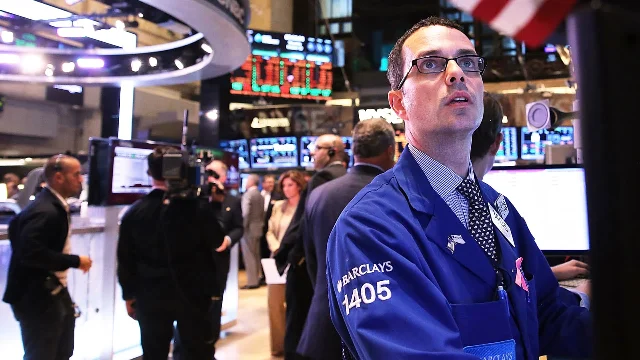
NYSE trading floor with Barclays trader, November 2013
NYSE trading floor on the day ICE completed its acquisition, November 13, 2013 — the floor Sprecher had once tried to split off for Nasdaq now belonged to ICE. 17
With the DB merger dead, NYSE Euronext was independent again — and exposed. On December 20, 2012, ICE announced a friendly acquisition at $33.12 per share, valuing NYSE at approximately $8.2 billion. 18 The transaction structure: roughly 67% stock and 33% cash; NYSE shareholders would hold about 36% of the combined company. Sprecher would remain chairman and CEO. Duncan Niederauer — who had twice been on the other side of a Sprecher bid — would become president and CEO of the NYSE Group.
Compare that $33.12 to the $42.50 Greifeld and Sprecher had offered in 2011. The same asset, 20 months later, sold for 22% less.
The NYSE board unanimously approved. Chairman Hessels, who had rejected the 2011 hostile bid with language about "unacceptable execution risk," now called ICE "the ideal partner for NYSE Euronext in an evolving market landscape." 19
Sprecher had made five structural changes between 2011 and 2012. First, ICE acted alone — without Nasdaq — eliminating the U.S. horizontal competition problem entirely (ICE was a commodities exchange, not a stock exchange). Second, the deal was friendly, giving the NYSE board the control and process it had demanded. Third, ICE committed to preserve the NYSE brand, the Wall Street trading floor, and the Liffe derivatives business. Fourth, the transaction structure carefully avoided both DOJ and EU sensitivities: no U.S. equities overlap, and ICE's derivatives franchise (commodities) sat in entirely different product markets from Liffe's (European rates and equities). Fifth, Sprecher made Niederauer a principal in the new company rather than an obstacle to it.
The EU Commission approved the ICE-NYSE deal unconditionally on June 24, 2013: "The Commission's investigation confirmed that the proposed transaction would not raise competition concerns as NYX and ICE are not direct competitors in the markets concerned." 20
ICE completed the acquisition on November 13, 2013, at a total transaction value of approximately $11 billion including assumed debt and synergies, creating a combined entity operating 16 global exchanges and 5 central clearing houses. 2 In June 2014, ICE spun off Euronext's continental European cash equities exchanges (Paris, Amsterdam, Brussels, Lisbon) via IPO at €14 per share — retaining NYSE, Liffe, and the broader derivatives network it had wanted all along. 20
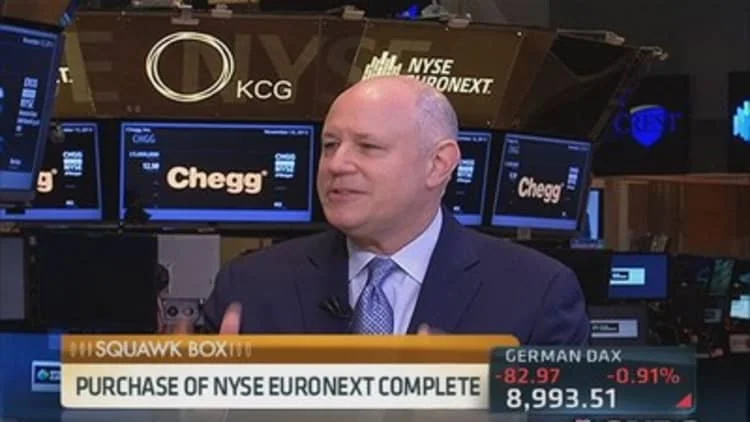
On the day of closing, Sprecher told CNBC: "There is no other New York Stock Exchange floor; there is nothing like this. And in a market where we don't really have full confidence in how our stocks are trading, there's something really rewarding about being here, and seeing human beings." 17

Frameworks you can use

The bear-hug letter: three conditions for it to work

The Nasdaq/ICE bear-hug attempt is a textbook example of a tactic that succeeded at the initial objective — creating shareholder pressure — and failed at the strategic objective — forcing the board to negotiate. Understanding why reveals the conditions under which a bear-hug letter is actually effective.
Condition 1: The economic superiority must be unambiguous and durable. Nasdaq/ICE's $42.50 was clearly higher than DB's $35.29. But the $350 million reverse termination fee they offered to cover antitrust risk immediately highlighted the thing they were trying to minimize. Shareholders reading the fee structure understood: the bidders themselves thought regulatory failure was a real possibility.
Condition 2: The board must have a visible governance vulnerability. The "What's the Rush?" letter worked rhetorically — it framed the NYSE board as rushing shareholders into a lower-value deal. But the board had a credible rebuttal: antitrust risk on the Nasdaq/ICE side was structural, not procedural. When a board can point to a structural deal-killer rather than a preference, the governance attack loses its bite.
Condition 3: Regulatory risk must be at worst manageable. This is the condition Greifeld failed. The DOJ's posture on exchange monopolies was not ambiguous. NYSE and Nasdaq were the only two stock listing venues for American companies; combining them was not a close antitrust call. When the regulator is both certain and fast — DOJ acted in 45 days — there is no time for shareholder pressure to accumulate. The target board is effectively shielded.

Regulatory preemption as a defense

The NYSE board never framed its rejection of the Nasdaq/ICE bid as "we prefer DB." It framed the rejection as "this deal cannot close." That is a fundamentally different claim, and a much stronger one for a board seeking to fend off a higher offer.
Under Delaware's Revlon doctrine (triggered when a company is being sold), a board ordinarily must maximize shareholder value — which typically means taking the higher bid. 21 But "certainty of value" — the probability that a higher nominal bid will actually close — is a legitimate competing consideration. If Deal A is worth $42.50 but has a 40% chance of closing, and Deal B is worth $35.29 but has a 90% chance of closing, the expected values favor Deal B. The NYSE board was arguing, in effect, that the Nasdaq/ICE bid's probability of closing was close to zero.
The DOJ proved them right. What makes this case instructive is the sequencing: the board made the regulatory argument before the DOJ had acted, relying on structural analysis of the U.S. equities market. Getting that analysis right — and having credible external legal counsel who agreed — is what turned an antitrust argument into a board defense that shareholders could not easily attack.

Cross-jurisdictional regulatory arbitrage

The same transaction — NYSE Euronext being acquired by a larger exchange operator — received opposite regulatory treatment in the United States and Europe, and then a third treatment when a differently structured deal came along. This reveals something important about how antitrust works across jurisdictions.
The DOJ analyzed horizontal competition in U.S. equity markets. When Deutsche Börse (no U.S. equities business) acquired NYSE, the DOJ saw no horizontal overlap and cleared the deal. When Nasdaq (U.S. equities) tried to acquire NYSE, the DOJ saw two-to-one consolidation in four product markets and blocked it. The EU Commission cared about entirely different markets — European exchange-traded derivatives — and found a quasi-monopoly the DOJ had no mandate to examine. 13
ICE's deal design in 2012 was a direct application of lessons from both failures. The deal avoided U.S. horizontal overlap (ICE is a commodities exchange, not an equities exchange). It avoided EU vertical silo concerns (ICE's derivatives were in different product markets from Liffe's). The Commission confirmed this explicitly: "NYX and ICE are not direct competitors in the markets concerned." 20
Cross-border M&A in regulated industries requires mapping each jurisdiction's analytical framework before signing — not as a compliance exercise, but as deal design. The question is not "will this get approved?" The question is "which version of this deal gets approved in all the jurisdictions we need?"

The "come back as a friend" strategy

The strangest data point in this case: the losing hostile bidder eventually won, at a lower price, with a friendlier structure. This is not accidental. It is a repeatable strategic pattern.
Several things changed between Sprecher's April 2011 attempt and his December 2012 success. He detached from Nasdaq, eliminating the U.S. equities problem. He negotiated rather than demanded. He made Niederauer a partner rather than a target. He waited until the DB merger collapsed, which removed NYSE's alternative and lowered the acquisition price by more than $3 billion. And he designed the transaction to pass regulatory review in both major jurisdictions.
The key insight is that a failed hostile bid is expensive intelligence. It forces you to understand exactly why the deal cannot close — regulatory structure, board dynamics, target management psychology, financing limits. The acquirer who actually absorbs those lessons and redesigns the approach accordingly has an advantage over a new entrant who hasn't paid that tuition.
The practical limits of this strategy are real: it requires patience (18 months in this case), the willingness to accept a lower price than you originally offered (Sprecher paid $9 less per share than his 2011 bid), and the discipline not to let the initial failure harden into a permanent adversarial posture with the target's management.

What to remember

  • Regulatory topology is the deal variable most bidders underweight. In exchange M&A, the combination of natural monopoly characteristics and nationally significant franchise status means regulatory analysis is not a post-signing checklist — it is the primary deal architecture constraint. Greifeld appears to have underestimated this. Sprecher, ultimately, did not.
  • "Merger of equals" framing creates specific vulnerabilities. When a premium is structurally suppressed by equal-ownership optics, any rival bidder who offers more cash automatically repositions the incumbent deal as a governance failure. The NYSE board needed a shareholder-value argument that did not depend on the DB premium being adequate — which is why the regulatory preemption argument was essential.
  • The DOJ and EU Commission operate on different theories of harm. The DOJ's Antitrust Division focuses on horizontal competition in identified U.S. product markets. The EU Commission is equally concerned with vertical foreclosure, market structure, and barriers to entry — particularly in infrastructure markets with strong network effects. A deal can be cleared by one regulator and blocked by the other because they are literally analyzing different questions.
  • Board fiduciary duty in a three-party bid is not simply "take the highest price." When regulatory risk substantially reduces the probability that a higher bid closes, the board's Revlon obligation requires weighing certainty of value, not just nominal value. The NYSE board's choice of the lower DB offer over the higher Nasdaq/ICE offer was defensible precisely because the DOJ confirmed within six weeks that the higher bid could not close.

Cover image: Jeff Sprecher, ICE CEO, interviewed on CNBC Squawk Box on the day the NYSE Euronext acquisition completed, November 13, 2013. 17

Más de este canal

Contenido relacionado

  • Inicia sesión para comentar.