


Eight days to zero: how Refco's $430 million secret destroyed the world's largest independent futures broker
16/6/2026 · 8:39

Eight days to zero: how Refco's $430 million secret destroyed the world's largest independent futures broker

In August 2005, Refco Inc. completed a $583 million NYSE IPO — then filed for Chapter 11 just 67 days later after its board discovered CEO Phillip Bennett had concealed $430 million in trading losses through a quarterly round-trip loan scheme running since 1998. The 8-day collapse wiped out roughly $4.4 billion in equity. Bennett received 16 years in federal prison; civil settlements topped $407 million. The case turns on four reusable frameworks: IPO as credibility laundering, due diligence as conscious selection, the PE quick-flip monitoring discount, and trust-dependent business model fragility.

On the morning of Monday, October 10, 2005, employees at One World Financial Center in Lower Manhattan arrived to find their CEO missing. Phillip R. Bennett — a Cambridge-educated British national who had built Refco Inc. from a mid-sized commodity shop into the largest independent futures commission merchant on the planet — had taken a "leave of absence." The company's statement that day disclosed why: Refco's board had discovered that $430 million owed to the firm by a Bennett-controlled private entity had been concealed from investors through a series of quarterly round-trip loans, and that every financial statement Refco had published since fiscal year 2002 "should no longer be relied upon." 1 2
Eight days later — on October 17 — Refco and 23 affiliates filed for Chapter 11 bankruptcy in the Southern District of New York, listing $16.5 billion in assets against $16.8 billion in liabilities. 1 The stock that had priced at $22 on August 11 — just 67 days earlier, in a $583 million IPO underwritten by Goldman Sachs, Credit Suisse First Boston, and Bank of America — had cratered from $28.56 to $0.80. 3 4 Roughly $4.4 billion in equity market capitalization had vanished in just over a week.
Refco was not insolvent when the story broke. Its regulated futures entities were financially sound; every major exchange confirmed their credit lines and capital were in order. 2 What killed the firm in eight days was the evaporation of the one thing a brokerage actually sells: confidence.
This case sits at the intersection of three negotiation and deal-making failure modes — an executive's decade-long information asymmetry, a private equity firm's incentive to exit fast rather than look hard, and a trust-dependent business model with no margin for scandal. It is case study CGOV006 in the ICMR India case library, the closest available structured academic treatment given that neither HBS nor HBR has published a dedicated Refco case. 5

The parties and the asymmetries

PartyStated positionHidden positionBATNAKey leverage
Phillip Bennett (CEO/owner)Running a high-growth derivatives brokerConcealing $430M in transferred losses from the 1990sNone — exposure meant criminal prosecutionPersonal control of the books; Bennett executed many loan documents himself
Thomas H. Lee Partners (PE sponsor)Disciplined financial sponsor conducting 7-month due diligenceMotivated to IPO quickly for fund-raising purposes; accepted Bennett's "tax purposes" explanation for red flagsWalk away from the deal$507M equity investment; control of 57% of shares; power to delay or block the IPO
IPO underwriters (Goldman, CSFB, BofA)Rigorous due diligence before certifying the S-1Reputationally exposed to a company whose auditor had already flagged "significant deficiencies"Decline to underwriteAssociation with a prestigious NYSE listing; $583M deal fee economics
Customers (200,000+ accounts)Trusting a regulated FCM with their margin depositsLegally obligated in many cases to remove funds from any firm with known illegal activityMove funds to a competitor FCMImmediate ability to withdraw — which they exercised
Regulators (CFTC, CME, SEC)Monitoring financial stability of futures marketsNeeding to preserve orderly markets while managing a live collapseWatch a disorderly bankruptcy unfoldAbility to pressure potential buyers; 20-day equity-withdrawal suspension authority

Background: how Refco became the world's largest independent FCM

Refco was founded in 1969 by Raymond Earl Friedman (the name is a contraction of "Ray E. Friedman and Co.") as a New York City-based commodities and futures broker. 1 By 2005, it had grown to serve more than 200,000 customer accounts across 23 offices in 14 countries, clearing 654 million derivatives contracts in a single fiscal year and processing $13.7 trillion in U.S. Treasury repo transactions. 3 It was the largest broker on the Chicago Mercantile Exchange, the largest independent Futures Commission Merchant (FCM) in the United States measured by domestic customer segregated fund balances of approximately $4.1 billion, and a significant foreign exchange dealer. 3
Phillip Bennett joined Refco in 1981 after a decade at Chase Manhattan Bank, became CFO in 1983 and CEO in 1998. 6 He was worth more than $1 billion at the time of the fraud's exposure and owned seven Ferraris, a $20 million private jet, and a $29 million art collection. 7 What investors did not know was that his company had been cited by CFTC and NFA regulators more than 100 times since its founding — a regulatory record The Wall Street Journal later described as the worst in the futures industry. 1
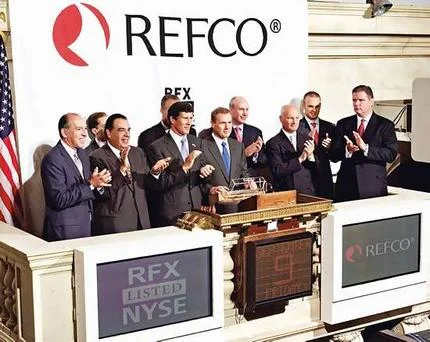
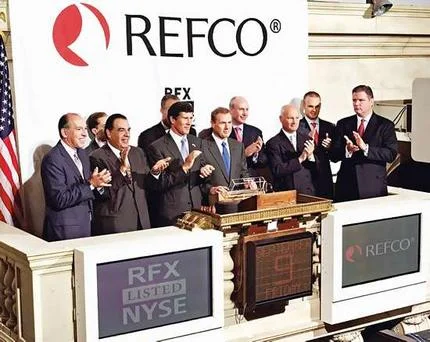
Refco executives at the New York Stock Exchange for the August 11, 2005 IPO
Refco executives at the NYSE celebrating the August 11, 2005 IPO. The company valued at ~$3.5 billion would file for bankruptcy 67 days later. 8

The mechanism: the quarterly round-trip loan

Beginning in at least 1998, Bennett's privately held company, Refco Group Holdings Inc. (RGHI), had accumulated approximately $430 million in trading losses — originating from the 1990s blow-up of speculator Victor Niederhoffer's accounts and roughly ten other customer positions. 1 Rather than write off these losses, Bennett transferred them to RGHI as a receivable owed to Refco. On Refco's books, the $430 million appeared as a legitimate asset. In reality, RGHI had no means to repay it.
The concealment mechanism was elegant in its simplicity. At each quarter-end — and later at each fiscal year-end — the following sequence ran like clockwork: 9 10
  1. Refco Capital Markets Ltd. (RCM), an unregulated Bermuda subsidiary, lent funds to a hedge fund called Liberty Corner Capital Strategy at approximately 2.50% interest
  2. Liberty Corner (operated from Summit, New Jersey by William "Terry" Pigott) re-lent the same amount to RGHI at 3.25% — earning a spread of roughly $90,000 per transaction
  3. RGHI used the proceeds to "repay" the $430 million receivable to Refco, wiping the bad debt from its balance sheet for reporting purposes
  4. A few days after quarter-end, the entire sequence reversed — the money traveled back, and the debt returned to RGHI's books
In the earlier cycles, Austrian bank BAWAG replaced Liberty Corner as the conduit. A single transaction in February-March 2005 involved $335 million over ten days. 1 Bennett personally executed many of the loan documents.
The scheme was discovered not by auditors but by the newly hired Refco controller, Peter James, who noticed during a routine internal review over the first weekend of October 2005 that Bennett had failed to execute the quarter-end unwinding on time — leaving the $430 million receivable visible on Refco's books with no offsetting cleanup transaction in progress. 1 2
Liberty Corner's attorney Kevin Marino later stated: "There's no way anyone at Liberty could have known this was a bad loan or anything approaching a bad loan. We were never told there was $430 million of bad debt, we were never told there was an attempt to conceal debt for Mr. Bennett." 10

The 8-day collapse

Day 1 — Monday, October 10: Refco announces Bennett has taken a leave of absence; the board discloses the $430 million hidden receivable and declares its financial statements from FY2002 through May 2005 unreliable. Bennett secures a €350 million emergency loan from BAWAG, collateralized by his Refco stock — which would be worthless within days — and wires the funds to Refco to repay the hidden balance. Former SEC enforcement attorney Robert Heim told the press: "If Refco doesn't convince customers over the next several days that it's a financially sound institution, there is a very serious chance they could have to file for bankruptcy protection." 11
Day 3 — Wednesday, October 12: Bennett arrested by federal prosecutors on securities fraud charges. Released on $50 million cash bail, placed under house arrest. His attorney Gary Naftalis says Bennett plans to fight the charges. 1
Day 4 — Thursday, October 13: Refco places a 15-day moratorium on its largest unit, Refco Capital Markets Ltd., and ceases seeking new business. Goldman Sachs is hired as financial advisor to explore a sale. Confidence in the institution's survival collapses.
Day 5 — Friday, October 14: Refco Securities begins unwinding proprietary and client positions. The SEC suspends equity capital withdrawals from Refco Securities and Refco Clearing for 20 days. S&P cuts Refco's credit rating for the third time in four days, declaring payment default "highly likely." The NYSE halts trading in Refco shares indefinitely. 2
Days 6–7 — Weekend, October 15–16: Goldman Sachs and regulators work through the weekend to find a buyer for the regulated futures business. JC Flowers & Co. emerges as leading bidder. By this point, more than 60% of Refco's institutional client base has already fled to competitor FCMs. An unnamed FCM executive explained the dynamic: "You may not know the depth of it, but do you want to continue to do business there? The answer, almost legally in many cases, is no. For many corporate accounts, you have a fiduciary responsibility to get the funds out of there." 2
Day 8 — Monday, October 17: Refco Inc. and 23 affiliates file Chapter 11 in the Southern District of New York (Case No. 05-60006). The filing lists $16.5 billion in assets against $16.8 billion in liabilities. Refco simultaneously announces a tentative $768 million sale of its regulated futures business to a JC Flowers-led group. Shares crash from $28.56 to $0.80. NYSE delists the stock. RCM accounts are frozen. 1

The fire sale: from $768 million to $323 million

The JC Flowers tentative deal for $768 million collapsed almost immediately. The bankruptcy judge rejected the proposed break-up fee as unjustified, reopening the bidding. 1 Over the following three weeks the auction played out against a backdrop of continuous customer flight:
  • Interactive Brokers submitted a bid of $857.9 million — then withdrew on the morning of the final auction on November 10 2
  • Dubai Investment Group offered $1 billion for all of Refco — rejected 1
  • Man Financial (the brokerage arm of British alternative-investment firm Man Group) won with a final bid of $323 million — excluding Refco's regulatory capital of more than $700 million 12
The $445 million gap between Interactive Brokers' walk-away price and Man's winning bid captured, in a single number, the cost of the three-week customer exodus. Man Group deputy CEO Peter Clarke told investors Refco had lost the "bulk" of its institutional clients but that the private client business had held. On Man's emergence as buyer, Clarke said: "Any concerns about the past can be, as the US bankruptcy court says, 'car washed', so we do not take any historical or contingent liabilities." 2 Man later sold Refco's European operations to Marathon Asset Management for a nominal fee of approximately $1, and those operations were subsequently relaunched as Marex Financial. 1
The bankruptcy itself took until January 2020 to fully resolve — 14 years. The Chapter 11 reorganization plan was confirmed on December 15, 2006 and covered 26 affiliated debtors. Of $9.69 billion in filed claims, $5.37 billion were allowed, and total recoveries reached approximately $4.8 billion. 13 Recovery rates varied sharply: senior secured creditors received 100 cents on the dollar; holders of senior subordinated notes received 84.5 cents; general unsecured creditors received roughly 50–53.6 cents; RCM securities customers — whose funds had been commingled with Refco's own in an unregulated Bermuda account — ultimately recovered 99.7 cents, a result achieved only through years of active litigation by the Chapter 11 trustee Marc S. Kirschner. 13
Approximately 17,000 customer accounts at RCM had been effectively unsecured, their funds commingled with Refco's corporate assets — a structural vulnerability that investor Jim Rogers discovered when $362 million of his Rogers Raw Materials Fund was frozen on Day 8. 2 Kirschner later reflected: "The cases are an excellent illustration of the human and monetary costs of a meltdown caused by massive fraud." 13

The PE backstory: 13 months from buyout to IPO

The Refco collapse cannot be understood without the Thomas H. Lee Partners transaction that preceded it. In August 2004, TH Lee acquired a 57% equity stake in Refco for $507 million in cash — part of a total deal valued at roughly $1.9–2.25 billion depending on how the assumption of debt was counted. 3 14 The thesis was straightforward: buy a fast-growing derivatives broker modeled on the CME's own stellar 2003 IPO, clean it up, and take it public. TH Lee spent $10 million and seven months conducting due diligence, deploying KPMG and other advisors.
During that review, a whistleblower told TH Lee that Refco had in the 1990s transferred losses to offshore subsidiaries. KPMG recommended commissioning a specialized audit to investigate. TH Lee instead accepted Bennett's explanation that the transfers were "for tax purposes" and proceeded. 15 Thirteen months after closing the buyout — in August 2005 — TH Lee took Refco public. The holding period was among the shortest LBO-to-IPO turnarounds on record; typical private equity holding periods run three to five years. Through dividends and IPO proceeds, TH Lee recouped $162.5 million before the collapse and collected an additional $113 million from management contracts. 16 Its remaining stake, worth $1.38 billion at the IPO, fell to $21.5 million — a 98% loss on the residual position. 16
In August 2007, Refco's bankruptcy trustee sued TH Lee, alleging the firm had "made a conscious choice to bury those problems" in its "rush to go public," with the motive of building a track record for fundraising purposes. 15 TH Lee ultimately settled for $130 million in cash plus a share of any government restitution recovered — one of the largest individual settlements in the class action. 17
HBS professor Josh Lerner, writing about LBO-to-IPO quick flips in a 2006 Working Knowledge piece, observed that short-hold PE transactions tend to underperform: the sponsor "has been working with the management team for a much shorter time. It is as if you took your dog to obedience school for one lesson, and expected him to do all sorts of tricks!" 18 In Refco's case, the lesson wasn't finished — and no one checked the homework.
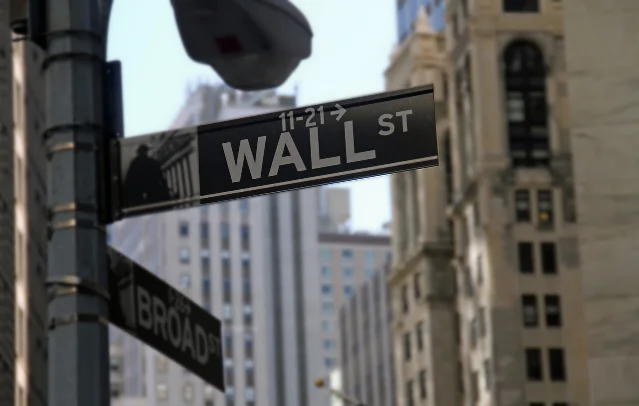
Wall Street and NYSE, lower Manhattan — Refco was headquartered nearby at One World Financial Center
Wall Street and the NYSE, lower Manhattan — Refco traded as RFX on the NYSE from August 11, 2005 until its delisting on October 17, 2005, a span of 67 days. The auction for Refco's regulated futures business concluded at the SDNY Bankruptcy Court (Case No. 05-60006), with Man Financial winning at $323 million. 1

The criminal and civil reckoning

The legal aftermath ran for nearly a decade and reached every layer of the transaction.
Phillip R. Bennett pleaded guilty on February 15, 2008 to all 20 federal criminal counts: one conspiracy, two securities fraud counts, three false SEC filings, seven wire fraud counts, one false statement to auditors, one bank fraud count, and five money laundering counts — carrying a combined statutory maximum of 315 years. 19 On July 3, 2008, SDNY Judge Naomi Reice Buchwald sentenced him to 16 years in federal prison and ordered forfeiture of $2.4 billion. 20 Judge Buchwald told Bennett: "You tried to make Refco successful, but your success was in many ways a sham." 21 Federal prosecutors described his conduct as placing Bennett "on a plateau of criminality that frankly makes comparisons difficult." 7 On May 26, 2020, at age 71, Bennett received compassionate release on COVID-19 and health grounds and was immediately deported to the United Kingdom. 22
Robert C. Trosten (CFO) left Refco in October 2004 with a $45 million payout that was not disclosed in the IPO prospectus. 1 He pleaded guilty to five counts in February 2008, cooperated as a government witness in the Grant and Collins trials, and in June 2014 received a sentence of time served — the judge finding that Trosten had "paid his debt to society." 23
Tone N. Grant (former president and co-owner) was the only senior Refco executive to stand trial. Convicted of five felony counts on April 17, 2008, he was sentenced to 10 years in federal prison. 14
Joseph P. Collins — lead outside counsel at Mayer Brown and Refco's principal attorney for the transactions that structured the concealment — was convicted in his second trial in November 2012 (his first conviction was overturned on appeal) and sentenced to one year and one day in prison. U.S. Attorney Preet Bharara said Collins was "a lawyer deeply and corruptly enmeshed in coordinating and concealing the massive accounting fraud that ultimately led to Refco's collapse." 24
On the civil side, the class action (In re Refco Securities Litigation, No. 05-cv-8626, SDNY) produced a total investor recovery of more than $407 million: BAWAG settled for $108 million; TH Lee for $130 million; the underwriting banks (Goldman Sachs, Credit Suisse, Bank of America, and Deutsche Bank) for $49.5 million collectively; Grant Thornton LLP for $25 million; and a range of individual officer defendants for smaller amounts. 17
Financial fraud and bankruptcy: the criminal reckoning from the Refco collapse
The Refco criminal proceedings produced a 16-year prison sentence and $2.4 billion forfeiture order for CEO Phillip Bennett; civil class-action recoveries topped $407 million across all defendants. 17

Frameworks you can use

The IPO as credibility laundering — how institutional signals substitute for independent scrutiny

Refco's August 2005 IPO conferred four overlapping credibility signals in a single transaction: NYSE listing, SEC review of the S-1 registration, investment-grade underwriter involvement, and a Big Four audit. Each signal told potential investors the firm had been independently verified by a credible institutional gatekeeper. None of them had actually found the fraud.
The SEC's review of IPO documents is, as former SEC chief accountant Lynn Turner noted, "a desktop review" — agency staff read the prospectus and request clarifications; they do not conduct forensic accounting. 25 Grant Thornton had, in the very S-1 it certified, disclosed that Refco's internal controls had "significant deficiencies" — meaning there was "more than a remote likelihood that a misstatement of the financial statements that is more than inconsequential will not be prevented or detected." 2 That disclosure appeared in the risk factors section. Investors buying into a 25%-first-day-pop IPO by Goldman Sachs and CSFB did not linger there.
The practical takeaway for any due-diligence context: institutional endorsements (ratings, listings, sponsor names, auditor sign-offs) are process signals, not outcome signals. They tell you a form was followed; they do not tell you the form found the problem. When multiple gatekeepers are endorsing the same transaction, the temptation to treat their collective presence as a substitute for your own independent investigation is highest — and the actual verification depth may be lowest, because each party assumes the others checked what it did not.

Due diligence as conscious selection — the difference between "could not find" and "chose not to look"

In Refco's case, a whistleblower told Thomas H. Lee's team during the 2004 LBO due diligence that the firm had transferred losses to offshore subsidiaries in the 1990s. KPMG recommended commissioning a specialized audit to investigate. TH Lee accepted Bennett's "tax purposes" explanation and proceeded. Fordham law professor Edward Pekarek, writing about the case in a 2007 SSRN paper, described the situation as not "a needle in a haystack — it's a needle in a pile of needles": the fraud was hidden within genuine, legitimate transactions. 25
Bankruptcy trustee Kirschner put the same point more bluntly: "There were a number of red flags that the Lee folks ignored. They learned of significant problems at Refco, which they basically ignored in the rush to go public." 15
The framework distinction that matters: "could not have found" and "chose not to pursue" carry different legal and professional consequences, but they also reflect a different decision process that deal-makers can actively audit. Three diagnostic questions for any due diligence where time pressure is acute: (1) Has a specific concern been raised and then explained away by the target's management? (2) Has a third-party advisor recommended a deeper investigation that was not commissioned? (3) Does the deal timeline create a financial incentive for the buyer to reach a "clean" conclusion? When the answers are yes, yes, and yes — as they were in Refco — the due diligence result deserves explicit skepticism regardless of how many firms were engaged.

The LBO-to-IPO quick flip and the PE monitoring discount

Thomas H. Lee's 13-month hold — from August 2004 buyout to August 2005 IPO — sits at the extreme short end of the PE holding-period distribution. The typical LBO-to-exit timeline runs three to five years. HBS research on reverse LBOs (companies taken public by PE sponsors) found that "quick flip" transactions — those exited within a year of acquisition — underperform the S&P 500 by roughly 5% over the following three years. 18
The structural reason: a PE sponsor's value-creation role — operational improvement, management monitoring, governance reform — requires time to execute. A sponsor that acquires and immediately files for IPO has not had the runway to identify problems, install systems, or change management culture. In Refco's case, TH Lee was simultaneously preparing its next fund raise, giving it an additional incentive to show fast realized returns on recent investments. The bankruptcy trustee's lawsuit alleged this directly: TH Lee rushed the IPO to "create a favorable track record for marketing purposes." 15
The framework for deal-making: when evaluating a company being sold or IPO'd by a financial sponsor, the PE holding period is an independent risk signal. A very short hold period (under 18 months) is not evidence of fraud — but it is evidence that the sponsor's role as a value-creation monitor was compressed or incomplete. The question to ask is not "who are the sponsors?" but "how long did they actually own it, and what did they change?"

Trust-dependent business models and the confidence run

The most striking fact about Refco's eight-day collapse is that the regulated FCM entities were never insolvent. The exchanges confirmed their credit. Their segregated customer funds were intact. The company filed for bankruptcy not because it ran out of money but because it ran out of customers — and it ran out of customers before it ran out of money.
This is the defining feature of trust-dependent business models: brokerages, banks, money market funds, custodians, and crypto exchanges all operate on the assumption that clients will not simultaneously demand their assets back. The moment that assumption is credibly threatened, the rational response for any individual client — especially one with a fiduciary duty to its own investors — is to withdraw. Each withdrawal makes the next client's decision easier, not harder. The result is a self-fulfilling run with a speed that has no relationship to the firm's actual solvency position.
Refco ran through this dynamic in eight days. More than 60% of its institutional client base had left by the time Man Financial won the auction. 2 The Man bid of $323 million against Interactive Brokers' withdrawn bid of $857.9 million — a $534 million gap across three weeks — translates directly into the dollar cost of the confidence destruction.
For deal-makers and investors evaluating trust-dependent counterparties, governance and reputational risk function as a separate risk category from balance-sheet risk. The diagnostic indicators Refco had been emitting for years — over 100 regulatory citations since founding, an unregulated offshore subsidiary holding client funds without proper segregation, an auditor disclosing internal control deficiencies in the IPO prospectus itself — were visible warning signs that the trust layer was brittle. Refco's business model was built on customer confidence in an institution that, unknown to those customers, was being operated as a cover for its CEO's personal loss-concealment scheme.
Cargando vista previa del enlace…

What to remember

  • A brokerage's real collateral is confidence, not capital. Refco's regulated FCM entities were solvent on every day of the eight-day collapse. The firm failed because customers with fiduciary obligations to their own investors had no rational choice but to withdraw once fraud at the CEO level was confirmed. In any trust-dependent business — brokerage, bank, custodian, exchange — governance failure is a liquidity risk, not just a reputational one. The confidence run can arrive faster than any liquidity facility.
  • "Could not find" and "chose not to pursue" are different failure modes. Thomas H. Lee was told by a whistleblower that Refco had transferred losses offshore. Its own advisor recommended a deeper investigation. TH Lee accepted the CEO's explanation and rushed to IPO in 13 months rather than the industry-standard 3–5 years. The due diligence form was observed; the substance was abandoned. Any buyer whose financial incentives align with reaching a "clean" conclusion deserves a second auditor with explicit authority to chase down red flags the first team did not.
  • Institutional endorsements are process signals, not verification outcomes. Goldman Sachs, Credit Suisse First Boston, Bank of America, and Grant Thornton all certified the Refco IPO. The SEC reviewed the prospectus. The NYSE listed the stock. None of them caught a fraud that had run continuously for seven years. When four gatekeepers endorse the same transaction, each one's due diligence tends to be shallower than it would be if it stood alone — each assumes the others have validated what it has not checked. The combination of a PE sponsor, a Big Four auditor, top-tier underwriters, and an exchange listing creates the appearance of multiple independent validations; the reality may be multiple parties sharing the same unchecked blind spot. 25
  • A short PE hold period is an independent risk signal. Thirteen months from buyout to IPO gave Thomas H. Lee insufficient time to operate as a genuine corporate monitor. HBS research on reverse LBOs shows that quick-flip transactions (under one year from acquisition to exit) underperform over the following three years. 18 When evaluating any PE-backed company coming to market, ask not who sponsored it but how long they actually owned it — and what governance, control, or management changes they demonstrably made during that window.

Cover image: Refco executives at the NYSE on IPO day, August 11, 2005. Image from ForexFraud.com.

Contenido relacionado

Añade más opiniones o contexto en torno a este contenido.

  • Inicia sesión para comentar.