InBev's $52 billion hostile takeover of Anheuser-Busch: how a Belgian-Brazilian brewer dethroned America's king of beers

InBev's $52 billion hostile takeover of Anheuser-Busch: how a Belgian-Brazilian brewer dethroned America's king of beers

In June 2008, InBev — a Belgium-headquartered, Brazilian-controlled brewer with near-zero U.S. presence — launched a hostile bid for Anheuser-Busch, the maker of Budweiser and the most iconic beer company in America. In 32 days, it turned a unanimous board rejection into a $70-per-share signed merger agreement. This case dissects the dual-track pressure campaign that made it possible: a simultaneous Delaware Chancery lawsuit to strip the board's defensive bylaws and an SEC consent solicitation to replace all 13 directors by shareholder written consent. It examines A-B's three defenses, each of which backfired, and the fatal governance flaw — a family holding 4% of the stock while acting as if it owned 100%.
Business Negotiation Classics: One Case a Day
12/6/2026 · 16:06
1 suscripciones · 27 contenidos
On June 11, 2008, Carlos Brito — the Brazilian-born CEO of InBev — put a letter in front of August Busch IV that no Anheuser-Busch chief executive had ever received. It offered $65 per share in cash for every share of the company Busch's family had controlled since 1852. 1 The total tab: roughly $46.4 billion, the largest all-cash acquisition ever attempted at the time. A-B stock had closed at $52.58 less than three weeks earlier. 2
Thirty-two days later, A-B's board unanimously agreed to sell at $70 per share.
What happened in those 32 days illustrates a specific hostile-takeover discipline: using Delaware corporate law, SEC procedure, and the physics of shareholder economics to strip a resistant board of its most valuable asset — time.

The parties and their positions

PartyStated objectiveReal leverageBATNAHidden preference
InBev (Brito / Lemann / Telles)Acquire A-B to gain U.S. distribution and create the world's largest brewerOnly credible all-cash buyer; $51.6B committed financing; Delaware litigation threatLaunch a below-$70 hostile tender offer directly to shareholdersComplete before credit markets froze; avoid protracted litigation
A-B board (Busch IV / Warner / Whitacre)Reject or reprice the offer; prove A-B can achieve $65+ on its ownManagement of the largest U.S. beer company with a fiercely loyal distributor networkExecute Blue Ocean + Grupo Modelo white-knight transactionMaximize per-share price; protect St. Louis jobs and the Busch legacy
Busch family (August III / August IV)Maintain family control of the companyEmotional brand ownership; public sympathyIrrelevant — family held ~4% of shares; no blocking power 3August IV: resist; August III: reportedly accepted the inevitable
Large institutional shareholders (Barclays 6.1%, Berkshire ~5%)Maximize per-share cash recoverySwing-vote power over any consent solicitationHold or sell on the open marketAccept a deal that priced the stock at a premium to any foreseeable independent trading range
Grupo Modelo (Fernandez family, 90-year-old Antonino)Remain a Mexican company; preserve independenceA-B held 50.2% economic interest; Modelo could complicate any mergerInvoke contractual rights to buy back A-B's stake if acquired by a rival brewerRefuse to be a white knight; protect own independence

Background: a family brand, not a family company

By 2008, InBev was seven years old as a corporate entity but carried brewing lineage stretching back to 1366. 4 The 2004 merger of Belgium's Interbrew and Brazil's AmBev created a company with €14.4 billion in 2007 revenue and operations across 30 countries — but near-zero direct U.S. presence. The real power sat with three Brazilian investors: Jorge Paulo Lemann, Marcel Telles, and Carlos Alberto Sicupira — the co-founders of 3G Capital, the investment partnership that controlled InBev through its holding entity, Stichting InBev AK, with roughly 63.47% of InBev's voting shares. 2 Brito had earned his position by demonstrating, after each previous acquisition, that he could cut costs further and faster than his own targets.
Anheuser-Busch was the mirror image. Its 48.5% U.S. market share, its Budweiser and Bud Light franchises, and its stranglehold on American three-tier distribution made it look impregnable. 2 It wasn't. The Busch family — whose name was on every can — held only about 4% of the outstanding stock by 2008. The largest shareholders were institutional: Barclays Global Investors at 6.1%, Berkshire Hathaway at nearly 5%. There was no blocking mechanism. There was no poison pill strong enough to survive a Delaware written-consent process. There was, as Julie MacIntosh later wrote in Dethroning the King (Wiley, 2010), "hubris and naivete" that provided "an apt comparison to the broader state of America at the time." 5
One other factor gave InBev unusual intelligence: in 2006, A-B had signed a distribution agreement making it the exclusive U.S. importer of InBev brands — Stella Artois, Beck's, Bass. For two years, InBev watched A-B's distribution economics from the inside. 2
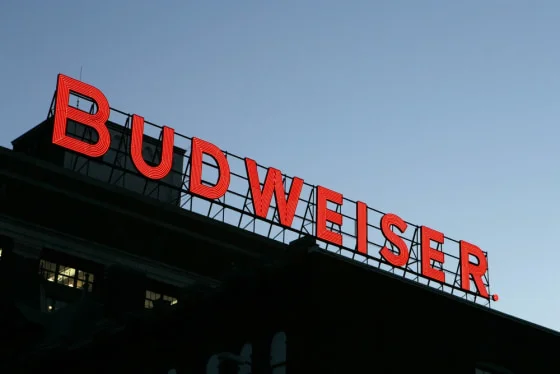
Budweiser sign atop the Anheuser-Busch brewery in St. Louis
The Budweiser sign above the St. Louis brewery — a landmark whose future became central to InBev's public promises 6

The opening bid and A-B's rejection

The deal's public life began on May 23, 2008, when the Financial Times' Alphaville blog reported InBev planned an offer at $65 per share. A-B management "first became aware" of the takeover interest from that article, according to the company's own SEC proxy. 2 Goldman Sachs was retained as financial adviser the same day.
On June 2, Lemann and Telles met Busch IV in Tampa, Florida. The two Brazilians expressed interest in a transaction but made no formal proposal. Busch IV asked directly whether InBev had a proposal — a detail Brito would later cite in his formal offer letter. 1
Nine days later came the letter. At $65 per share — a 35% premium to the 30-day average price — InBev promised to position Budweiser as its global flagship, keep St. Louis as the North American headquarters and "global home" of the Bud brand, retain all existing U.S. breweries, and invite A-B directors onto the combined board. 1 Brito had already lined up eight bank syndicates — Santander, Barclays, BNP Paribas, Deutsche Bank, Fortis, ING, JPMorgan, and RBS — to back the full purchase price.
A-B's board held four meetings over the next two weeks. On June 25, Goldman Sachs and Citigroup delivered oral opinions that $65 per share was "inadequate" from a financial standpoint. 2 On June 26, the board unanimously rejected the offer as "inadequate and not in the best interests of Anheuser-Busch's stockholders." 7
It was a formal act of defiance backed by no effective power.

A-B's three-pronged defense

A-B's management deployed the standard hostile-takeover playbook with the urgency of people who knew the clock was running.
The "Blue Ocean" plan was the financial centerpiece. What had been a four-year, $400 million cost-reduction program was emergency-accelerated into a three-year, ~$1 billion plan, announced to investors on June 27 and featuring the layoff of 10–15% of A-B's 8,600 salaried employees. 2 It was designed to show shareholders that A-B could independently generate the value InBev was offering. The market's reaction was skeptical. Juli Niemann, an analyst at Smith, Moore & Co., asked the obvious question publicly: "Why didn't they do this earlier?" 8
The Grupo Modelo white-knight gambit was the structural play. A-B held a 50.2% economic interest in Modelo, the Mexican brewer behind Corona. If A-B could acquire the remaining Modelo shares, the combined transaction value would increase by an estimated $10–15 billion — theoretically pricing InBev out of the deal. 9 The problem was the Fernandez family, which controlled Modelo through a voting trust anchored by 90-year-old patriarch Antonino Fernandez Rodriguez. On June 19, Modelo CEO Carlos Fernandez resigned from A-B's board — a signal, unmistakable to anyone watching, that Modelo would not play white knight. 2 Grupo Modelo's official statement set its position with finality: "Our goal is to continue to be a Mexican company that brews high quality beer in Mexico for markets all over the world." 9
The bylaw amendments were the procedural play — A-B tightened its consent-record-date procedures to slow any written-consent solicitation InBev might launch. 2 It was a sensible delay tactic. InBev's legal team had been preparing for it.

InBev's two-front attack

InBev filed its Delaware Chancery Court complaint hours before A-B's board voted to reject on June 26 — a sequencing choice that was not accidental. 10 The complaint sought a declaratory judgment under 8 Del. C. § 141(k) and § 228: A-B shareholders could remove all 13 directors without cause, by written consent, without calling a shareholder meeting. 7 If confirmed, A-B's board — which had just rejected $65 — could be replaced by InBev nominees before any shareholder meeting was ever convened.
On July 7, InBev filed its preliminary consent solicitation statement with the SEC, formally asking shareholders to approve three things: repeal any bylaws A-B had amended after June 26; remove all 13 current directors; elect InBev's hand-picked 13-director replacement slate. 3 The nominee list included Adolphus A. Busch IV — the uncle of CEO August Busch IV and a half-brother of former chairman August Busch III. The Busch family fracture, rooted in a 1975 boardroom coup in which August III had removed their father Gussie Busch as chairman, was now a public instrument of InBev's campaign. 6
A-B countersued, filed a parallel action in the Eastern District of Missouri, and issued its own PREC14A on July 9, urging shareholders to return the "white consent revocation card" rather than InBev's blue card. The board argued that InBev's nominees "have been chosen by InBev not to protect the interests of the Company's stockholders, but rather for the singular purpose of approving a transaction that the Board has already determined to be inadequate." 7
Warren Buffett — A-B's second-largest individual shareholder at roughly 5% and $2.49 billion at stake at $70 per share — offered the market a studied non-answer. "I haven't talked about [InBev's offer] with anybody," he told CNBC on June 25. "It's an interesting spectator sport." 11 The New York Times reported on July 11 that Buffett and other large shareholders leaned toward a deal — a signal that moved the equation decisively. 12

The endgame: July 8–13, 2008

On July 8, Busch IV and two independent directors — Douglas Warner III (former JPMorgan chairman) and Edward Whitacre Jr. (former AT&T chairman) — contacted InBev with a deadline: submit your "best and final" offer before the July 9 board meeting, or A-B would proceed with an alternative strategic transaction. Goldman Sachs simultaneously told InBev's advisers Lazard and JPMorgan that any revised offer must come without financing conditions. 2
InBev came back at $70 per share — a 7.7% increase from $65 — and called it final. 2 A-B's board discussed countering and decided not to: the minutes record that "making a counteroffer at this time might jeopardize the basis for proceeding." Three facts drove that judgment: the board itself had demanded a best-and-final offer; InBev's senior representatives — including the controlling shareholder's representatives — confirmed $70 was their ceiling; and both Goldman and Citi had already indicated $65 was inadequate, implying $70 was not.
The July 11–13 weekend in New York was the paperwork war. Sullivan & Cromwell (InBev) faced Skadden Arps (A-B) across the table. The significant open points:
  • Breakup fee: InBev opened at 3.5% of transaction value plus $50 million in expense reimbursement. A-B countered at 1% with no reimbursement. They settled at $1.25 billion (~2.4%), double-triggered — each side would owe the other if they walked away for most deal-killing reasons. 2
  • Dividend: A-B extracted a pre-close quarterly dividend increase from $0.33 to $0.37 per share.
  • Financing: On July 12, InBev executed its final loan commitment — a $51.6 billion syndicated facility anchored by Santander, Barclays, BNP Paribas, Deutsche Bank, JPMorgan, and RBS. 2
On Sunday, July 13, A-B's board convened for the last time as an independent company's board. Goldman and Citigroup delivered written fairness opinions — Goldman received roughly $40 million for its work; Citi up to $32 million. 13 The vote was unanimous. Both companies issued a joint press release that evening.
Asked about the process at the announcement press conference, Busch IV said: "The process was at times difficult for all parties. The result was the right one. … In the end, it was a friendly transaction." 8
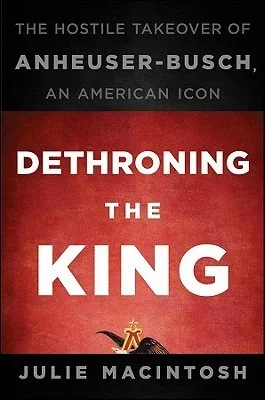
Dethroning the King book cover by Julie MacIntosh
Dethroning the King (Wiley, 2010) by Julie MacIntosh — the definitive account of the InBev-A-B takeover and its human cost 14

Regulatory clearance and the closing

The path to closing required navigating four jurisdictions. Brazil (September 17) and Germany (August 20) approved without conditions. 15 China approved on November 18 with restrictions capping InBev's ability to increase its stakes in Tsingtao Brewery and Zhujiang Beer.
The U.S. Department of Justice issued a "second request" on August 18 but ultimately required a single divestiture: InBev had to sell Labatt USA to address beer-market concentration in Buffalo, Rochester, and Syracuse, New York, where Labatt held 13–21% share against A-B's 24–28%. 16 KPS Capital Partners, through North American Breweries, became the DOJ-approved buyer.
A-B shareholders voted to approve the merger on November 12. The transaction closed on November 18, 2008 — two months into the worst financial crisis since the Depression. Julie MacIntosh later described InBev's timing with precision: they had "just kind of barrel-rolling under the garage door just as it was slamming shut." 17 The $51.6 billion in bank financing was committed before Lehman Brothers collapsed on September 15. Had InBev waited 90 days, the deal would have been impossible.

Post-deal: the culture lands

Carlos Brito had promised to "continue to support Blue Ocean." 8 He did — and then kept going. Within months, what A-B's management had marketed as a three-year, $1 billion savings plan was upgraded to a three-year, $2.25 billion target. 18 The company cut 1,400 U.S. salaried employees, eliminated executive offices and the corporate jet fleet, stretched supplier payment terms from 30 to 120 days, and sold $8.4 billion in non-core assets — Busch Gardens, SeaWorld, and the aluminum can manufacturing operation — against an original $7 billion target. 19
In AB InBev's first full financial year (2009), the company reported normalized EBITDA margin of 35.5% — 415 basis points above the prior-year combined benchmark — on net revenue of $36.8 billion. 20 The company reduced net debt by $11.8 billion in that first year alone. Morningstar analyst Ann Gilpin summarized the tension plainly: AB InBev was "the best-run brewer in the world by a large margin" — and had "overpaid for a no-growth company." 19
The cultural bluntness was not softened. At an industry wholesaler conference shortly after close, an InBev executive told the room: "The InBev culture will exist. The culture is non-negotiable. Employees are on the bus or off the bus." 19
Busch IV did not ride the bus. He collected roughly $100 million from his equity at close and a consulting contract paying $120,000 per month through 2013, attended one of nine AB InBev board meetings in 2010, entered rehabilitation for depression and related issues in early 2010, and resigned from the AB InBev board in March 2011 citing "personal and health reasons." 6 In January 2011 he had told reporters: "I would have given up my life to save the company. But I couldn't do anything." 6
An anonymous adviser quoted in Dethroning the King put the whole episode this way: "The way this played out was Shakespearean in nature. I haven't decided which play. The dynamic between father and son was just Shakespearean and tragic." 5
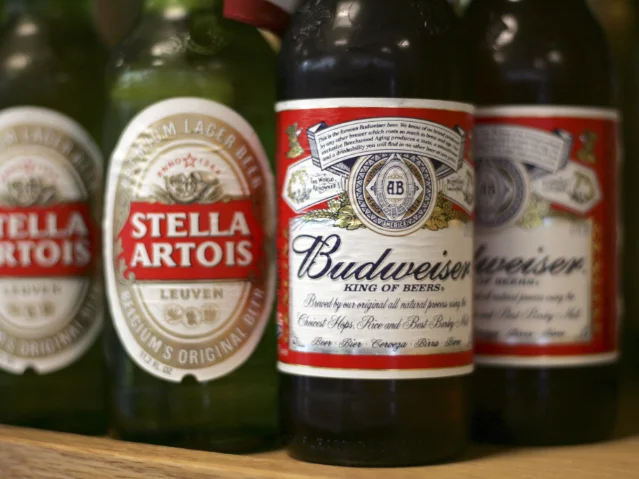
Budweiser and Stella Artois bottles side by side
Budweiser and Stella Artois — two brands that spent decades on opposite sides of the Atlantic, now owned by the same company 17

Frameworks you can use

InBev's use of Delaware § 228 was not novel in principle but was rarely executed at this scale. Under Delaware law, shareholders of a company that has opted for annual director elections (as A-B had by 2008) can remove and replace directors by written consent — without a shareholder meeting, without a proxy fight, without a record date set by the incumbent board. 10
A-B's defensive bylaw amendment — intended to control the consent-record-date process — was a speed bump. InBev's June 26 lawsuit sought judicial confirmation that the bylaw was inoperative. The combination of lawsuit and SEC consent solicitation filing created a binary outcome for A-B's board: negotiate now, or lose control of the negotiation entirely when your shareholders sign InBev's blue cards.
Transferable principle: if you are advising a company that is or might become a hostile target, understand the consent solicitation mechanics of your jurisdiction before you receive a letter. Bylaw amendments that require advance-notice procedures for director removal — or that preserve staggered elections — dramatically raise the cost of a consent campaign. Once a hostile bidder has filed with the SEC and secured litigation rights in Delaware, those defenses must already be in place; designing them under fire is nearly impossible.

Framework 2: The dual-track pressure campaign — simultaneous litigation and capital-market attack

InBev ran two parallel escalation tracks that each made the other more powerful. The Delaware lawsuit made A-B's bylaw defense legally uncertain. The SEC consent solicitation created an active public mechanism through which the largest shareholders — Barclays, Berkshire, and dozens of institutional funds — could displace the board with a single blue card. Neither track alone would have forced the board to the table in 33 days. Together, they eliminated the board's most important negotiating resource: the option to wait.
The architecture matters. Each track fed the other. The lawsuit's pending resolution kept uncertainty over the bylaw amendments alive. The consent solicitation meant that every day's delay was a day InBev could be collecting signed cards. When Buffett signaled publicly that he leaned toward a deal, the consent solicitation's implicit threat reached its maximum force — not because Buffett would necessarily sign, but because the board could now see a scenario where 50%+ of shares were in favor before it had any good answer.
Transferable principle: in adversarial negotiations where one party has or can manufacture institutional support, the most effective escalation pairing is a legal mechanism that creates uncertainty about the existing governance structure and a capital-market mechanism that offers shareholders a direct channel to express that preference. A board that must defend on both fronts simultaneously will almost always find it rational to negotiate rather than fight — the expected outcome from winning both battles is rarely better than the value available at the table.

Framework 3: The late-stage defense as inadvertent confession

The Blue Ocean plan — specifically the decision to accelerate it from $400 million over four years to $1 billion over three years, announced on June 27, 2008 — was the most instructive element of A-B's defense. It said, clearly, that A-B's prior management had been running the company at a cost structure significantly above what was achievable. 2
InBev's own response to Blue Ocean noted "significant execution risk" — and then, after the deal closed, doubled the target and hit it. 8 Niemann's "why didn't they do this earlier?" captured the shareholder calculus exactly: if the savings are real, they were being foregone every year that the plan wasn't implemented. A defense that proves the acquirer's value-creation thesis is not a defense at all.
Transferable principle: any value-creation plan deployed specifically to resist an acquisition will be scrutinized for two things — whether it can actually be executed, and whether its existence demonstrates that prior management was not maximizing value. Both points work against the target. Before deploying a late-stage operational defense, the board needs to ask: if we can do this, why haven't we? A credible answer to that question changes the calculus. No answer to it typically accelerates capitulation.

Framework 4: Ownership illusion and the governance trap

The Busch family's grip on A-B was psychological, cultural, and reputational — but not economic. Holding ~4% of shares in a Delaware corporation, with no supermajority provisions, no staggered board (after the 2006 governance change), and no poison pill that could survive a consent solicitation, the family had no more standing to block a transaction than any other 4% holder. 3
MacIntosh identified the management consequence: the board "needed to have pushed much harder for August III and Pat Stokes to be more global in their approach to the beer business" years before the bid arrived. 21 August III had spent three decades building U.S. market dominance — A-B's share rose from 23% when he took charge to over 50% at its peak — but had blocked acquisition of Grupo Modelo when the deal would have created a global scale platform. By 2008, the company that needed global scale to protect its domestic business had neither.
Transferable principle: in any public company where a founding family or controlling individual commands cultural authority disproportionate to their economic ownership, examine whether the formal governance structure supports or merely tolerates that authority. Rights plans, staggered boards, supermajority voting thresholds, and dual-class share structures are real defenses. Brand reputation and family name are not. A company that relies on the latter while failing to maintain the former will find, in a contested situation, that the distinction is absolute.

What to remember

  • The consent solicitation is the nuclear option. Delaware's written-consent mechanism under § 228 allows shareholders to remove and replace an entire board without a meeting. A bidder who files a consent solicitation with the SEC simultaneously starts a clock that no bylaw amendment can reliably stop. If your governance structure does not include provisions specifically designed to raise the cost of a consent campaign — advance-notice bylaws, staggered elections, supermajority thresholds — a determined hostile bidder can bypass your board before you've had time to engage counsel.
  • A late-stage operational defense that validates the acquirer's thesis will accelerate capitulation. A-B's Blue Ocean acceleration confirmed that significant value was being left on the table under incumbent management. InBev didn't just survive Blue Ocean — it doubled it. Any board deploying a similar plan needs to explain, credibly, why the savings weren't achievable before the bid. The answer rarely satisfies shareholders who have been offered a 35% premium.
  • Dual-track pressure eliminates the option value of time. InBev's simultaneous Delaware lawsuit and SEC consent solicitation filing — executed hours before A-B's board voted to reject — removed the board's ability to run out the clock. A-B went from formal rejection to signed merger agreement in 17 days. Time, in a hostile context, is not neutral; it belongs to whoever is creating the most legal and capital-market uncertainty for the other side.
  • Family brand equity and economic ownership are not the same thing. The Busch family's 4% stake had no blocking power once InBev filed its consent solicitation. The board's fiduciary obligation ran to all shareholders, not to one family's 150-year legacy. When Warren Buffett — holding five times the family's combined stake — signaled that he leaned toward accepting, the governance reality became undeniable. Companies whose independence depends on institutional investor goodwill rather than structural protections are structurally vulnerable from the day they go public.
Cargando vista previa del enlace…
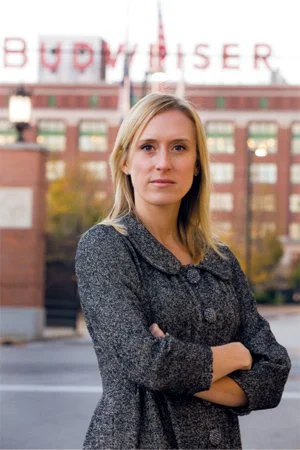
Cover image: Julie MacIntosh, author of Dethroning the King, photographed in front of the Budweiser brewery in St. Louis. Photo by Kevin A. Roberts for St. Louis Magazine. 21

Añade más opiniones o contexto en torno a este contenido.

  • Inicia sesión para comentar.