


The short that started a war: Ackman vs. Icahn and the five-year Herbalife battle
15/6/2026 · 8:26

The short that started a war: Ackman vs. Icahn and the five-year Herbalife battle

In December 2012, Bill Ackman announced a ~$1 billion short position against Herbalife at the Sohn Conference, calling it "the best-managed pyramid scheme in the history of the world." What followed was a five-year war: Carl Icahn took the opposing side with board seats and an estimated $214 million initial stake; Ackman spent $264,000 lobbying Congress and civil-rights groups while Herbalife spent $1.89 million to fight back; and the FTC reached a $200 million consent order in July 2016 that restructured Herbalife but declined to call it a pyramid scheme. Ackman exited in February 2018 with a ~$1 billion loss. Icahn exited by May 2021 with a ~$1.3 billion profit. The case is a textbook study in activist short-selling, counter-positioning, and the gap between information asymmetry and regulatory outcome.

On December 20, 2012, Bill Ackman of Pershing Square Capital Management walked to the front of a Manhattan conference room and spent three hours telling Wall Street that Herbalife — a nutritional supplements company with 3.5 million distributors in 80 countries — was "the best-managed pyramid scheme in the history of the world." 1 His 342-slide presentation, delivered at a special Sohn Conference session, backed a short position of roughly $1 billion — more than 20 million shares, representing approximately 20% of Herbalife's float. He predicted the stock would go to zero.
By Christmas Eve, Herbalife's stock had fallen from $42.50 to $26 — a 39% drop in days. 2 Then something unexpected happened. Instead of regulators moving against Herbalife, a parade of Wall Street names moved against Ackman.
What followed across the next five years was one of the most unusual investment battles in modern financial history: a short-seller trying to use media, lobbyists, and regulatory agencies as instruments of value destruction; a counter-investor turning that pressure into a long position; and a federal regulator reaching a conclusion that satisfied no one's thesis completely. The case was later documented in Scott Wapner's book When the Wolves Bite (2018) and structured as a business school case study by IESE — HBS case IES352-HCB-ENG — examining hedge-fund activism, short-selling, and CEO response strategy. 3 4

The parties: objectives, leverage, and what each side kept private

PartyStated objectiveBATNAHidden preferenceKey leverage
Ackman / Pershing SquareExpose Herbalife as a pyramid scheme; drive share price to zero; force FTC shutdownExit the short at a loss; declare moral victoryWin before borrowing costs devoured returns; avoid a short squeeze as long as possibleA 342-slide thesis that had already moved regulators in prior campaigns; media access and credibility
Icahn / Icahn EnterprisesProfit from a rising HLF share price; make Ackman's position increasingly costly to maintainSell his stake at break-evenSqueeze Ackman out of his short as quickly as possibleUnlimited dry powder to accumulate shares; board seats that gave Herbalife cover and operational guidance
Herbalife boardSurvive the short attack intact; neutralize the pyramid scheme allegation before it reached regulatorsAccept a restructuring deal with the FTC if the alternative was shutdownAvoid any formal "pyramid scheme" designation — even an implicit oneCorporate lobbying budget ($1.89M in 2013, outspending Ackman 7-to-1); access to Washington legislators; 35+ years of compliance history
FTCDetermine whether Herbalife's compensation structure was deceptive or unfair to participantsLitigate to a ruling (risky given the 1979 Amway precedent)Secure structural reform without having to prove the hard legal standard for a pyramid schemeCivil investigative demand authority; consent order negotiation; ability to set MLM industry-wide standards through a settlement

Act I: The thesis and the panic, December 2012

Ackman's core argument, assembled from months of fieldwork by his team and an initial tip from research firm Indago Group, was that Herbalife's distributors earned nearly all their income from recruiting new distributors — not from selling supplements to real customers. 5 An internal HBS Digital Initiative analysis published in 2015 later confirmed the structural argument: 89% of Herbalife members received $0 in gross commissions, and distributors earned "more than 10 times as much from recruiting rewards as they did from selling products to retail customers." 5
Herbalife's communications team recognized the threat immediately. A spokesperson told the press that Ackman had deliberately excluded company executives from the presentation because they "would have torn his premises and his interpretation of our business model to shreds." 1 The company announced a large investor day for early January 2013, designed to rebut Ackman point-by-point.
Ackman's conflict-of-interest exposure was obvious: every piece of negative information he published was also an attempt to profit from a short position. He addressed this pre-emptively by pledging to donate any personal gains from the trade to his charitable foundation, calling the proceeds "blood money." 2 The gesture was real — it also illustrated a structural weakness in the campaign. His credibility depended on persuading the FTC. But the FTC operates on its own timeline, through its own processes, and cannot be scheduled by a hedge fund's short position.

Act II: Icahn's counter-punch and the CNBC brawl, January 2013

On January 9, 2013, Dan Loeb's Third Point fund disclosed it had acquired an 8.24% stake in Herbalife — approximately 8.9 million shares — and circulated a letter to investors calling Ackman's thesis "preposterous." 6 Loeb's central point was surgical: the short thesis required believing the FTC had been "asleep at the switch" for 30 years and would "awaken at the behest of a hedge fund short seller." He put Herbalife's fair value between $55 and $68 per share. Loeb, it emerged later, had also hired a former FTC lawyer to assess the regulatory risk before he bought a single share — a detail Ackman had apparently skipped. 7 Loeb exited the position after approximately 16 days, pocketing a quick gain as the stock bounced. 8
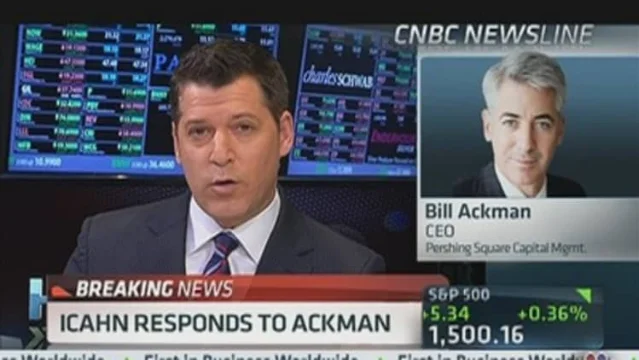
Carl Icahn's involvement was different in kind. He was not looking for a quick trade. On January 25, 2013, Ackman appeared on CNBC's "Fast Money Halftime Report," hosted by Scott Wapner, to respond to Icahn's criticism from the day before on Bloomberg TV. Icahn called into the live broadcast — and what happened next became one of the most watched segments in CNBC's history.
Icahn called Ackman a "liar" and "the crybaby in the schoolyard." 9 Ackman shot back: "This is not a guy who keeps his word. This is a guy who takes advantage of little people." 10 Icahn told Wapner that Ackman's use of investor capital for the Herbalife campaign was "reprehensible." 9 The broadcast went on for nearly 30 minutes, with Wapner at one point warning Icahn the exchange was live.
Icahn's stated conclusion: this might become "the mother of all short squeezes." A month after the broadcast, his SEC filings confirmed he had built a large long position in Herbalife — then worth roughly $214 million — entered at around $26–30 per share. 10 By 2013 he had negotiated five board seats with Herbalife in exchange for holding a minimum stake.
Ackman and Icahn during their famous CNBC on-air confrontation, January 25, 2013
Ackman and Icahn during their live CNBC confrontation on January 25, 2013 — the broadcast that signalled Icahn had taken the opposing side of Ackman's trade. 9

Act III: The lobbying war and the FTC investigation, 2013–2014

Ackman had promised that if the government found Herbalife legal, he would "lobby Congress for them to change the law." 2 Over 2013 he made good on that spirit — but inverted. Rather than wait for a finding, he spent $264,000 on federal lobbying — Pershing Square's first-ever Washington engagement — retaining three firms including the Moffett Group (run by former U.S. Representative Toby Moffett at $84,000) and Wexler & Walker ($150,000). 11 His team helped organize rallies, press conferences, and letter-writing campaigns in California, Nevada, Connecticut, New York, and Illinois. He also paid approximately $130,000 to Latino advocacy groups, including the Hispanic Federation, to identify Herbalife victims among immigrant communities. 12
On January 22, 2014, Senator Edward Markey (D-MA) sent letters to the FTC and SEC urging investigation. His office had met with Ackman's team. 13 Ackman had donated $32,400 to the Democratic Senatorial Campaign Committee on the same day Markey won his Democratic primary. 13
Herbalife's lobbying spend was $1.89 million in 2013 — roughly seven times Ackman's total — directed at keeping Congressional sentiment on the company's side. 11 The company's formal response to Ackman's campaign was unambiguous: "a cynical, self-serving attempt to manipulate the market by buying his way into an investigation to cover his own reckless $1 billion bet." 11
On March 12, 2014, Herbalife disclosed it had received a civil investigative demand from the FTC — a formal investigative subpoena. 14 The stock fell 8% on the announcement. NPR noted that the FTC issues such demands "30, 35 times a year" and that enforcement action follows only a fraction of the time. 14 Columbia Law professor John C. Coffee Jr. described the dynamics publicly as "the private attorney general on steroids" — a short-seller using legal and political mechanisms to substitute for what the government had not done independently. 15 For Icahn, the CID was not threatening; it was clarifying. He knew the FTC investigation would take years — years during which he could keep accumulating shares.

Act IV: The FTC's half-verdict, July 2016

The two-year investigation resolved on July 15, 2016, when the FTC filed a complaint and a simultaneous consent order against Herbalife International in the U.S. District Court for the Central District of California (FTC File No. 142 3156, Docket No. C-4587). 16 The terms were significant:
  • $200 million in consumer redress — among the largest MLM consumer protection payments in FTC history
  • At least 80% of company-wide product sales must go to verified end-users outside the distributor network
  • At least two-thirds of distributor rewards must be based on tracked and verified retail sales
  • A new distinction between "discount buyers" (self-use only, no income opportunity) and active business participants
  • A seven-year independent compliance auditor, paid by Herbalife, reporting to the Commission
  • Prohibition on earnings claims implying participants can "quit their job" or achieve financial freedom 16 17
FTC Chairwoman Edith Ramirez declared: "The company promised people a dream: a chance to change their lives, quit their jobs and gain financial freedom. Instead, it gave them an illusion." 16 The settlement required Herbalife to "fundamentally restructure its business so that participants are rewarded for what they sell, not how many people they recruit." 17 In January 2017, the FTC mailed redress checks to nearly 350,000 former Herbalife business participants — most receiving between $100 and $500 — from the $200 million fund. 18
What the FTC did not do: it did not call Herbalife a pyramid scheme, did not shut the company down, and did not use the word "pyramid" anywhere in the complaint or consent order. When a reporter at the press conference asked about the label, Ramirez replied: "Our focus isn't on the label." 16 Herbalife's CEO immediately claimed the settlement confirmed the company "was not an illegal pyramid scheme." Ackman, in later public statements, described his reaction as "incredibly disappointed" that the FTC had allowed Herbalife to continue operating. 10
On the day of the settlement announcement, Herbalife's stock rose. The market's interpretation: survival was worth more than the $200 million fine.
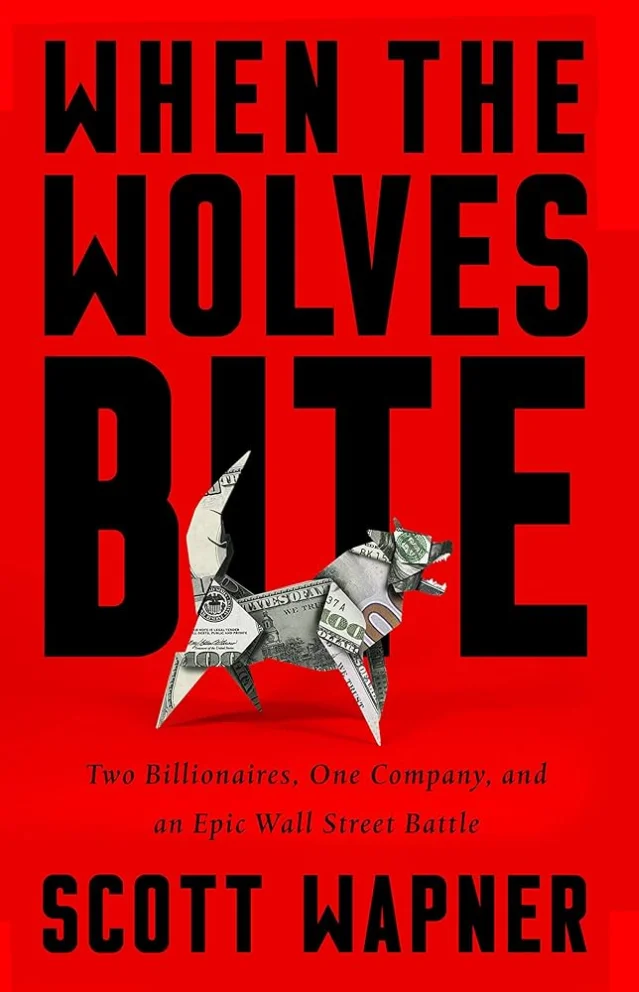
When the Wolves Bite — Scott Wapner's 2018 book on the Ackman-Icahn battle
When the Wolves Bite (PublicAffairs, 2018) by CNBC host Scott Wapner — the most complete journalistic account of the five-year battle, written while Ackman's position was still open. The book's title was borrowed from a 2017 Yale Law Journal paper by then-Delaware Chief Justice Leo Strine. 4

Act V: The exit — Ackman folds, Icahn counts his money, 2017–2018

The FTC settlement did not break Ackman's conviction — it broke his patience. Through 2017, Herbalife's stock climbed 51% in a single year. 19 Pershing Square recorded its third consecutive year of negative returns — 2015 at -20.5%, 2016 at -13.5%, 2017 at -4% — while the S&P 500 averaged 11% annually over the same period. 20 AUM fell from a 2015 peak above $20 billion to $8.2 billion by early 2018. 20 Blackstone and other institutional investors withdrew.
On November 1, 2017, Ackman converted his entire short position into put options — capping his downside to the premium paid, and ending the possibility of a short squeeze crushing Pershing Square further. 19 He told CNBC: "We've been entirely right on our Herbalife investment in terms of the fundamentals of the business. We've been wrong on the share price." 19
On February 28, 2018, Ackman called Scott Wapner and confirmed Pershing Square had exited all remaining positions. 21 Herbalife's stock hit $95.88 intraday — more than double the price at which he had shorted it. 22 Reuters noted that Pershing Square's total loss was "unknown" but was widely reported at approximately $1 billion. 22 Icahn, having entered at $26–30 per share in early 2013, fully exited his position by May 2021 for a total estimated profit of approximately $1.3 billion. 23 He told CNBC at exit: "I think this is an example of activism working very well. It was certainly an interesting ride fighting off bear raids as well as aiding the company in their numerous negotiations with the government. But all's well that ends well." 23
Ackman waited six more years to claim any version of a win. On February 15, 2024, when Herbalife's stock plunged 32% on disappointing earnings to a 14-year low, he posted on X: "It is a very good day for my psychological short on Herbalife. And it is an even better day for the world to see one of the biggest pyramid schemes fail." 24 By that point he held no financial position in the company.
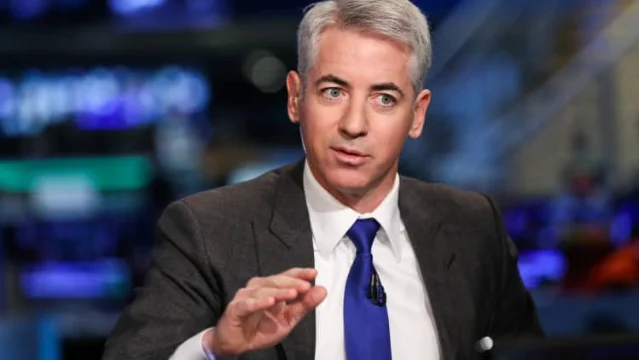
Bill Ackman at a CNBC appearance, 2017
Bill Ackman, November 2017, shortly before converting his Herbalife short into put options. 19

Frameworks you can use

Short-selling as activist negotiation tactic — and its structural ceiling

Ackman's campaign was not a passive bet; it was an attempt to use public information asymmetry as a forcing mechanism. The 342-slide presentation, the lobbying spend, the Congressional outreach, and the civil-rights coalition work all served a single function: manufacture the conditions under which a regulator would intervene faster than the market's short-covering pressure could mount. Academics studying activist short-selling — notably Bliss, Molk, and Partnoy in their 2019 paper "Negative Activism" — identify this as a distinct strategy class: not just betting on decline but actively accelerating the informational and political conditions that produce it. 25
The tactic has a structural ceiling: the activist short-seller controls the disclosure of information but not the pace of the regulatory response. Ackman's thesis was structurally confirmed by the FTC — the agency's complaint acknowledged that half of Herbalife's sales leaders earned under $5 a month on average from product sales, and that 57% of nutrition club operators reported no profit or a loss. 18 But the FTC took two years to act, offered a settlement rather than a shutdown, and declined the pyramid scheme label. The borrowing costs on a 5-year short position — plus the dividend payments a short-seller must cover — ran continuously throughout that window.
The practical framework: before initiating an activist short, model the "partial vindication" scenario explicitly. If a regulator concludes you were right about the facts but imposes a fine rather than a shutdown, what does your position look like at that date? Ackman had no answer to that question in 2012.

Counter-positioning as asymmetric defense

Icahn's response to Ackman was not a defense of Herbalife's business model — he built no 342-slide presentation about the company's nutrition science. His positioning was purely structural: identify a short-seller whose conviction is creating artificial price suppression, buy the suppressed asset, and let the short-seller's timeline work against him.
The asymmetry mattered. Ackman's short position had a hard deadline — the cost of carrying a multi-year short in a rising stock compounds. Icahn's long position had no equivalent time pressure. With board seats secured in 2013, Icahn was aligned with management on regulatory negotiations. He could afford to hold through the FTC investigation, through the consent order, and through Ackman's eventual option conversion — because each passing month made Ackman's cost structure worse, not Icahn's.
The takeaway for any counter-positioning decision: the party with the longer time horizon wins, as long as the underlying asset does not reach zero. Icahn's bet was that the FTC — despite pressure from a well-funded, publicly credible activist — would not shut Herbalife down. His $1.3 billion profit rested entirely on that regulatory judgment, not on any view about whether Herbalife's products worked.

Regulatory uncertainty as leverage — and what happens when it resolves

Columbia Law's Professor John Coffee described Ackman as "the private attorney general on steroids." The phrase captures something real: the FTC investigation created a two-year window of uncertainty that functioned as a de facto restraint on Herbalife's share price and recruitment ability. During that window, Ackman's campaign had structural value — the investigation itself was leverage, regardless of outcome.
The moment the FTC filed its consent order, that leverage disappeared. The ambiguity was resolved — partially, in a way that satisfied neither side but eliminated the investment thesis's dependence on regulatory uncertainty. Herbalife's stock rose on settlement day because the worst-case outcome (shutdown, pyramid scheme designation) was gone. Regulatory uncertainty is not a renewable resource in activist short-selling. Ackman had no second thesis once the FTC acted.
This is the Amway precedent problem that Coffee identified: the FTC's 1979 ruling in In re Amway Corp. had established that an MLM company satisfying three specific safeguards (a buyback policy, a 10-customer rule, and a 70% retail sales rule) was legal. Herbalife had adapted its formal documentation to satisfy those safeguards well before Ackman arrived. The FTC knew it would face that precedent in any litigation. Consent order — with structural reform requirements but no pyramid scheme finding — was the most the agency could achieve within existing legal constraints. 15

Information asymmetry and the "controlled exit" problem

Perhaps the sharpest lesson from the Herbalife battle is what happens when a negotiator — in this case, a short-seller using public pressure as his primary tool — has superior information about a company's fundamental weakness but no mechanism to convert that information into a controlled exit.
Ackman was right that Herbalife's compensation structure was misaligned with retail sales. The FTC's complaint confirmed the fundamental issue. But being right about the analysis and being positioned to profit from it required a third variable he could not control: the regulator had to act fast enough, and decisively enough, that the stock fell before Icahn and other counter-longs could absorb all the selling pressure. The FTC acted in two years rather than two months, and acted short of closure.
Professor Coffee's observation about the Amway precedent illuminates why: the legal standard for prosecuting a pyramid scheme was set in 1979, before the internet era of MLM expansion, and was effectively frozen by that ruling. The FTC was not negligent — it was constrained. Ackman's lobbying campaign assumed the agency could move faster than its legal architecture permitted. 15
Cargando vista previa del enlace…

What to remember

  • Regulatory uncertainty is a consumable asset, not a durable one. Ackman's campaign derived its structural value from the FTC investigation being unresolved. The moment the consent order settled the question — even without the pyramid scheme label — that leverage expired. Any strategy that depends on regulatory ambiguity must have an explicit plan for the scenario in which the regulator reaches a conclusion before your position does.
  • Counter-positioning wins when time horizon is asymmetric. Icahn's ~$1.3 billion profit against Ackman's ~$1 billion loss had nothing to do with better information about Herbalife's nutrition products. Icahn recognized that Ackman's short carried time-decay costs (borrowing fees, dividends, reputational compounding) that his long position did not. In any campaign where one party is paying to maintain a position and the other is not, the party with the lower carrying cost wins if the underlying question is genuinely open.
  • The FTC's "not on the label" framing was the decisive outcome. The Amway (1979) precedent constrained the FTC's legal options. Rather than litigate a difficult pyramid scheme standard, the agency secured structural reform — the 80% retail rule, the two-thirds reward floor, the seven-year compliance monitor — through a consent order. Both sides could claim partial vindication. The structural reforms Ackman sought were implemented; the company survived. Understanding what a regulator can and cannot achieve within its legal constraints is a prerequisite for any strategy that depends on regulatory action.
  • Public disclosure is a pressure tactic, not a closing mechanism. Ackman's 342-slide presentation moved the stock 39% in days and triggered a two-year FTC investigation. But pressure is not outcome. A well-funded, operationally resilient target with its own lobbying resources can outlast a short-seller's patience — and its own timeline. 3

Cover image: AI-generated. The IESE Business School case study "Who Wants to Be a Millionaire? Bill Ackman's Big Short of Herbalife" (IES352-HCB-ENG, Harvard Business Publishing, 2014), authored by Tom Vandebroek, Fabrizio Ferraro, and Jan Simon, provides structured academic framing for the full campaign. 3

Contenido relacionado

Añade más opiniones o contexto en torno a este contenido.

  • Inicia sesión para comentar.