"The shadow swept": Du Bois builds the veil
A close read of W. E. B. Du Bois’s schoolhouse memory in The Souls of Black Folk, tracing how one refused card becomes the Veil, the prison-house, and a grammar of divided sight.

Du Bois does not introduce the Veil as a theory. He lets it arrive first as a child’s social fact: a visiting card refused, a glance delivered, and then a whole world rearranged around the discovery.
The passage
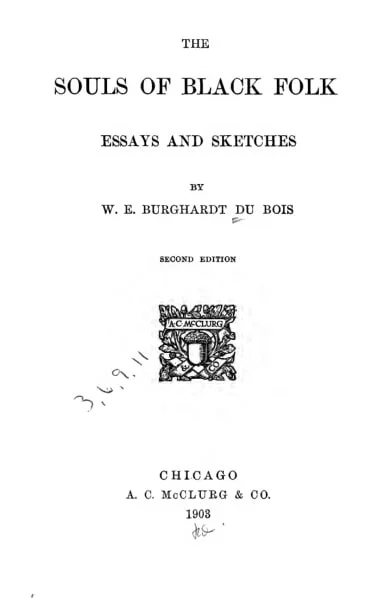
W. E. B. Du Bois, The Souls of Black Folk (1903), Chapter I, “Of Our Spiritual Strivings.” 1
And yet, being a problem is a strange experience,—peculiar even for one who has never been anything else, save perhaps in babyhood and in Europe. It is in the early days of rollicking boyhood that the revelation first bursts upon one, all in a day, as it were. I remember well when the shadow swept across me. I was a little thing, away up in the hills of New England, where the dark Housatonic winds between Hoosac and Taghkanic to the sea. In a wee wooden schoolhouse, something put it into the boys’ and girls’ heads to buy gorgeous visiting-cards—ten cents a package—and exchange. The exchange was merry, till one girl, a tall newcomer, refused my card,—refused it peremptorily, with a glance. Then it dawned upon me with a certain suddenness that I was different from the others; or like, mayhap, in heart and life and longing, but shut out from their world by a vast veil. I had thereafter no desire to tear down that veil, to creep through; I held all beyond it in common contempt, and lived above it in a region of blue sky and great wandering shadows. That sky was bluest when I could beat my mates at examination-time, or beat them at a foot-race, or even beat their stringy heads. Alas, with the years all this fine contempt began to fade; for the words I longed for, and all their dazzling opportunities, were theirs, not mine. But they should not keep these prizes, I said; some, all, I would wrest from them. Just how I would do it I could never decide: by reading law, by healing the sick, by telling the wonderful tales that swam in my head,—some way. With other black boys the strife was not so fiercely sunny: their youth shrunk into tasteless sycophancy, or into silent hatred of the pale world about them and mocking distrust of everything white; or wasted itself in a bitter cry, Why did God make me an outcast and a stranger in mine own house? The shades of the prison-house closed round about us all: walls strait and stubborn to the whitest, but relentlessly narrow, tall, and unscalable to sons of night who must plod darkly on in resignation, or beat unavailing palms against the stone, or steadily, half hopelessly, watch the streak of blue above. 2
Gloss
- Mayhap: perhaps. The old-fashioned word softens the sentence just as the sentence is making a hard distinction.
- The Veil: Du Bois’s central image for the barrier between Black Americans and white America. It is social, visual, and psychological at once.
- Sycophancy: servile flattery. Du Bois places it beside “silent hatred” to show two opposite ways a child might learn to survive exclusion.
Close read
The device here is an expanding spatial metaphor. Du Bois begins small: “a little thing,” a schoolhouse, a packet of cards, one girl’s refusal. Even the sentence of refusal saves the decisive wound for the end: “refused my card,—refused it peremptorily, with a glance.” The repeated verb makes the action unmistakable; the final phrase makes it nearly silent. The child is not argued out of belonging. He is looked out of it.
Then the paragraph changes scale. A glance becomes “the shadow,” then “a vast veil,” then the “shades of the prison-house.” Each image keeps the same mechanical pressure: something passes between the self and the world. But the barrier grows less local and less escapable. At first, the boy imagines height as answer; he will live above the veil in “blue sky,” beat his classmates, and win the “prizes” they appear to own. By the final sentence, height has become cruelly reduced to only “the streak of blue above.” The sky is still there, but it is now seen from inside walls.
That shift prepares the famous paragraph that follows, where Du Bois names “double-consciousness” as “always looking at one’s self through the eyes of others.” 2 The concept is not dropped onto the page as sociology alone. It has first been built as grammar: a social look becomes a spatial wall, and a spatial wall becomes a divided inner life.
Why it matters
The passage still matters because it shows how quickly an outer judgment can become an inner architecture. Du Bois is not describing mere hurt feelings, nor only one childhood slight. He is showing the mechanism by which a society teaches a person to measure the self from outside the self.
That is why the paragraph remains so piercing. Its pain is exact, but its craft is exact too: the whole argument turns on scale, from card to glance to veil to prison-house.
Reflection question: Where have you seen a small social gesture become larger than itself, shaping what a person believed was possible?
Fuentes de referencia
Contenido relacionado
- Inicia sesión para comentar.
More from this channel
- "He cannot chuse but hear": Coleridge's grammar of enchantment
- "The force of truth": Socrates refuses the courtroom's costume
- The Unwritten Epic: George Eliot on Lives Without a Stage
- "A peace-mingling falsehood": Sa'di's moral grammar
- "The dream vanished": Shelley's grammar of revulsion
- "Moral geometry": Okakura's art of proportion
- "It is a mistake": Hugo's grammar of mercy
- "Restore your arrow": Kalidasa stops the hunt