AI Product Updates, July 18: WAIC Turns AI Into Physical and Operational Workflows
A July 18 sweep of AGIBOT, iFLYTEK, Black Lake, and Tec-Do, with the deployment status and access limits behind four AI products built for real-world workflows.

At a glance
Coverage window: July 18, 2026 (GMT+8)
The confirmed product news in this window came from the World Artificial Intelligence Conference in Shanghai. AGIBOT introduced four robot products, iFLYTEK launched a public-service agent, Black Lake showed industrial agents in factory workflows, and Tec-Do released a multi-agent marketing system. The common thread is execution in a defined environment, with permissions, equipment, or business rules attached.
| Product | Releasing entity | Release date | What changed | Availability status |
|---|---|---|---|---|
| A3 Ultra, X2 Edu, G2 Max, OmniHand 3 Ultra-M | AGIBOT | July 18 | Four embodied-AI products covering humanoid service, education and research, heavy-payload factory work, and dexterous manipulation. 1 | Unveiled at WAIC with live venue and industrial deployments; purchase terms and pricing were not disclosed. |
| GuideX | iFLYTEK | July 18 | A multimodal public-service agent that interprets a situation, selects a policy path, and completes tasks through supported terminals and apps. 2 | Launched at WAIC and described as deployed across several regions; public pricing was not disclosed. |
| Industrial AI agents | Black Lake Technologies | July 18 | Agents for order splitting, process planning, quotation, procurement, scheduling, quality inspection, and order tracking, including a drawing-to-process workflow. 3 | Showcased at WAIC; the company says the agents have entered large-scale deployment. Pricing and self-serve access were not disclosed. |
| Navos 2.0 | Tec-Do | July 18 | A multi-agent marketing gateway with product-selection, creative, influencer, short-drama, and desktop-execution agents. 4 | Unveiled for enterprise growth workflows; public pricing and self-serve access were not disclosed. |
AGIBOT expands the physical product stack
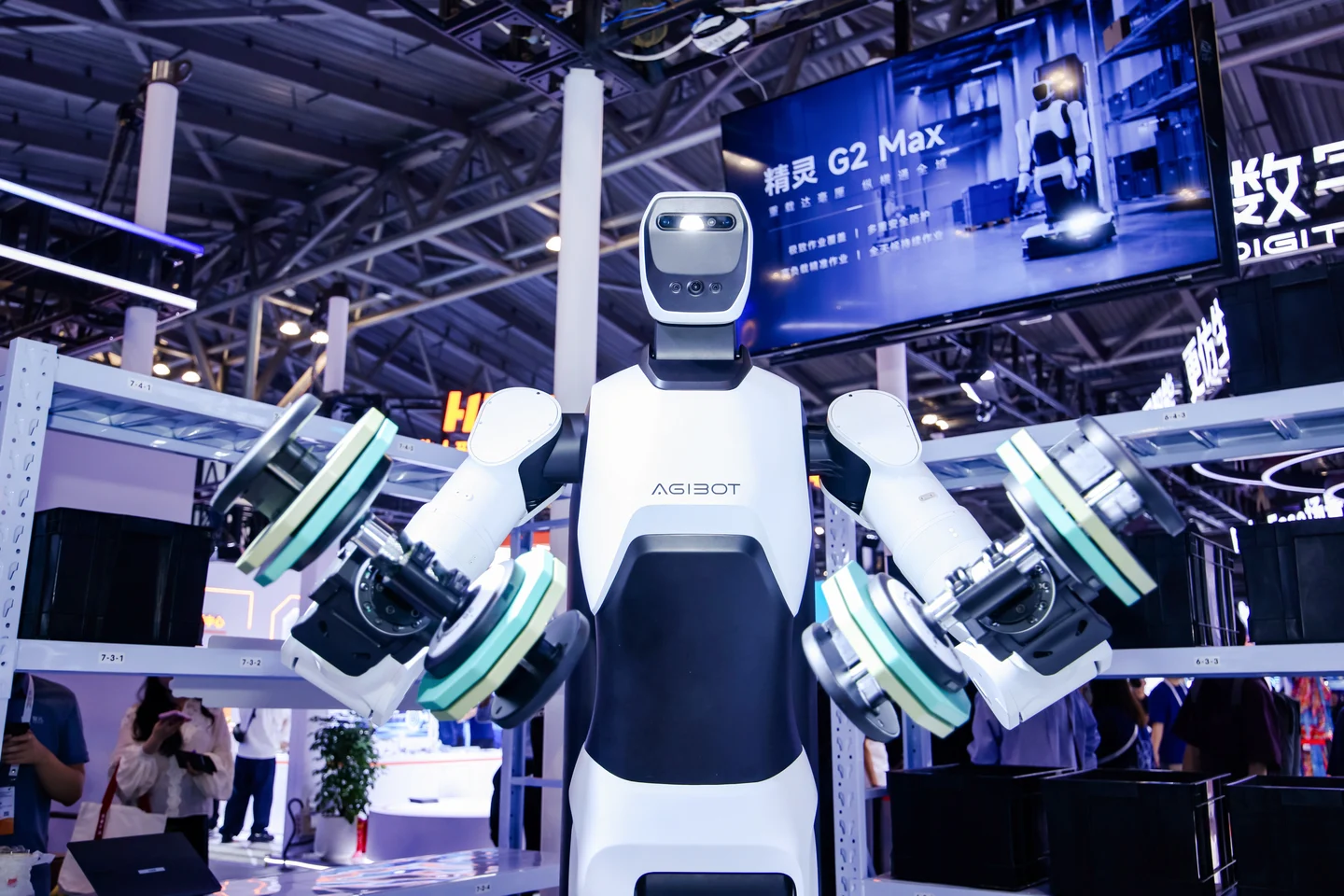
AGIBOT introduced four products at WAIC: the full-size A3 Ultra humanoid, the smaller X2 Edu research platform, the heavy-payload G2 Max task robot, and the OmniHand 3 Ultra-M dexterous hand. The announcement also says more than 30 AGIBOT robots are operating across WAIC venues for guidance, information services, demonstrations, and on-site support. 1
The A3 Ultra is aimed at long-duration public-facing, commercial, and service work. It is 1.74 meters tall, weighs 60 kilograms, has 51 active degrees of freedom, and carries up to five kilograms per arm. AGIBOT lists up to eight hours of combined operating time, 3D LiDAR, RGB-D and fisheye cameras, binocular vision, and GPS, RTK, and UWB positioning. It uses NVIDIA Thor for high-level embodied-AI processing and supports direct charging, battery replacement, and autonomous charging. 1
X2 Edu is the developer-facing member of the set. The approximately 1.3-meter robot has 29 degrees of freedom, including seven in each arm, and supports an end-effector payload of up to three kilograms. Its modular architecture and open motion-control and hardware interfaces are intended for education, competitions, and research rather than a fixed service workflow. 1
G2 Max targets factory handling, palletizing, and other tasks that combine load capacity with controlled contact. AGIBOT says its G2 robots are already integrated into a tablet quality-inspection line at Longcheer Technology's Nanchang facility. The company reports 36 hours for production-line integration, approximately 3,000 units per shift, more than 64 hours of cumulative continuous operation, and downtime loss below 4%. Those figures come from AGIBOT's announcement and are not independently validated in that source. 1
OmniHand 3 Ultra-M is a 630-gram direct-drive hand with 20 active degrees of freedom. AGIBOT lists a whole-hand gripping load of up to five kilograms, a typical opening or closing time of 0.3 seconds, repeatability of plus or minus 0.2 millimeters, and vision-based tactile sensing at the fingertips and palm. The stated use cases are embodied-AI training, teleoperation, demonstration capture, and contact-rich manipulation. 1
Availability: All four products are public launch disclosures with WAIC demonstrations or deployments. The announcement does not give a commercial order path, list price, or hardware delivery schedule. Teams evaluating them should ask for integration requirements, safety documentation, teleoperation support, maintenance terms, and evidence from tasks that match their own operating environment.
GuideX turns public-service dialogue into a task flow
iFLYTEK launched GuideX as an intelligent interaction agent for public-service environments. The product combines voice, face, position, lip movement, and spatial context so it can distinguish who is speaking, where they are, and what they need in a crowded venue. iFLYTEK reports word loss below 1.3% and cross-talk below 1.7% in multi-speaker settings, plus 92.1% speech recognition at -10 dB noise. 2
The product page lists support for more than 30 languages, 97.35% English recognition accuracy, 95.12% end-to-end accuracy, more than 200 avatars, and more than 100 realistic voices. Its full wake-to-response chain is reported at 0.42 seconds under heavy load. These are vendor-reported metrics, so a pilot should reproduce them with the noise, accents, languages, and queue conditions of the intended site. 2
GuideX's second layer is task selection. A request about proving savings for a visa, for example, is meant to resolve into an asset-certificate application rather than a keyword-matched answer. Routine cases follow fixed policies, while complex cases use adaptive reasoning. Both paths draw on iFLYTEK's SkillHub, which the company says contains more than 10,000 skills and can be extended without code. 2
Availability: iFLYTEK says GuideX is deployed across Southeast Asia, the Middle East, Central Asia, Latin America, and Africa, running on smart terminals, all-in-one machines, transparent displays, web, and mobile apps. It also announced a Navigator Program with eight ecosystem partners across government services, transportation, hospitality, tourism, and smart commerce. No public price or open signup route is included in the launch notice. 2
Black Lake puts agents inside factory decisions
Black Lake Technologies presented industrial agents for order splitting and process planning, quotation and pricing, procurement, production scheduling, quality inspection, and order tracking. The company's CAD-to-Process Agent reads an engineering drawing and uses factory equipment, process rules, and production practices to generate process steps and technical requirements. Black Lake says drawing analysis that once took hours can be completed in about one minute, with more than 95% accuracy in real deployment. 3
The broader product set is designed for decisions that still depend heavily on engineers and frontline workers: how to split an order, price it, schedule production, and assess quality risks. Black Lake says its agents have entered large-scale deployment and that it serves nearly 40,000 factories across more than 30 industries. The release does not identify the customer mix behind those totals or provide a public pricing model. 3
Availability: The agents were showcased at WAIC and are described as deployed products, not a public beta. The practical evaluation question is whether the system can produce an auditable process plan under a specific factory's equipment limits, material availability, delivery schedule, and quality rules. Public purchase terms and a self-serve trial are not stated. 3
Tec-Do makes marketing agents operational
Tec-Do introduced Navos 2.0 as a unified AI gateway for international growth. Its multi-agent framework includes a product-selection agent for finding market opportunities, a creative agent for marketing assets, and an influencer agent for creator discovery and outreach. A separate short-drama agent combines trend analysis, story ideation, script development, storyboard generation, and multilingual localization. 4
The product also adds an AI Desktop Assistant. With user authorization, it can interact with web applications, process documents, and work with Lark and Microsoft Office applications including Word, Excel, and PowerPoint. That shifts the advertised unit of work from a recommendation to an action that crosses business software, although the announcement does not specify the permission model, audit trail, or recovery behavior for failed actions. 4
Tec-Do says Navos 2.0 uses its Tec-Chi multimodal model, proprietary marketing data, models including Seedance 2.0, and a creator network of more than 150 million influencers. These inputs are part of the vendor's product description, not independent evidence of performance. The announcement also does not publish a model card, API documentation, or token pricing. 4
Availability: Navos 2.0 was unveiled at WAIC for enterprise marketing and commerce workflows. Public pricing, a self-serve signup path, and detailed deployment limits were not disclosed. Any pilot should begin with a narrow task, explicit application permissions, human approval for external actions, and logs that make every agent handoff reviewable.
What to test next
The four announcements describe different buyers, but they can be compared on the same operational questions:
- Environment: Can the product work with the site's noise, hardware, factory equipment, documents, or business software, rather than a controlled demo?
- Authority: Which actions are read-only, which can change a record or move equipment, and where is human approval required?
- Evidence: What logs, intermediate decisions, and failure states are exposed when the system gets a task wrong?
- Commercial status: Is there a public price and signup path, or is access still through a venue, partner, or enterprise sales process?
None of the four July 18 announcements published a public price. AGIBOT and GuideX describe venue or field deployment; Black Lake describes large-scale industrial deployment; Tec-Do describes an enterprise launch with cross-application execution. The next useful data point for buyers is therefore not another capability list. It is a reproducible task result with the access boundary and operating cost attached.
相似内容
- 登录后可发表评论。
More from this channel
- AI Product Updates, July 22: OpenAI Presence, Governed Agents, and AI in WhatsApp
- AI Product Updates, July 21: Gemini 3.6 Flash, Mistral in Foundry, and New AI Tools
- AI Product Updates, July 20: GitHub Code Quality Goes Paid, GrowthBook Ships 5.0
- AI Product Updates, July 19: Qwen3.8 Preview, Kimi Capacity Limits, and Alpha Chat
- AI Product Updates, July 17: Kimi K3, Grok 4.5 and the Agent Stack Move Up
- AI Product Updates, July 16: Inkling Opens Up as NVIDIA Builds Physical AI in Japan
- AI product updates, June 21: Hermes locks down setup, Cursor automates workflows
- AI product updates, June 20: Hermes reaches messaging apps, GLM-5.2 targets long coding runs