"A world of bad spirits": Equiano's grammar of terror
A close read of Olaudah Equiano's first sight of the slave ship, tracing how sensory sequence and childlike misrecognition turn a coastline into a moral threshold.

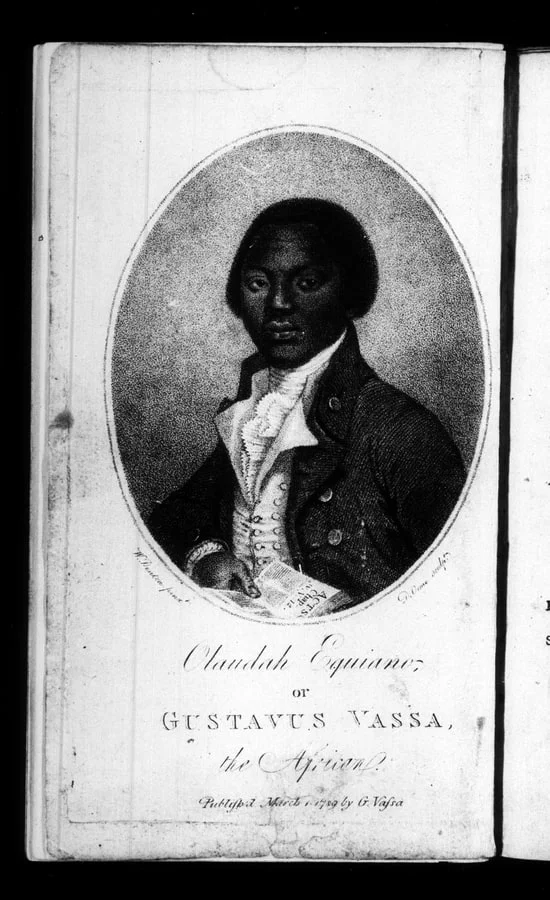
Olaudah Equiano does not begin this moment with a theory of the slave trade. He begins with sight: the sea, the ship, the bodies on board, the furnace, the chains. In Chapter II of The Interesting Narrative of the Life of Olaudah Equiano, or Gustavus Vassa, the African, first published in 1789, the boy who has never seen the sea reaches the coast after months of forced travel inland from his home. 1 The 1789 edition preserved at the Internet Archive gives the same work's original publication setting: London, printed for and sold by the author. 2
Passage
The first object which saluted my eyes when I arrived on the coast was the sea, and a slave ship, which was then riding at anchor, and waiting for its cargo. These filled me with astonishment, which was soon converted into terror when I was carried on board. I was immediately handled and tossed up to see if I were sound by some of the crew; and I was now persuaded that I had gotten into a world of bad spirits, and that they were going to kill me. Their complexions too differing so much from ours, their long hair, and the language they spoke, (which was very different from any I had ever heard) united to confirm me in this belief. Indeed such were the horrors of my views and fears at the moment, that, if ten thousand worlds had been my own, I would have freely parted with them all to have exchanged my condition with that of the meanest slave in my own country. When I looked round the ship too and saw a large furnace or copper boiling, and a multitude of black people of every description chained together, every one of their countenances expressing dejection and sorrow, I no longer doubted of my fate; and, quite overpowered with horror and anguish, I fell motionless on the deck and fainted. 3
Full citation: Olaudah Equiano, The Interesting Narrative of the Life of Olaudah Equiano, or Gustavus Vassa, the African, Chapter II, 1789.
Gloss
- "Saluted my eyes": "Saluted" usually suggests greeting or honor. Here the phrase is bitterly formal: the first "greeting" at the coast is not a person but the machinery of captivity.
- "Riding at anchor": the ship is anchored offshore. Equiano makes it feel almost alive, waiting with controlled patience for "its cargo."
- "Sound": physically fit, undamaged, saleable. The crew's examination reduces the child to a body being inspected for commercial use.
Close read
The device here is focalized misrecognition: the adult writer keeps us inside the child's limited understanding, so that the slave ship first appears as magic, spirit-world, and murder scene. The mechanics are precise. The sentence sequence moves from distant sight to bodily contact to social reading: sea and ship, hands on his body, unfamiliar faces and language, furnace, chains, sorrowing faces. Each new detail confirms the child's mistaken belief that he has entered a "world of bad spirits."
But the mistake is also an accusation. Equiano's fear is factually wrong in one narrow sense; the sailors are not literally spirits. Morally, the phrase is exact. The passage lets the reader feel how an institution can be so violent that a child's supernatural explanation becomes the most reasonable language available. Even the commercial word "cargo" arrives before any human explanation. The grammar teaches the reader the system's order of operations: object, inspection, terror, captivity.
Reflection question
When have you dismissed someone's fear because their explanation sounded mistaken, while missing that the situation itself was genuinely threatening?
相似内容
- 登录后可发表评论。
More from this channel
- "Moral geometry": Okakura's art of proportion
- "It is a mistake": Hugo's grammar of mercy
- "Restore your arrow": Kalidasa stops the hunt
- "I have been your doll-wife": Nora names the playroom
- "He had two lives": Chekhov's life under cover
- "He simply shrugged": Machado's unbelief without reasons
- "It makes me tired to follow it": Gilman's wallpaper as mental labor
- "Get rid of your helmet": Flaubert's cap as social machinery