"I have been your doll-wife": Nora names the playroom
A close read of Nora's Act III speech in Ibsen's A Doll's House, tracing how affectionate household language becomes a grammar of ownership.

Nora does not begin her exit by slamming a door. She begins by renaming the room she has been living in. In Act III of Henrik Ibsen's A Doll's House (1879), translated by R. Farquharson Sharp, the marriage conversation becomes a vocabulary lesson: what Torvald calls love, Nora starts calling play. 1
The Passage
NORA. That is just it; you have never understood me. I have been greatly wronged, Torvald--first by papa and then by you.HELMER. What! By us two--by us two, who have loved you better than anyone else in the world?NORA. [shaking her head]. You have never loved me. You have only thought it pleasant to be in love with me.HELMER. Nora, what do I hear you saying?NORA. It is perfectly true, Torvald. When I was at home with papa, he told me his opinion about everything, and so I had the same opinions; and if I differed from him I concealed the fact, because he would not have liked it. He called me his doll-child, and he played with me just as I used to play with my dolls. And when I came to live with you--HELMER. What sort of an expression is that to use about our marriage?NORA. [undisturbed]. I mean that I was simply transferred from papa's hands into yours. You arranged everything according to your own taste, and so I got the same tastes as you--or else I pretended to, I am really not quite sure which--I think sometimes the one and sometimes the other. When I look back on it, it seems to me as if I had been living here like a poor woman--just from hand to mouth. I have existed merely to perform tricks for you, Torvald. But you would have it so. You and papa have committed a great sin against me. It is your fault that I have made nothing of my life.HELMER. How unreasonable and how ungrateful you are, Nora! Have you not been happy here?NORA. No, I have never been happy. I thought I was, but it has never really been so.HELMER. Not--not happy!NORA. No, only merry. And you have always been so kind to me. But our home has been nothing but a playroom. I have been your doll-wife, just as at home I was papa's doll-child; and here the children have been my dolls. I thought it great fun when you played with me, just as they thought it great fun when I played with them. That is what our marriage has been, Torvald.
Gloss
Serious conversation: Nora does not mean solemn talk in general. She means mutual inquiry: two people "sat down in earnest" to find out what is true between them.
Doll-child / doll-wife: The compound is deliberately childish and legal-sounding at once. "Doll" marks Nora as an object arranged for another person's pleasure; "child" and "wife" name the two domestic roles through which that arrangement has been passed along.
Merry: Nora separates merriment from happiness. "Merry" is visible performance: lightness, play, liveliness. Happiness would require inward consent.
Close Read
The passage turns on a sequence of corrections. Torvald hears "serious" and translates it into "worries" and "business matters"; Nora corrects him toward shared thought. He hears "wronged" and translates it into a failure of gratitude; Nora corrects him toward understanding. He hears "not happy" and repeats it as scandal; Nora corrects him with the smaller, sharper word "merry". The drama is doing its thinking through misdefinition: each time Torvald supplies the household's old meaning, Nora replaces it with a more exact one.
That is why the doll metaphor lands so hard. Nora does not merely say that her father and husband controlled her. She describes a transfer of handling: "from papa's hands into yours." The phrase makes marriage feel less like a vow than a change of possession. Ibsen then lets the image multiply downward. Father plays with daughter; husband plays with wife; mother plays with children. The home is not a refuge from power but a training room where power is copied, miniaturized, and passed on.
Notice, too, how calm the syntax becomes at the moment of accusation. Nora says, "I have been your doll-wife" in a balanced sentence that mirrors "papa's doll-child." The parallel grammar is the evidence. She does not need to shout because the sentence itself proves the pattern: different men, different household names, same structure. Her awakening is not a sudden change of feeling. It is a change in naming.
Why It Still Matters
Nora's speech remains uncomfortable because Torvald's language is not pure cruelty. He calls her dear; he insists he loved her; he imagines kindness as proof. The scene asks whether affection can still be possessive when it is tender, generous, even sincere. Nora's answer is that love which never has to listen becomes another form of furniture-arranging.
Reflection Question
Where in your own life might someone else's affectionate name for you also be quietly assigning you a role?
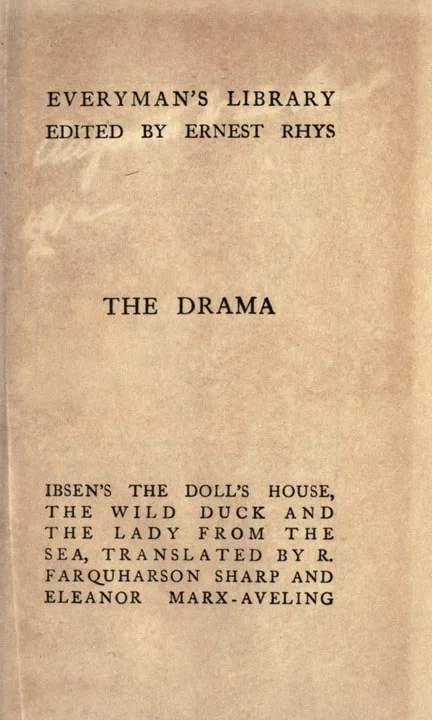
Cover image: title page from the 1911 Everyman's Library scan of A Doll's House, and Two Other Plays, preserved by the University of Toronto and Internet Archive. 2
相似内容
- 登录后可发表评论。
More from this channel
- "The dream vanished": Shelley's grammar of revulsion
- "Moral geometry": Okakura's art of proportion
- "It is a mistake": Hugo's grammar of mercy
- "Restore your arrow": Kalidasa stops the hunt
- "A world of bad spirits": Equiano's grammar of terror
- "He had two lives": Chekhov's life under cover
- "He simply shrugged": Machado's unbelief without reasons
- "It makes me tired to follow it": Gilman's wallpaper as mental labor