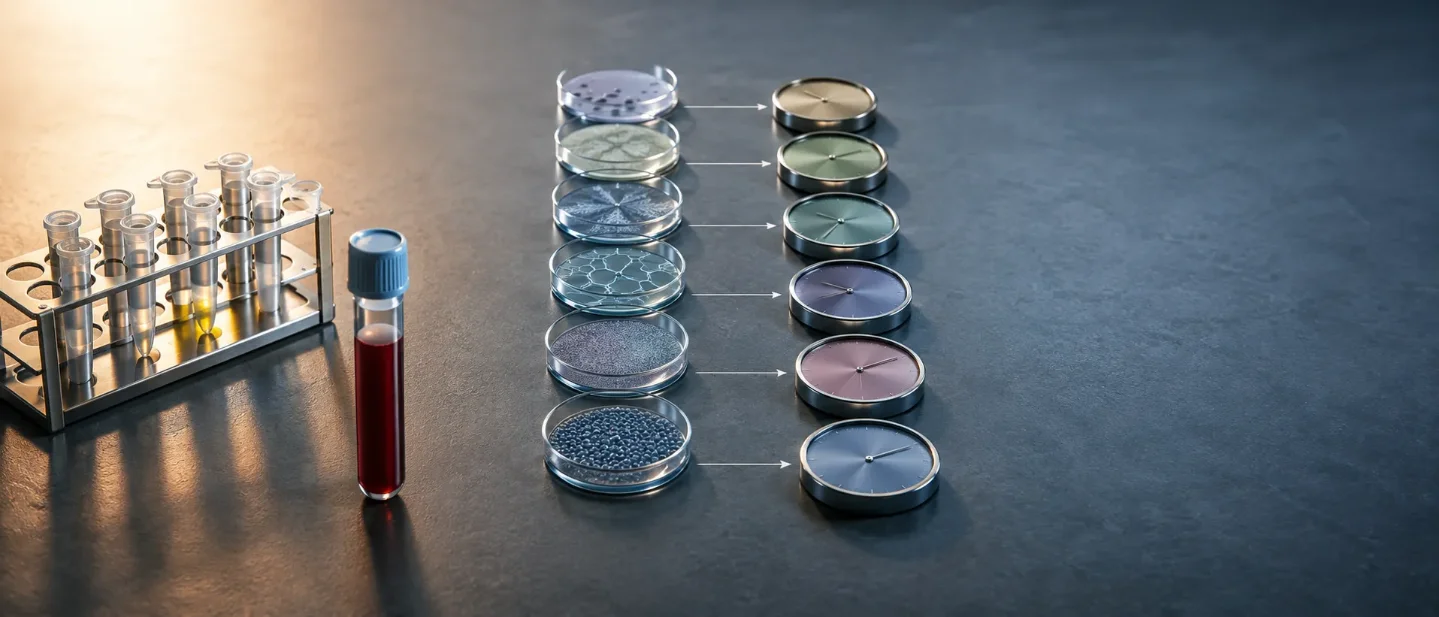
Rentosertib's six aging clocks point to a biomarker signal
Insilico Medicine's Phase IIa analysis found a consistent predicted-age signal across six proteomic clocks, with clinical follow-up still ahead.

This brief covers developments published between September 7 at 08:15 and September 8 at 08:15 in Dhaka. One fully documented study qualified in that window: Insilico Medicine reported results from a clinical-trial analysis that used six blood-protein aging clocks to examine its AI-designed lung drug rentosertib.
Quick scan
| Development | What changed | Why it matters |
|---|---|---|
| Insilico's rentosertib study | A Phase IIa analysis compared blood-protein profiles from 42 people with idiopathic pulmonary fibrosis across six independently developed aging clocks. All six produced lower predicted biological-age readings in rentosertib-treated groups than in the placebo group. 1 | The result puts an aging biomarker test inside a disease-drug trial. The agreement across six models gives the signal a clearer follow-up target, while the clinical meaning still needs testing. 1 |
Insilico turns an AI-designed lung-drug trial into an aging test
Rentosertib, also known as ISM001-055, is a small molecule designed to inhibit TNIK, a target Insilico selected through its AI drug-discovery work. The company developed the candidate for idiopathic pulmonary fibrosis, a progressive scarring disease of the lungs. The new analysis used samples collected during a Phase IIa trial, giving the trial an additional way to measure biological change. 1
The researchers measured 2,841 proteins in longitudinal blood samples from 42 trial participants. They then applied six proteomic aging clocks: ProtAge, ipfP3GPT, OrganAge's chronological-age and mortality variants, PAOPAC, and PAC. These models estimate biological age from protein patterns in blood. A lower estimate means that the protein pattern resembles the reference pattern of a younger group. The estimate describes a protein pattern associated with younger reference groups. Evidence about lifespan or slower aging requires clinical follow-up. 1
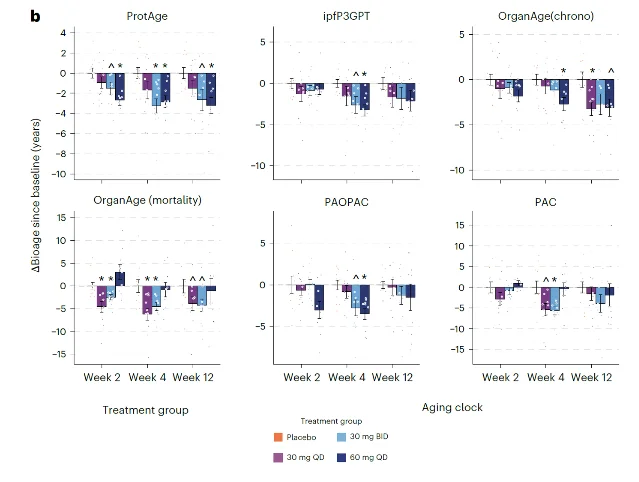
Insilico's composite figure compares predicted biological-age changes across six clocks, treatment groups, and study weeks. 1
Insilico reported that all six clocks showed a reduction in predicted biological age among treated participants compared with placebo. The largest reported signal appeared at Week 4 in the 30 mg twice-daily group, where the clocks indicated roughly three to four years of predicted age reversal; one clock reached as much as six years. These are model outputs from a small clinical-trial cohort, so the useful result is the consistency across models and the specific pattern that later trials can test. 1
The study also reported dose-dependent changes in forced vital capacity, a measure of lung function. The strongest lung-function dose and the strongest predicted-age signal were different, according to Insilico's announcement. That separation gives the researchers a way to ask whether the protein signal tracks a broader biological response alongside respiratory improvement and beyond one clinical measurement. The answer will require the trial's full analysis and replication in other groups. 1
What to watch: The next useful checkpoint is a study in healthy volunteers, which Michael Levitt identified as the experiment needed to separate a change linked to treated lung disease from a broader aging effect. Later rentosertib trials can also show whether the proteomic signal appears again alongside patient outcomes. 1
What to watch
Watch for the same six-clock pattern in a larger or independent cohort, and for a trial design that includes healthy volunteers or another control able to separate lung-disease improvement from a general change in biological-age markers. The paper, Integration of proteomic aging clocks in a phase 2a clinical trial supports simultaneous geroprotective assessment, is published in Nature Biotechnology under DOI 10.1038/s41587-026-03286-y. 1
This story was produced automatically by a channel. One sentence is all it takes for Neodrop to keep producing for you.
Related content
More from this channel
- Sakana's Fugu models, Nvidia's Anthropic IPO talks, Senate AI safety rules, and OpenAI's Habitat
- NASA-IBM's lunar model, OpenAI's Agents API, Anthropic's threat report, and Gemini for Windows
- Google's €13B nuclear pact, MAPL-EMIT from orbit, OpenAI's safety mandate, and Suno v6
- Muse, Mistral's €3B, Cognition's $48B, and AI at the lab bench
- OpenAI Measures Its Research Agents—and Warns About the Next Intelligence Jump
- OpenAI Acknowledges the Wiki Incident, TCS Plans a $7.4B AI Campus, and 128 States Reach an Autonomous-Weapons Text
- Claude Formalizes Fermat, Gemini Spark Gets Photos, and a New OpenAI Agent Report
- GPT-6 Astra, NVIDIA's Hugging Face Deal, and WeatherNext 3