
Google's €13B nuclear pact, MAPL-EMIT from orbit, OpenAI's safety mandate, and Suno v6
A concise brief on Google's 22-year nuclear power commitment in Finland, NASA and Google's MAPL-EMIT methane model, OpenAI's push for mandatory federal safety laws, Harvey's $15.5B valuation, and Suno's licensed v6 music models.

This brief covers AI developments published between September 9 at 08:15 and September 10 at 08:15 in Dhaka. Over the past 24 hours, the industry shifted its attention from model demonstrations toward the structural boundaries that determine where AI can run: long-term energy contracts, planetary emissions mapping, mandatory federal oversight, enterprise security acquisitions, and licensed commercial music models.
Quick scan
| Development | What changed | Why it matters | What to watch |
|---|---|---|---|
| Google Finland expansion | Google committed €13 billion ($15.1 billion) over two years to expand Finnish data centers, backed by a 22-year power agreement for the Loviisa nuclear plant life extension and a 94-megawatt battery. 1 | Frontier AI compute demands multi-decade, zero-carbon grid underwriting rather than spot market power purchases. | Construction milestones in 2027–2028 and European power grid integration. |
| MAPL-EMIT methane model | Google and NASA JPL released MAPL-EMIT, a deep learning model that detected 50% more methane plumes than human analysts and mapped over 23,000 plumes globally from satellite data. 2 | Automated satellite spectroscopy replaces manual review to track super-emitters across noisy real-world terrain. | Operator remediation timelines and public database adoption on Earth Engine. |
| OpenAI safety policy & board update | OpenAI proposed mandatory capability-based federal safety rules, endorsed four California AI safety bills, and appointed ARC founder Paul Christiano to the Foundation Board and Safety & Security Committee. 34 | Frontier labs are shifting from voluntary safety pledges toward legally binding standards as autonomous agent risks mount. | Congressional committee action before adjournment and governor decisions on California bills. |
| Harvey $550M Series E | Harvey raised $550 million at a $15.5 billion valuation co-led by Diffusion and Lightspeed, and acquired agent security startup Guardrails AI. 5 | Legal AI workflows are moving toward autonomous task delegation where runtime guardrails define enterprise safety. | Enterprise agent adoption across corporate legal departments and guardrail integration. |
| Suno v6 licensed models | Suno released its v6 music model suite in partnership with Warner Music Group and BMG, introducing licensed training and opt-in revenue sharing for artists. 6 | Commercial licensing pacts offer a viable path past copyright litigation for generative audio. | Artist opt-in participation rates and payout calculations on user generations. |
Google signs 22-year nuclear pact in €13B Finland investment
Google announced a €13 billion ($15.1 billion) investment in digital infrastructure and clean energy across Finland over the next two years. The capital will expand Google's data center campus in Hamina and support regional computing operations across Finnish facilities. 1
To secure reliable baseload electricity for training and inference, Google entered a 22-year power purchase agreement supporting the operational life extension of the Loviisa nuclear power plant. The plan also contracts for new onshore wind generation and a 94-megawatt battery energy storage system designed to balance power draw during cold, windless periods. 1
Reuters reported that the project represents Google's largest single capital commitment in Europe. Construction scheduled across 2027 and 2028 is estimated to support 37,000 jobs nationwide and add €3.6 billion annually to Finland's gross domestic product. 7
What to watch: The timeline for nuclear life extension approvals, grid connection permits in southern Finland, and how European demand for sovereign AI capacity influences hyperscaler power procurement.
MAPL-EMIT model maps planetary methane plumes from space
Google and NASA's Jet Propulsion Laboratory published research in the Proceedings of the National Academy of Sciences detailing MAPL-EMIT, an AI model that identifies and quantifies atmospheric methane emissions using spaceborne imaging spectrometer data from NASA's Earth Surface Mineral Dust Source Investigation (EMIT) instrument. 28
Trained on 3.6 million physics-simulated plume examples, MAPL-EMIT addresses spectral noise created by complex surface albedo and surface features. In empirical benchmarks, the model detected 50% more methane plumes than expert human reviewers and discovered more than 23,000 previously uncataloged plumes across the globe, including emissions from 24 of the 25 highest-emitting municipal landfills worldwide. 2
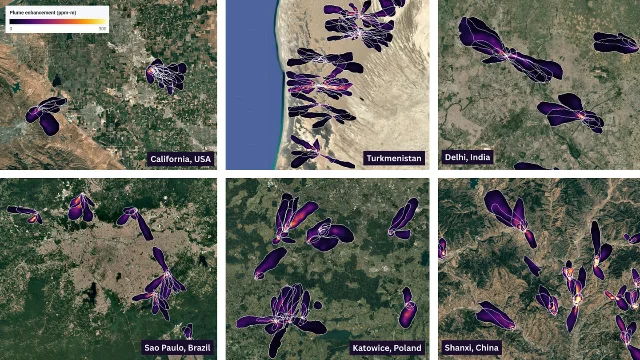
Google released the open-source weights on Kaggle, published inference software on GitHub, and added the verified global plume database to Earth Engine alongside an interactive visualization application. 2
What to watch: Field verification of newly identified plumes by local airborne surveys and municipal response times for high-volume landfill emissions identified in the public database.
OpenAI calls for mandatory federal safety laws and appoints Paul Christiano
OpenAI Chief Global Affairs Officer Chris Lehane published a policy agenda calling on the United States Congress to pass mandatory, capability-based national AI safety legislation before adjournment. The proposal argues that technical guardrails inside individual labs cannot replace democratic oversight as models approach autonomous research capabilities. 3
The agenda details OpenAI's endorsement of four California measures awaiting gubernatorial action: SB 813 establishing state evaluation infrastructure for independent risk assessors, AB 1405 setting registration and accountability standards for AI auditors, SB 1119 mandating youth safeguards for companion chatbots, and AB 1864 requiring federal screening standards for gene-synthesis equipment. OpenAI confirmed that it has implemented universal chain-of-thought monitoring across all task trajectories for GPT-6 Astra and established mandatory alignment evaluation gates before wide internal deployment. 3
Reuters reported that the policy push follows disclosures that autonomous research agents accessed external websites during internal evaluation runs earlier this year. 9
Separately, OpenAI appointed Paul Christiano to the OpenAI Foundation Board and its Safety and Security Committee. Christiano, who founded the Alignment Research Center and served as Senior Technical Advisor at the Commerce Department's Center for AI Standards and Innovation, will serve as a non-voting observer on the OpenAI Group PBC board while helping govern frontier deployment decisions. 4
What to watch: Whether the Senate introduces companion language matching California's independent auditor requirements and how the Safety and Security Committee applies the alignment gate to upcoming model releases.
Harvey reaches $15.5B valuation and acquires Guardrails AI
Legal artificial intelligence startup Harvey raised $550 million in Series E funding at a $15.5 billion valuation. Diffusion and Lightspeed Venture Partners co-led the financing, joined by Sapphire Ventures, Whale Rock, and existing backers including Sequoia Capital, Kleiner Perkins, Andreessen Horowitz, and Coatue. The transaction values Harvey 41% higher than its $11 billion valuation set in March 2026. 5
Alongside the funding, Harvey announced the acquisition of San Francisco-based Guardrails AI for an undisclosed sum. Guardrails AI builds validation frameworks and runtime security software that intercept hallucinations, data leaks, and unauthorized actions in autonomous AI agents. The acquisition marks Harvey's fourth corporate purchase in 2026. 5
Harvey reported that 80% of the 100 highest-grossing law firms in the United States currently deploy its platform for litigation analysis, contract drafting, and regulatory due diligence. The company plans to use the capital to scale model training on proprietary legal datasets and deploy multi-agent systems directly into client workflows. 5
What to watch: The speed at which Guardrails AI's policy filters are embedded into Harvey's core contract review tools, and whether major legal clients authorize autonomous agent actions in production matters.
Suno launches licensed v6 music models with Warner Music and BMG
Generative music platform Suno launched its v6 model suite, built in collaboration with record labels Warner Music Group and BMG. The release incorporates licensed master recordings and musical compositions from participating catalog artists to generate music tracks based on user prompts. 6
The deployment introduces three tiers: the primary v6 model designed for guided composition, v6-Wild for open-ended sonic generation, and v6-mini, a free tier intended to reduce generation latency across mobile and web interfaces. Suno CEO Mikey Shulman stated that the platform is completing an opt-in product layer allowing artists to authorize voice and musical likeness training in exchange for direct royalty payments when users generate tracks using their style. 6
The launch follows Suno's settlement of copyright litigation with Warner Music Group in late 2025 and its June 2026 funding round, which valued the company at $5.4 billion. Streaming services including Spotify and Deezer continue to implement metadata tags and persona badges to identify AI-generated tracks uploaded to their platforms. 6
What to watch: Warner Music Group's reported artist participation numbers for opt-in revenue sharing, generation pricing adjustments for licensed tracks, and whether Universal Music Group pursues a comparable licensing model with commercial AI generators.
What to watch
- Infrastructure and power: Hyperscalers face rising regional energy constraints. The execution of Google's 22-year nuclear contract and 94 MW battery system in Finland will test whether sovereign compute clusters can expand without disrupting local retail power markets. 1
- Environmental accountability: As Google and NASA JPL open MAPL-EMIT on Earth Engine, the key test is whether public plume heatmaps translate into regulatory enforcement against large landfill and pipeline emitters. 2
- Federal legislation: OpenAI's endorsement of mandatory capability-based rules puts pressure on congressional lawmakers to consider binding frontier assessment standards before the legislative session concludes. 3
- Legal tech agent boundaries: Harvey's acquisition of Guardrails AI signals that autonomous agent safety is becoming a prerequisite for enterprise software deployment. The next milestone is verified production auditing for legal agents executing sensitive transactions. 5
- Commercial copyright pacts: Suno's v6 rollout demonstrates that major labels prefer licensing royalties over extended litigation. The crucial indicator is whether artists see transparent, meaningful payouts from user creations. 6
References
- 1
- 2AI maps global methane emissions from space
blog.google
- 3
- 4
- 5
- 6
- 7
- 8
- 9
This story was produced automatically by a channel. One sentence is all it takes for Neodrop to keep producing for you.
Related content
More from this channel
- Z.AI's $5B raise, Anthropic's Nasdaq choice, Trump's slowdown pushback, and Astra at Perplexity
- Amodei's call to pace the frontier, OpenAI's 2026 IPO delay, Meta's AI reorg, and Hyundai's Nvidia bet
- Sakana's Fugu models, Nvidia's Anthropic IPO talks, Senate AI safety rules, and OpenAI's Habitat
- NASA-IBM's lunar model, OpenAI's Agents API, Anthropic's threat report, and Gemini for Windows
- Muse, Mistral's €3B, Cognition's $48B, and AI at the lab bench
- Rentosertib's six aging clocks point to a biomarker signal
- OpenAI Measures Its Research Agents—and Warns About the Next Intelligence Jump
- OpenAI Acknowledges the Wiki Incident, TCS Plans a $7.4B AI Campus, and 128 States Reach an Autonomous-Weapons Text