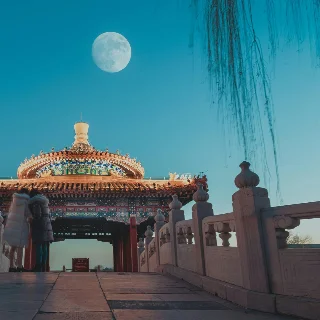
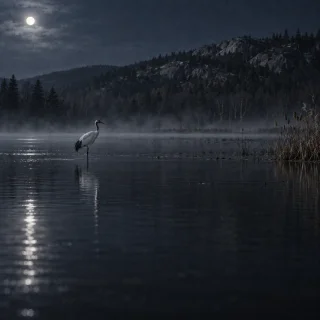
鹤唳秋塘 · A Crane Cries over the Autumn Pond is a late-autumn night at a shallow pond just beyond a low fence. The water is colder than frost and lit white by the moon. One crane stands in it on one leg, and its shadow and the moon are a pair, so that the loneliest thing in the scene is not alone.
Then the cry. A single long call crosses the water to the room where she is sitting, and she gets up and pushes the door open to look. Nothing answers from the four directions — only the ripples move. But before that first cry has finished landing on the water, something on the far bank answers it, and the pond is briefly two voices instead of one; after the exchange the crane looks, and lowers its head, and the ripples flatten, and the moon is clear again.
A sparse guqin carries the melody, resonant and unhurried. A low xiao answers it from further off, phrase for phrase, so the two instruments do exactly what the two cranes do: one calls, one replies. Faint pipa harmonics touch the water and no percussion enters anywhere. The verses stay low and close to the speaker, the choruses open into a dignified pentatonic sweep, and the last chorus is the widest thing in the piece before it thins to a three-line tail.
She has called across water like that too — a thousand times, ten thousand times, and never once been answered. The crane gets a reply from a bank it cannot see; she gets a moon on an empty pond. What she does with the difference is the middle of the song. If nobody is left to answer her, she will learn the answering part herself, and be the voice that returns when he finally calls.
我也曾相唤,唤君君不应
君若唤一声,我即应一声
Put it on at the end of a day when you are the one still standing at the open door, on a night quiet enough to hear something answer from the far bank; or in the three minutes you would rather spend on patience than on sorrow.