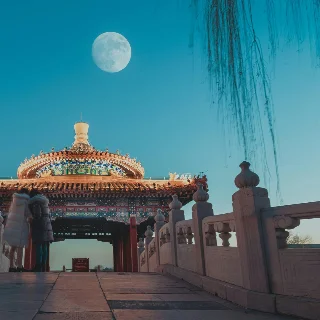
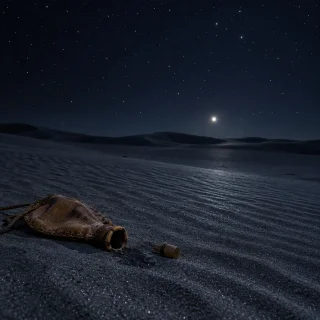
孤星度碛 · A Lone Star Across the Waste is one night in the eight-hundred-li Moheyan waste west of the Jade Gate, where Xuanzang — the Tang monk who left Chang'an in 629 to bring the scriptures back from India 1 — is alone on the sand and has just lost the last of his water. The skin lies tipped on its side, the stopper out, and the sand has already drunk what was left in it.
He turns the horse back east. Home is under ten li away and there is a spring at the end of it. Ten li into the turn he stops, because he once swore that he would not take one step east before he had gone all the way west, and that vow is the only thing water cannot buy back 2.
So he rides west again, into sand where nobody walks and the bones of those who tried lie under it. He steers by one low star, and lets the dead be the road. The chorus turns the choice over line by line: the west he might die in, the east he will not live in.
A sparse plucked konghou carries the melody, its notes left to ring out into the empty air. A low breathy xiao answers under the verses like wind moving across open sand, faint high guqin harmonics touch the starlight, and no drum enters anywhere. The verses stay low and close to the breath, the choruses open into a wide pentatonic sweep, and the last chorus is the widest thing in the piece before a thin four-line tail over one repeated konghou string.
宁向西边死
不向东边生
Put it on for the last stretch of a long drive, at the hour when turning back would be reasonable and something in you refuses; or late at night, when the road ahead is emptier than the one behind.