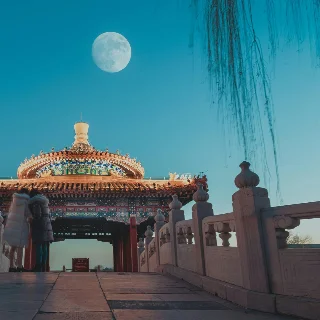
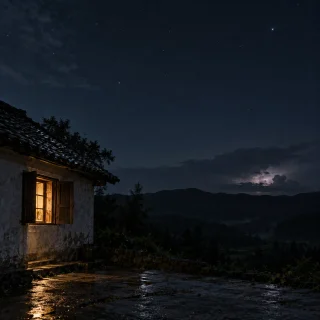
雷始收声 · When Thunder Withdraws Its Voice is one midnight at the foot of the southern hills, when a single roll of thunder passes over the roof and no rain follows it.
That one roll is the year's last. The old almanac of the seasons puts the thunder's final word at the autumn equinox, in the middle of the eighth month; after that turn the sky keeps quiet, and it is not heard from again until the spring rain returns 1. The equinox carries three signs in order — the thunder withdraws its voice, the insects seal up their burrows, the water begins to shrink 2. This song stays with the first of them.
So she gets up, sits by the window, and waits for the clouds to pass until the hills come clear. She keeps count: one roll going out over the hills, one going into the cloud, and by the third nothing answers from inside it. The chorus asks when the thunder returns and answers itself — its return is the spring rain. In the second verse the insects thin out night by night and the stream runs lower, and the bridge states what that comes to: everything with a voice puts it away in turn, and the threshold grows quieter for it.
The arrangement holds the same restraint. An erhu carries the melody in long slow bows left to die away into open air; once or twice a low bowed swell stands in for the distant thunder, far off and unemphatic; sparse guqin harmonics sit under the verses, a soft low sheng opens under the choruses, and a low xiao answers in the bridge. No drum enters anywhere. The verses stay low and close to the breath, the choruses open wider, and the last chorus is the widest point in the piece before a thin four-line tail.
天不曾作别
只把声收起
Put it on late, with a window open, on the first night the air turns colder than you expected — or for the last stretch of a drive home after the last warm day of the year.