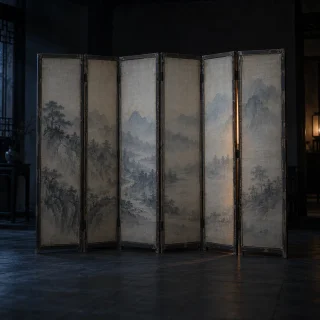
屏山不移 · The Painted Hills Do Not Move is a late-autumn night in an empty inner room. A six-panel folding screen of pale silk is wiped down and opened to face the hall. Painted on the silk in thin ink: layered ridges, and a narrow track coiling at the foot of the hills, running off into the mist. Long after dark she sits before it and walks the painted road with her fingertips — the hills on the screen are a hand's width away, the hills he crossed are not.
A low dizi carries the melody, breathy and cold, like wind working through a room before anyone speaks. Sparse guqin is plucked under the verses, faint pipa harmonics enter at the bridge, and no percussion comes in at all. The verses stay close and low; the choruses open into a dignified pentatonic sweep, then thin back to a sparse tail.
The turn comes in the middle of the night. Whoever laid this silk meant only to paint the hills in front of him, and could not have known that someone would one day search those same ridges for a person. What was scenery has become the only place where the journey is still visible.
屏上关山近,只在十指间
天外关山远,一步隔千山
Listen at the end of a day when someone is far away, on a night quiet enough to hear the distance; or in any three minutes you would rather spend on patience than on sorrow.