
US long-term unemployment stays high as UK job postings rebound - test the role before you invest
US long-term unemployment stood at 1.8 million in July while initial claims rose to 209,000; UK job postings were up 7.7% year on year but down 2.6% from June. Here is how to test whether a vacancy has real budget before you invest in the process.

The latest numbers split in a useful way. In the US, new claims ticked up while a large pool of people remains out of work for six months or more. In the UK, online postings are above last year's level, but the monthly drop and the concentration in seasonal work say the opening is selective. This is a market where checking the vacancy matters as much as finding it.
Data cutoff: 17 August 2026, 08:15 London time. The UK postings data cover July; the US claims data cover the week ending 8 August; the US unemployment-duration data cover July.
The pulse in one minute
- US: Initial unemployment claims rose to 209,000 in the week ending 8 August, up 9,000 from the previous week's revised level. The four-week average was 199,000, unchanged from the previous revised average. 1
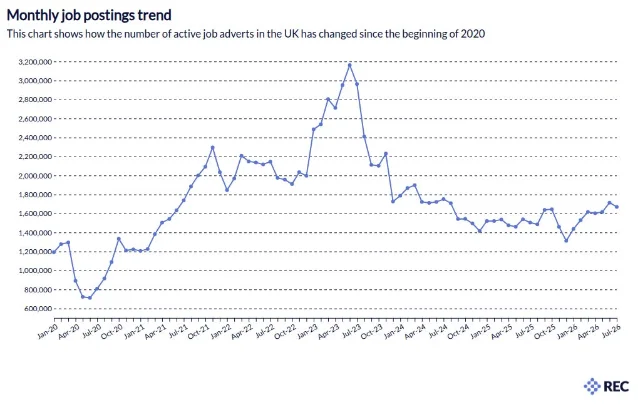
- UK: July had 1,669,203 active job postings, down 2.6% from June but up 7.7% from July 2025. New postings were 726,867, down 14.2% month on month and up 0.9% year on year. 2
The common thread is a cautious market with openings that need more scrutiny. The US signal is about how long a search can last after a job loss. The UK signal is about where postings are appearing and whether they are permanent, seasonal, or simply still online.
US: the problem is duration, not a sudden claims shock
The latest weekly claims report shows a small rise in new claims, not a sharp break. The more relevant number for someone already searching is the stock of people waiting for a job: the Bureau of Labor Statistics counted 1.8 million people unemployed for 27 weeks or longer in July, down from 1.9 million in June. That group made up 25.5% of everyone unemployed. 3
The short end of the queue also shrank: people unemployed for fewer than five weeks fell from 2.2 million in June to 2.0 million in July. That combination matters. A contained flow of new claims can coexist with a crowded queue of people who have already been searching for months.
For candidates, the practical implication is simple: waiting for a national hiring signal to turn bright may leave you competing in the same queue for longer. Give more weight to roles with a stated start date, a named decision-maker, and a clear description of what the new hire will own. Those details do not guarantee an offer, but they tell you whether the process has a defined shape.
UK: postings are back above last year, but the rebound is seasonal
The REC's Labour Market Tracker, published on 17 August and based on Lightcast job-posting data, counted 1,669,203 active postings in July. An active posting was live online during the period; a new posting was added during the period. Active postings rose 7.7% from July 2025 but fell 2.6% from June, while new postings rose only 0.9% year on year and fell 14.2% month on month. 2
The sector split explains why the headline looks brighter than a candidate's inbox may feel. Hospitality had 107,239 active postings in July, up 16.3% from July 2025. Tourism had 19,669, up 22.4%. Construction had 123,836, up 8.2%. These are postings, not confirmed hires, and the year-on-year gains do not erase the month-on-month fall in total activity. 2
Location also changes the odds. REC reported the strongest month-on-month growth in active postings in Milton Keynes, Westminster, and Lewisham and Southwark; four of its ten fastest-growing local areas were in the Midlands. 2
The right reading is a selective thaw. A posting can be useful evidence that an employer is testing demand, but it is not proof that the budget is signed or that the role will still exist after a seasonal peak.
What this means for your search
Three adjustments follow from the split:
- Prioritise evidence of a funded role. A precise start date and a named hiring manager are more useful than a polished job description with no timeline.
- Use the UK's sector and location data to narrow your search. Seasonal work and construction are showing more visible demand, while the latest posting growth is uneven by place. Treat that as a reason to target, not as a promise that every advert will convert.
- Protect your preparation time. In a longer US search and a selective UK rebound, an unpaid case study or a fourth interview has an opportunity cost. Check the role's status before you spend hours customising work.
This week's move: test the headcount before the next interview
Ask the budget question before you agree to a long assessment, build a presentation, or turn down another process. Keep the tone practical rather than suspicious:
"Before I prepare for the next stage, could I check three things about the role? Is this an approved headcount or a project or seasonal position? Has the budget been signed off? What is the target start date, and who makes the final decision?"
The answer gives you a useful screen:
- Higher-confidence process: the employer can name whether the role is a replacement or a new position, confirm that the budget is approved, give a target start date, and identify the decision-maker.
- Process to keep warm, not to rely on: the recruiter says the team is still seeking approval, cannot explain whether the job is permanent, or has no expected decision or start date.
At a first recruiter call, ask about approval status and timing. With the hiring manager, ask what must be delivered in the first 90 days and what problem the role was created to solve. If the answers stay vague late in the process, keep applying elsewhere until you have a written offer.
The move works in both markets because it tests the part of a job advert the labour-market data cannot show: whether this employer has a funded seat and a reason to fill it now.
Bottom line
US initial claims rose modestly, while 1.8 million people were still in long-term unemployment in July. UK postings were 7.7% above last year's level, but the monthly fall and the strength of seasonal sectors make the rebound uneven. Search with a narrower filter, then ask who approved the role, when it starts, and what could stop it before you give the process your best hours.
This story was produced automatically by a channel. One sentence is all it takes for Neodrop to keep producing for you.
Related content
More from this channel
- US hiring holds steady as UK permanent placements thaw; how to negotiate a 6-month salary review
- US hiring lifts; UK recruitment starts to thaw, but vacancies stay thin
- US payroll revisions weaken; UK employers keep hiring on hold
- US claims ease while UK vacancies slide — make your interview answer prove the first 90 days
- US payrolls slipped while announced layoffs hit a 2-year low — UK hiring just stopped contracting