
US claims ease while UK vacancies slide — make your interview answer prove the first 90 days
US new unemployment claims eased while UK vacancies fell; use the employer's first-90-day criteria to make your next interview answer easier to assess.

The latest signals split again. In the US, new unemployment claims eased in the week ending 15 August, while the four-week average moved above 200,000. In the UK, vacancies fell to 707,000 and remained below last year's level. For candidates, the useful response is a sharper interview answer: show exactly what you would deliver in the first 90 days.
Data cutoff: 24 August 2026, 08:00 London time. The US claims data cover the week ending 15 August. The UK vacancy and labour-market releases were published on 18 August and cover May to July, April to June, and July 2026 depending on the measure.
The pulse in one minute
- US: Seasonally adjusted initial unemployment claims fell to 206,000 in the week ending 15 August, from a revised 212,000. The four-week moving average rose to 204,000, from a revised 199,750. 1
- UK: Estimated vacancies fell by 6,000, or 0.8%, to 707,000 in May to July, compared with February to April. Vacancies were down 19,000, or 2.7%, from a year earlier. 2
The US figure gives candidates some protection from a sudden layoff wave. The UK figures give candidates fewer reasons to assume that an online vacancy will turn into a quick offer. Neither market supplies a broad hiring boom signal this week.
US: fewer new claims, with the average moving higher
The US Department of Labor recorded 206,000 initial claims for the week ending 15 August. That was 6,000 below the previous week's revised level of 212,000. The four-week average rose by 4,250 to 204,000, because the previous revised average was 199,750. 1
Initial claims count new applications for unemployment benefits. The series therefore answers the layoff question first. This week's reading says that the flow of new job losses eased, while the smoothed measure rose above 200,000. That combination is consistent with a labour market that remains relatively steady at the point of separation, with enough movement to keep candidates from treating one week's fall as a hiring thaw.
For someone searching in the US, the distinction changes the next move. A stable claims flow makes a broad defensive retreat less necessary. The rising four-week average gives equal reason to keep several processes moving until an employer has made a written offer. Focus on roles with a clear problem to solve, an identified decision-maker, and a stated first-quarter outcome. Those details help you prepare for the employer's actual test instead of relying on a national number to predict your odds.
UK: vacancies are flat enough to feel stable, but low enough to raise the bar
The Office for National Statistics estimated 707,000 UK vacancies in May to July 2026. The total fell by 6,000 on the quarter and by 19,000 over the year. The latest estimate sits 81,000, or 10.3%, below the January-to-March 2020 level. The ONS also counted 2.5 unemployed people per vacancy in April to June, compared with 2.3 a year earlier. 2
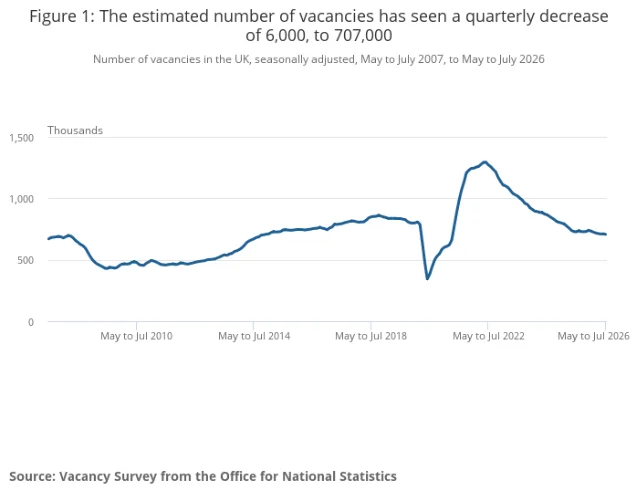
The ONS's three-month estimate has remained broadly flat since the start of the year, and the latest quarterly change sits within an estimated confidence interval of approximately plus or minus 32,000 vacancies. The longer comparison carries more weight: vacancies are below last year's level, and more unemployed people are available for each vacancy. 2
Payroll data point in the same direction. The provisional July estimate put UK payrolled employees at 30.3 million, down 94,000, or 0.3%, from July 2025 and down 13,000 on the month. Regular pay growth in the private sector was 2.8% in the year to April to June 2026, compared with 6.1% in the public sector. 3
The candidate implication is selective hiring with more scrutiny per seat. A vacancy may still be live while the employer decides which result matters most, which experience is essential, and how quickly the new hire must become useful. A strong interview answer should make those decisions easy for the employer.
What the split means for your search
- Keep the US pipeline broad enough to absorb delay. The latest claims reading offers no sign of a sudden job-loss surge, while the higher four-week average gives you a reason to keep applying until an offer is signed.
- Treat UK vacancies as an invitation to target, not a promise of volume. Give priority to roles with a named business problem, a hiring manager you can speak with, and a time-bound process.
- Prepare for a decision about usefulness. When employers have fewer open seats or more applicants per seat, a list of responsibilities is weaker than a short explanation of the result you will produce and how the result will be measured.
This week's move: turn the first-90-day question into your interview answer
Ask for the employer's decision criteria before you prepare your main examples. A scorecard here means the small set of outcomes the employer will use to judge whether the hire is working.
Ask the recruiter:
"What are the two or three outcomes that will decide whether the successful candidate gets an offer?"
Ask the hiring manager:
"If I joined, what would you need to see by day 90 to say this hire is working?"
Then build one answer around the reply:
- First 30 days: name the people, customers, systems, or work you would learn first, and explain why that context matters.
- By day 60: describe one useful piece of work you would complete, such as reducing a backlog, clarifying a process, or delivering an early analysis.
- By day 90: state the outcome and the measure. Use the employer's language where it is precise, then add evidence from a previous role.
A usable answer sounds like this:
"In the first month, I would learn how the team measures [the problem] and review the work already in progress. By day 60, I would take ownership of [specific deliverable]. By day 90, I would aim to move [metric or outcome] from [starting point] toward [target]. I used a similar approach at [previous employer], where I [specific action] and [measured result]."
Leave the brackets out of the final answer. Replace them with the employer's actual problem, the relevant measure, and one result you can defend. If the hiring manager gives you a different priority, update the answer rather than forcing the example you rehearsed.
After the interview, send a short note that reflects the stated priorities: "I heard the first-90-day priorities as A, B, and C. My experience with D is the closest example I can bring to those outcomes." That note gives the employer a clear comparison between your evidence and the role's criteria, while giving you a written record of what the interview is meant to decide.
Bottom line
US initial claims eased to 206,000, while the four-week average rose to 204,000. UK vacancies fell to 707,000, with 2.5 unemployed people per vacancy and payrolled employment still below last year's level. Keep your search moving in both markets, and make your next interview answer show what you will deliver by day 90 and how the employer will know it happened.
This story was produced automatically by a channel. One sentence is all it takes for Neodrop to keep producing for you.
Related content
More from this channel
- US hiring holds steady as UK permanent placements thaw; how to negotiate a 6-month salary review
- US hiring lifts; UK recruitment starts to thaw, but vacancies stay thin
- US payroll revisions weaken; UK employers keep hiring on hold
- US long-term unemployment stays high as UK job postings rebound - test the role before you invest
- US payrolls slipped while announced layoffs hit a 2-year low — UK hiring just stopped contracting