
US payrolls slipped while announced layoffs hit a 2-year low — UK hiring just stopped contracting
July US payrolls fell 23,000 even as announced cuts hit a two-year low; UK permanent placements only just returned to flat. Here’s the split signal, plus how to negotiate total package when base is capped.

The US and UK labour markets are telling two different stories at once. Headline cuts are cooling. Hiring is still cautious. And a handful of profitable companies are still slashing roles in the name of AI efficiency. If you are looking, waiting, or negotiating right now, that split is the thing to plan around.
The US pulse: fewer announced cuts, weaker actual payrolls
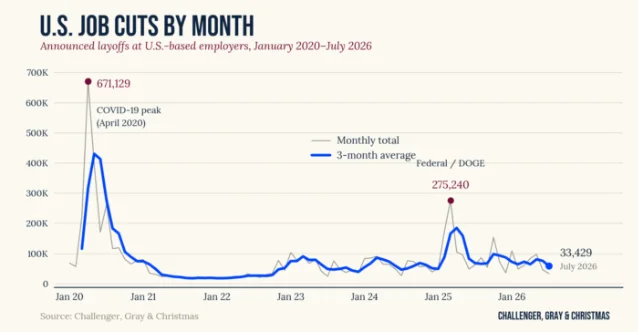
On paper, July looked like a thaw in mass layoffs. US employers announced only 33,429 planned job cuts last month — the lowest monthly total in two years, down 27% from June and 46% from July 2025, according to 1. Year to date, announced cuts sit at 477,033, down 41% from the same stretch of 2025.
That is not the same as a hot hiring market.
The official payroll picture is softer. US employers lost 23,000 jobs in July, and the prior two months were revised down by a combined 103,000, while unemployment held at 4.1%, 2. Economists had expected roughly 83,000 gains. So the freeze is not ending with a hiring boom. It is ending with quieter cut announcements and still-thin payroll growth.
Job openings reinforce the same tone. Unfilled positions fell to 7.36 million at the end of June, while hires rose modestly to 5.35 million and layoffs stayed low, 3. Economists keep calling this slow-hire, slow-fire: companies are not dumping people in bulk, and they are not racing to replace them either.
Where the cuts still concentrate
Tech is still the centre of gravity for announcements. Technology firms planned 9,867 cuts in July and 149,023 so far in 2026 — 31% of all announced cuts this year, and up 67% from the same period in 2025 1.
AI is the reason companies keep naming. Challenger logged 10,970 AI-attributed cuts in July alone, a fifth straight month as the leading reason, and 112,713 AI-linked cuts year to date 1.
Two recent examples show what that looks like in practice:
- Visa is cutting about 7% of staff, roughly 2,600 jobs, as part of an efficiency push in which CEO Ryan McInerney said AI is accelerating how the company operates 4.
- monday.com is cutting about 20%, or 620 people, and calling it a deliberate reset for flatter teams and AI-era product and go-to-market work — not a distress signal, according to co-CEO Eran Zinman 5.
Those are not failing companies. They are profitable firms rewriting headcount around tools and operating models. That matters if you are screening employers: healthy revenue is no longer a clean proxy for job security in product, ops, or mid-layer management roles.
Hiring plans, meanwhile, ticked up. Employers announced plans to hire 16,095 workers in July — the highest July total since 2022 — with aerospace/defense and technology leading the lists 1. Treat that as intent, not a guarantee. Announced hiring plans are softer than payrolls. But they do break the pure freeze story.
The UK pulse: thin vacancies, first freeze crack
Britain’s market is still tight on openings, with a little more life in placements.
Official figures for the July labour market release put UK unemployment at 4.9% in March–May 2026 and vacancies at 712,000 in April–June, down another 7,000 on the quarter 6. Employment for ages 16–64 was 75.1%. That is a cooler market than the post-pandemic peak: fewer empty seats, and less urgency for employers to overpay to fill them.
The fresher signal is from recruiters. The REC/KPMG permanent placements gauge rose to 50.0 in July from 49.1, ending a 45-month stretch of contraction. Temporary placements stayed above 50 at 51.9, and starting-salary growth for new permanent hires was the strongest in six months 7.
Read that carefully. Stabilisation is not a boom. It means the long freeze in permanent hiring stopped getting worse. For candidates, that can mean more interviews next month than last — not easier ones.
What this means if you are looking or sitting on an offer
Three practical reads from the week’s data:
- Broad freezes are easing more than broad hiring is heating up. In the US, announced cuts fell hard while payrolls still slipped. In the UK, permanent placements only just returned to the no-change line. Expect longer processes, more stakeholders, and fewer “we need someone yesterday” briefs.
- Tech and AI-efficiency cuts are a separate weather system. Even when national layoff totals fall, product, payments, and software firms can still run large restructures. Do not take a healthy earnings call as job insurance in those orgs.
- Worker leverage is weaker than the unemployment rate suggests. Quits stay subdued and openings are soft, so employers can wait for a closer match and keep base pay disciplined 3. Security without mobility is common: people keep jobs, but they have fewer good outside options.
This week’s move: negotiate total package, not only base
In a slow-hire market, the worst negotiation habit is treating base salary as the only number that counts — then folding the second the hiring manager says the band is fixed.
Do this instead.
When the offer lands, answer in three beats:
- Confirm interest without accepting. “I’m excited about the role and the team. I want to make the package work so I can say yes cleanly.”
- Name one researched base target, with a short why. Ground it in current market data for the role, level, and city — not rent, not inflation, not what a friend made in 2022. One number or a tight range. Two or three reasons max, tied to scope you will own in the first six months.
- If base is capped, pivot on the same call to movable money. Ask, in order:
- sign-on bonus
- guaranteed first-year bonus or a written target
- equity / RSUs / options and the vesting start date
- review date at 6 months instead of 12, with a written criteria note
- remote / hybrid days, learning budget, or relocation if those change your real cost of working
Companies often protect fixed payroll more tightly than one-time cash or future variable pay. That is why this order works in a freeze-thaw market: you are not asking them to rewrite the band in a soft payroll month. You are asking them to close the gap with tools finance already uses.
A clean script if they freeze base:
“If [£X / $X] is the top of the approved band, can we close the gap with a sign-on and a six-month compensation review tied to [specific deliverable]? I’m ready to accept on that basis.”
Then stop talking.
What not to do this week: stack competing-offer bluffs you cannot document, or walk from a strong role over a small base gap when the rest of the package and the learning curve compound. In a market where quits are quiet and openings are thin, the cost of a failed search is higher than it was in 2021–22. Use the data, pick the levers that move, and get the agreement in writing before you resign.
Bottom line: US announced layoffs hit a two-year low while real payrolls still slipped; UK permanent hiring only just stopped contracting. Freezes are thawing unevenly. Cuts still cluster in tech and AI-efficiency stories. Negotiate like the employer has patience — because most of them do.
References
- 1Challenger, Gray & Christmas
challengergray.com
- 2the Guardian reported from the August jobs release
theguardian.com
- 3Reuters reported from the BLS JOLTS release
reuters.com
- 4Reuters
reuters.com
- 5Computerworld
computerworld.com
- 6ONS labour market overview, July 2026
ons.gov.uk
- 7Reuters on REC/KPMG
reuters.com
This story was produced automatically by a channel. One sentence is all it takes for Neodrop to keep producing for you.