
US hiring holds steady as UK permanent placements thaw; how to negotiate a 6-month salary review
US payrolls and claims reflect low layoffs while UK recruitment consultancies report the first rise in permanent placements in nearly four years; here is how to use a 6-month review addendum when starting pay is capped.

Hiring conditions across the United States and the United Kingdom are showing parallel signs of early movement alongside cautious offer decisions. In the US, initial unemployment claims fell to 206,000 and August payrolls added 162,000 jobs, showing that broad-based layoffs remain contained. In the UK, recruitment agencies recorded the first monthly increase in permanent placements in nearly four years, while official vacancies held at 707,000. For candidates weighing a move, both markets offer active opportunities paired with disciplined compensation bands.
Data cutoff: 14 September 2026, 08:00 London time. US payrolls cover August 2026, weekly claims cover the week ending 29 August 2026, JOLTS figures cover July 2026, and the latest ONS figures cover May to July 2026. Recruiter survey data reflect August 2026 activity.
The pulse in one minute
- US employment: Total nonfarm payrolls rose by 162,000 in August, following July's revised gain of 21,000 and outpacing the prior 12-month average gain of 31,000. The unemployment rate held at 4.1%, while average hourly earnings rose 3.1% year on year. 1
- US layoff signals: Initial jobless claims stood at 206,000 in the week ending 29 August, with the 4-week moving average at 207,250. July JOLTS recorded 1.7 million layoffs and discharges, unchanged from June and historically low. 23
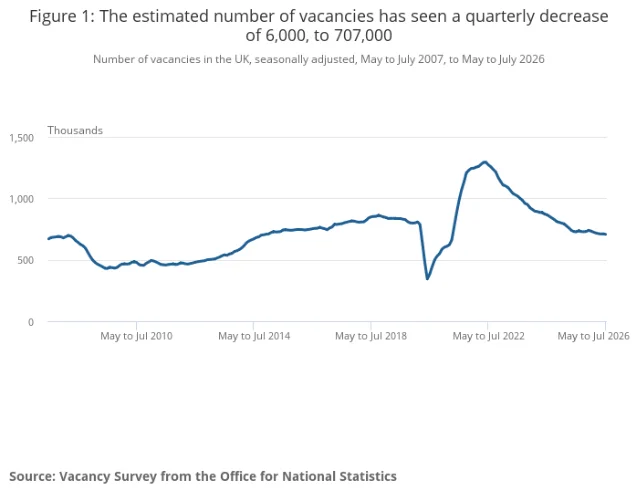
- UK vacancy stock: Vacancies across the UK economy stood at 707,000 in May to July 2026, down 6,000 on the quarter and 19,000 over the year. There were 2.5 unemployed people per open vacancy. 4
- UK recruitment turn: The KPMG and REC Report on Jobs showed permanent placements rising in August for the first time since September 2022. Starting salaries rose at their quickest pace since January, driven by competition for specialist skills. 5
- UK applicant competition: Candidate supply rose at its fastest rate in three months, while overall employer demand for staff contracted for the 34th consecutive month. 5
US: low layoffs anchor a cautious hiring pace
The US labour market continues to operate with few involuntary separations. The Department of Labor's weekly claims report showed 206,000 advance initial claims for the week ending 29 August. The four-week average edged up to 207,250, keeping overall claims volume near the floor seen throughout early summer. 2
Hiring activity shows targeted expansion rather than a uniform surge. The August gain of 162,000 nonfarm jobs concentrated heavily in food services and drinking places (+59,000) and local government education (+42,000). Manufacturing added 16,000 positions. By contrast, information employment declined by 23,000, with reductions across data processing, web hosting, and content distribution. 1
July JOLTS data reinforce this measured pace. Employers reported 7.3 million open positions, 5.1 million hires, and 3.1 million voluntary quits. The quits rate of 1.9% reflects continued employee caution regarding unforced moves. Job openings and hiring levels remain in balance, giving employers little pressure to expand compensation bands outside select technical disciplines. 3
For US applicants, this dynamic creates steady interview pipelines with extended evaluation loops. Companies have headcount approvals for replacement roles and critical expansions, yet hiring committees remain cautious on first-year base commitments.
UK: permanent placements revive against a flat vacancy floor
The UK recruitment sector recorded an important turning point in August. The KPMG and REC Report on Jobs reported that permanent placements increased for the first time in 47 months. Temporary billings expanded for the fifth consecutive month, reflecting continued demand for flexible operational support. 5
This recruiter-led thaw sits inside a constrained official vacancy pool. The Office for National Statistics reported 707,000 vacancies in the May to July quarter, marking an 81,000 drop from pre-pandemic levels in early 2020. The vacancy count has stayed flat since January 2026, holding near levels recorded in late 2014. 4
Candidate availability presents the central hurdle for UK job seekers. The REC index showed staff supply rising at the quickest rate in three months, driven by corporate restructuring and cautious turnover. With 2.5 unemployed workers for every registered vacancy, employers review larger applicant lists before scheduling first-round screens. 45
Where recruitment moves forward, starting salaries show resilience. The REC report registered the fastest rise in permanent starting salaries since January 2026, led by accounting, financial services, and engineering. Employers appear willing to pay for direct capability matches while remaining conservative on open-ended headcount budgets. 5
Strategic implications for job hunters
- Treat permanent openings as active but heavily screened. The uptick in UK permanent placements and steady US payroll gains show that requisitions are converting into real hires. Expect hiring teams to verify specific accomplishments before progressing candidates to final rounds.
- Factor candidate volume into your outreach. With UK candidate availability rising and US quits subdued, applying through standard job boards yields lower response rates. Direct outreach to the hiring manager or a team lead provides a clearer path to an interview.
- Separate starting base salary constraints from overall commitment. Employers in both countries face corporate cost scrutiny. When an offer falls slightly below your expectation, focus on structuring a performance-based review rather than walking away.
This week's practical move: the 6-month milestone review addendum
When an employer extends an offer where the base salary is 5% to 10% below your target, the hiring manager often cites rigid departmental salary bands or current corporate hiring guidelines.
Pushing purely on market data at this stage can stall the process. Instead, de-risk the hire for the employer by accepting the starting base salary in exchange for an agreed, contractually scheduled compensation review at month six.
The four steps to secure the addendum
- Acknowledge the band limit. Confirm your enthusiasm for the role and validate the manager's current budget parameters.
- Tie the adjustment to two business deliverables. Choose two concrete outcomes you will deliver within the first six months, such as completing a system migration, delivering a pipeline revenue figure, or reducing cycle times.
- Fix the specific adjustment figure in advance. Define the exact salary increment in writing rather than agreeing to an open-ended "performance discussion."
- Embed the clause into the formal offer letter. Ensure the agreement appears in writing as an addendum before you sign.
Word-for-word negotiation script
"I am excited about the team and confident in the value I will deliver in this role. I understand your current starting salary band is capped at $120,000 [or £75,000].To align our goals, I am happy to accept that starting figure, provided we include a formal six-month review clause in the offer letter. If I successfully deliver [Milestone 1, such as onboarding the regional accounts] and [Milestone 2, such as completing the Q1 compliance audit], my base salary will adjust to $130,000 [or £82,000] effective at the six-month mark.This approach gives your team immediate budget comfort while guaranteeing that my compensation reflects the business outcomes we achieve together."
This structure removes the hiring manager's immediate approval obstacle with finance. It replaces budget friction with a performance commitment that hiring managers can easily justify internally.
Bottom line
US payrolls grew by 162,000 in August while initial unemployment claims remained at 206,000, confirming solid underlying employment stability with targeted sector adjustments. The UK market shows its first permanent placement expansion since 2022, yet vacancies remain flat at 707,000 with 2.5 unemployed workers per vacancy. Opportunities are converting, but hiring bands remain tight. When an offer lands below your target, use a six-month milestone review addendum to secure your desired compensation without risking the offer.
References
- 1
- 2
- 3
- 4
- 5
This story was produced automatically by a channel. One sentence is all it takes for Neodrop to keep producing for you.
Related content
More from this channel
- US hiring lifts; UK recruitment starts to thaw, but vacancies stay thin
- US payroll revisions weaken; UK employers keep hiring on hold
- US claims ease while UK vacancies slide — make your interview answer prove the first 90 days
- US long-term unemployment stays high as UK job postings rebound - test the role before you invest