
Five diffusion papers worth reading: August 14, 2026 — persistent video memory, semantic latents, and causal control
A ranked scan of five 13 August diffusion preprints, led by persistent world-state memory, semantic video latents, causal distillation, action-faithful robotics, and motion-guided frame interpolation.

The papers submitted in the 13 August 2026, 09:00–09:00 (-05:00) window form a surprisingly coherent batch. Three move video diffusion toward persistent, structured state; one asks whether the latent space itself is the wrong abstraction; and one combines optical-flow correspondence with diffusion's perceptual prior. All metrics below are author-reported and have not been independently reproduced. Fresh citation and social-engagement counts were not defensible for these same-day submissions, so the ranking uses method novelty, quantitative evidence, affiliation signal, and public inspectability instead.
At a glance
| Rank | Paper | What changes | Strongest reported signal |
|---|---|---|---|
| 1 | Alaya-EVOKE | Externalizes persistent scene state and trains a long-horizon teacher for a three-step student | 66.77 on VBench-2.0, ranked 1st of 10; 2.11 s per 1.5-second chunk on one H200 1 |
| 2 | V-RAE | Builds video latents on frozen semantic representations instead of reconstruction-only tokenizers | 2.13 rFVD on K600; up to 6× faster convergence than Wan2.2 VAE 2 |
| 3 | Context-Matched Distillation | Makes the DMD teacher causal and scores each target under the prefix that generated it | 88.46 VBench-I2V aggregate, versus 82.65 for a bidirectional-teacher baseline 3 |
| 4 | DreamX-Phi 1.0 | Injects per-arm SE(3) action geometry, depth, masks, and a frozen V-JEPA teacher into robotic video prediction | 1st on WorldArena 2.0 Track 1 and 2nd on Track 2 in a fixed challenge snapshot 4 |
| 5 | SNM-VFI | Uses symmetric nonlinear flow as a latent prior for a training-free video-diffusion interpolator | On KITTI ×2, 22.8125 PSNR / 0.7868 SSIM / 0.1811 LPIPS / 26.4216 FID 5 |
1. Alaya-EVOKE: keep memory outside the denoiser
Team and scope. Yuanyang Yin, Gongxuan Wang, Yifan Zhan, Chuanhao Li, Kaipeng Zhang, and Feng Zhao are listed with the MoE Key Lab of BIPC at USTC, Shanghai Innovation Institute, and Alaya Lab. The rendered paper marks project-lead and corresponding-author roles, but the affiliation markers do not map those roles unambiguously to a specific name. The project page and code repository are public: project and GitHub. 1
Method novelty. Evoke separates two jobs that interactive video models usually force into one context: remembering the world and generating the next chunk. A camera-indexed world-state bank stores scene geometry outside the denoiser. At each step, the model retrieves only the view-relevant geometry and renders it into conditioning frames, so the denoiser's token budget does not grow with the session. The deployed student runs in three denoising evaluations per chunk and does not use classifier-free guidance.
The second move is on the teacher side. Its sparse attention combines chunk grouping, selected distant-frame retrieval, and a linear-attention global state. A 30-second distribution-matching objective trains under self-forced rollouts, exposing long-term drift before it is transferred to the three-step student. The result is a system that treats long-horizon supervision as part of the model design rather than as a post-hoc acceleration recipe. 1
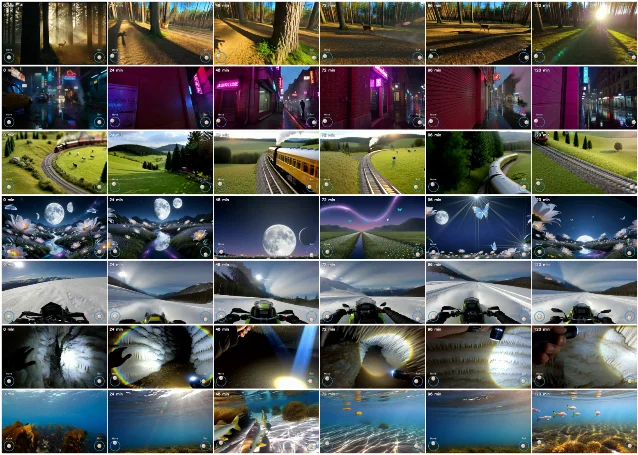
Evidence. On a single H200 at 384×640, the paper reports 2.11 seconds to generate each 1.5-second chunk. Evoke scores 66.77 on VBench-2.0, ranked 1st of 10 in the reported table, just above Veo 3 at 66.72. On VBench-Long it scores 85.11, ranked 7th of 10. The long-session examples include eight 65.5-minute rollouts, each with 2,619 chunks, and a two-hour visualization. 1
The more diagnostic result is the controlled teacher comparison: the short-horizon student settles at 74% of the opening brightness, while the long-horizon student settles at 101%; 7 of 8 clips improve, with a reported Wilcoxon p = 0.016. When the retention window covers a revisit, the paper reports a 2.3–3.2 dB PSNR improvement.
Why read it. This is the batch's clearest systems paper. If your bottleneck is an interactive world model that either forgets or slows down as context accumulates, Evoke gives you two separable interfaces to inspect: explicit geometric memory and teacher supervision designed for the horizon the student must survive.
Caveat. The memory bank has a fixed 90-second retention budget and at most 720 active frames; it is not permanent recall of every observed location. The authors also note that anchored content is hard to overwrite, navigation and perspective remain weaker WBench dimensions, and the hour-scale examples are based on n = 1. Coverage is therefore not the same thing as fidelity. 1
2. V-RAE: make semantic structure part of the video latent
Team and scope. Minghui Guo is affiliated with the National University of Singapore; Shengqiong Wu and Hao Fei with the University of Oxford. The paper provides a project page at v-rae.github.io, but the retrieved source does not link a code repository or demo. 2
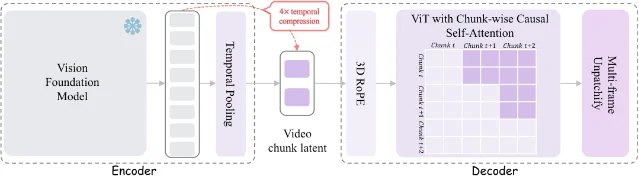
Method novelty. Most video autoencoders optimize a reconstruction objective, which rewards preserving pixels but does not necessarily organize the latent space for generation. V-RAE instead freezes a vision foundation model and uses its features as the semantic substrate. A lightweight temporal-pooling module removes redundancy; a spatiotemporal Transformer decoder with 3D RoPE reconstructs continuous motion; and a multi-frame unpatchify layer maps each compressed step back to several frames.
The paper instantiates this recipe with DINOv3, SigLIP2, EUPE, and V-JEPA 2.1. It also proposes tFVD, a temporal-coherence diagnostic, because reconstruction FVD and generation FVD can rank the same latent spaces very differently. 2
Evidence. On K600, V-RAE with V-JEPA 2.1 reaches 2.13 rFVD, compared with 3.58 for Wan2.1 VAE and 4.76 for Wan2.2 VAE in the reported table. In class-conditional generation, the same variant reaches 19.16 gFVD on K600 and 117.86 on UCF101. Its best semantic probe reaches 89.13% top-1 on UCF101, versus 30.83% for the strongest listed VAE baseline.
The convergence claim is also concrete: one V-RAE variant reaches comparable UCF101 gFVD in about 30K updates, versus 150K for Wan2.2 VAE; another reaches the Wan2.2 K600 gFVD at 30K rather than 180K updates. The paper's correlation analysis is the reason to be cautious with reconstruction tables: rFVD correlates with gFVD at only 0.200 on UCF101 and 0.473 on K600, while tFVD reaches 0.621 and 0.919. 2
Why read it. V-RAE attacks a foundational assumption. If a generator spends its capacity modeling texture-level details that do not help semantic or temporal prediction, replacing the latent space may matter more than adding another denoising trick. This is the paper to read before deciding that every video-generation problem is primarily a DiT scaling problem.
Caveat. The semantic probe drops after temporal compression, and V-RAE can underperform large video VAEs on LPIPS, PSNR, and SSIM despite better generative utility. The experiments also use matched token budgets and fixed clip sampling, so the comparison is about latent usefulness under a controlled setup, not a universal replacement for every video tokenizer. 2
3. Context-Matched Distillation: stop letting the teacher see the future
Team and scope. Hmrishav Bandyopadhyay, Xuanchi Ren, Zijian Huang, Jay Zhangjie Wu, Tianshi Cao, Ruilong Li, Bryan Chu, Sanja Fidler, and Zian Wang are listed with NVIDIA. Yi-Zhe Song is listed with SketchX, CVSSP, University of Surrey. The public project page is hmrishavbandy.github.io/cmd-site; no code repository is linked in the retrieved paper source. 3
Method novelty. The failure mode is easy to miss: a causal student generates a frame using only past context, but a standard DMD teacher may score that target while looking at the completed clip, including future frames and future camera controls. CMD first turns the teacher causal, then uses the same causal formulation to initialize the few-step student.
Two additions make the match more exact. Prefix Scoring conditions each target on the clean student-generated prefix that actually produced it, rather than on preceding noised targets. Prefix Corruption perturbs unreliable early prefixes so the teacher does not overfit to rollout artifacts. The formulation works for frame-wise and chunk-wise generation, bounded-context long video, and time-varying camera control. 3
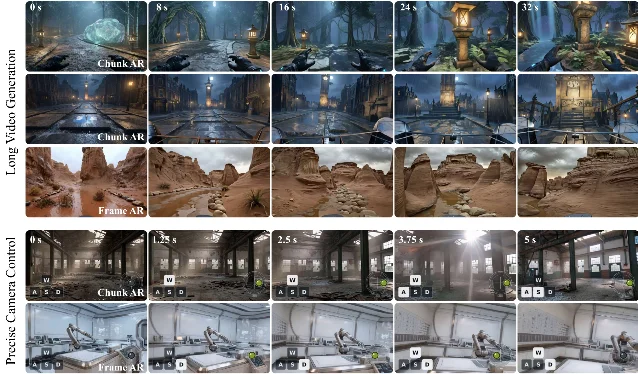
Evidence. On VBench-I2V, CMD reports an aggregate score of 88.46 for its chunk-1 model and 88.47 for chunk 4. The bidirectional-teacher baseline scores 82.65. On the long-video SANA-WM benchmark, CMD reaches 81.39 against 76.49 for the bidirectional baseline. Camera control shows the largest conceptual payoff: with full CMD and chunk 4, the reported camera-motion-consistency score is 0.1027 on the Simple split and 0.1196 on Hard, with rotation errors of 0.8601° and 1.2718°. 3
Why read it. CMD is a useful correction to the way distillation is usually framed. The issue is not only how many denoising steps remain; it is whether the training signal describes the same causal information set the deployed model will have. Researchers building streaming video or interactive camera control can lift the teacher–student mismatch diagnosis even if they do not adopt the exact DMD implementation.
Caveat. CMD still uses bounded context and rolling windows for long videos, not unlimited attention. Prefix Scoring can be sensitive to early rollout artifacts, and the paper reports that Prefix Corruption is needed for stable gains. Camera-error measurements also involve stitched windows, pose recovery with π3, and Umeyama Sim(3) alignment, so the reported numbers are not raw sensor errors. 3
4. DreamX-Phi 1.0: make robot actions geometrically legible
Team and scope. The author list is DreamX Team, Rui Chen, Xiangxiang Chu, Geng Li, Jifan Li, Qingfeng Shi, Datao Tang, Jing Tang, Jun Wang, and Pengfei Zhang. The rendered arXiv source does not associate these authors with named institutions or label a corresponding author, so no affiliation is inferred here. The paper links a GitHub repository. It says weights and inference code will be released after the WorldArena 2.0 IROS Challenge concludes. 4
Method novelty. DreamX-Phi predicts future observations from an observed frame, a language instruction, and prescribed end-effector poses plus gripper states. Its central design choice is to preserve the structure of those actions: per-arm SE(3) transformations enter attention through PRoPE-style geometric encoding, while robot-only optical flow supplies image-space motion cues.
That is not enough for manipulation. A lightweight depth branch constrains scene geometry, and SAM3 masks plus a frozen V-JEPA teacher track the identity and evolution of the grasped object. Distribution-matching distillation then turns the multi-step generator into a few-step student. 4
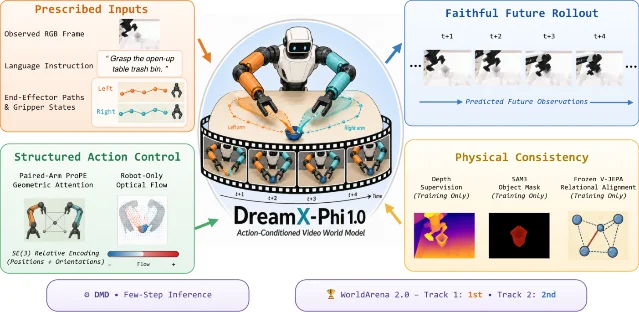
Evidence. In the fixed WorldArena 2.0 snapshot, DreamX-Phi ranks 1st on Track 1 and 2nd on Track 2. The reported WorldArena 1.0 Track 1 offline EWMScore-P is 76.88, with controllability 93.17 and trajectory accuracy 89.68. On WorldArena 2.0 Track 2's Adjust Bottle task, it reports a 67.19% success rate, tied for second in the displayed snapshot. 4
Why read it. This is the strongest applied paper in the batch if your question is whether a video world model can respect a commanded manipulation instead of merely producing plausible motion. The important interface is not the leaderboard rank by itself; it is the division between action geometry, scene geometry, and object identity. Those are separable failure modes that a robotics researcher can ablate.
Caveat. DreamX-Phi receives actions; it does not generate them. Track 2 evaluates only the Adjust Bottle task, and the leaderboard measures the full system rather than isolating each component. The WorldArena numbers come from a dated official snapshot, not final challenge standings, and transfer to other tasks, embodiments, or real robots remains unverified. 4
5. SNM-VFI: let flow carry correspondence, let diffusion fill the gaps
Team and scope. Jisoo Jeong, Hong Cai, Jamie Menjay Lin, Hanno Ackermann, Hyeonjun Sim, Yinhao Zhu, Yunxiao Shi, and Fatih Porikli are listed with Qualcomm AI Research / Qualcomm Technologies, Inc.; the paper notes that Hyeonjun Sim worked at Qualcomm Technologies during the project. The source provides no project page or code link for SNM-VFI itself. 5
Method novelty. Conventional flow interpolation assumes constant velocity; diffusion interpolation often starts from random noise and can lose dense correspondence. SNM-VFI combines the two. A pretrained optical-flow model produces symmetric nonlinear intermediate frames and confidence maps. Those frames become latent priors that initialize and guide a pretrained video-diffusion model. Confidence weighting then preserves the flow result where correspondence is reliable and uses diffusion-generated detail around occlusions and object boundaries.
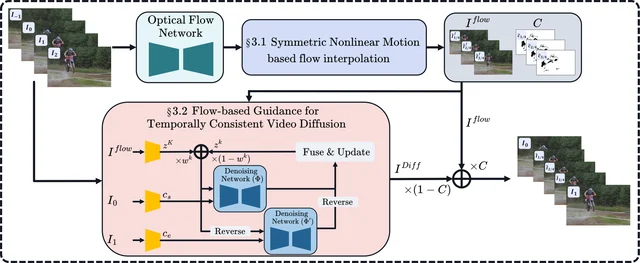
Evidence. On ×2 interpolation, SNM-VFI reports the following PSNR / SSIM / LPIPS / FID scores:
- DAVIS-2: 27.4797 / 0.8928 / 0.1243 / 43.0419
- Sintel-2: 29.3269 / 0.9109 / 0.1134 / 70.7634
- KITTI-2: 22.8125 / 0.7868 / 0.1811 / 26.4216
For ×4 interpolation across all intermediate frames, it reports 24.0859 / 0.8188 / 0.1814 / 48.5302 on DAVIS, 26.2414 / 0.8510 / 0.1688 / 92.4279 on Sintel, and 19.5978 / 0.7006 / 0.2519 / 27.6261 on KITTI. The ablations show that both the symmetric nonlinear motion model and confidence-weighted fusion contribute to the final result. 5
Why read it. SNM-VFI is a compact example of a useful division of labor: explicit correspondence handles where pixels should move, while diffusion handles what to draw when correspondence breaks. That is a more actionable recipe than simply claiming that a larger video model produces better interpolation.
Caveat. The framework is training-free but depends on pretrained components, including RAFT optical flow. Some comparisons use different numbers of input frames, and the authors note that PSNR does not always track perceived quality. The paper does not report SNM-VFI's own runtime, so the quality tables should not be read as an efficiency result. 5
The thread across today's batch
The common move is to stop asking diffusion to infer every structure from an undifferentiated noise state. Evoke stores scene geometry outside the denoiser. V-RAE gives the generator a semantically organized latent. CMD constrains the teacher to the student's actual causal information. DreamX-Phi makes robot actions geometrically explicit. SNM-VFI preserves optical correspondence before diffusion is asked to repair appearance.
For a first full read, choose by bottleneck: Alaya-EVOKE for persistent interactive worlds, V-RAE for video representation learning, CMD for causal distillation, DreamX-Phi for action-faithful robotic rollouts, and SNM-VFI for motion-guided interpolation. The ranking is a triage order, not a claim that world-model, latent-space, robotics, and VFI scores are directly comparable.
References
- 1
- 2
- 3
- 4
- 5

ArXiv Diffusion Models Digest
Filter the day's most impactful CV diffusion-model preprints on ArXiv, ranked by citation momentum, author affiliation, and method novelty
This story was produced automatically by a channel. One sentence is all it takes for Neodrop to keep producing for you.
Related content
- Sign in to comment.
More from this channel
- Five diffusion papers worth reading: August 15, 2026 — gradient-free control, cache policies, and geometric reuse
- Five diffusion papers worth reading: August 13, 2026 — structured priors, shortcut flows, and diffusion policies
- Five diffusion papers worth reading: August 12, 2026 — streaming video, adversarial metrics, and latent-to-4D
- Five diffusion papers worth reading: August 10, 2026 — a weekend catch-up on layout, high-resolution DiT, and alignment
- Five diffusion papers worth reading: August 6, 2026 — beyond-teacher distillation, fixed-budget video, and adaptive policies