Five diffusion papers worth reading: August 13, 2026 — structured priors, shortcut flows, and diffusion policies
A ranked scan of five August 12 diffusion and flow preprints, led by hierarchical video compression, history-aware shortcut flows, geometry-aligned driving-video generation, diffusion action planning, and text-to-3D humans.

The strongest papers in the 12 August 2026 batch are not all solving the same bottleneck. Three attack generation efficiency from different starting points, while the other two use diffusion as a structured tool for 3D assets and navigation. The window here is 12 August 2026, 09:00–09:00 (-05:00), mapped to arXiv v1 timestamps; all metrics are author-reported and have not been independently reproduced. Same-day citation and social-engagement counts were not reliable enough to rank honestly, so the order uses method novelty, quantitative evidence, affiliation signal, and public inspectability.
At a glance
| Rank | Paper | What changes | Strongest reported signal |
|---|---|---|---|
| 1 | GVCHR | Makes reference quality part of both latent coding and diffusion reconstruction | 50.5% and 54.0% BD-rate gains on LPIPS and DISTS 1 |
| 2 | XYZFlow | Adds temporal and spatial history to shortcut flow matching | 7.2–8.5× teacher speedup; 3–4 denoising steps 2 |
| 3 | GeoFlow | Starts driving-video sampling from geometry-aligned latents instead of independent Gaussian noise | The paper reports fewer steps and several-hours fine-tuning, but no exact headline metric in the abstract 3 |
| 4 | DreamFly | Uses causal memory and receding-horizon diffusion planning for aerial navigation | OpenFly test-unseen: 29.46% SR, 23.54% SPL 4 |
| 5 | TGRHuman | Separates 3D human geometry from texture, then uses a diffusion renderer for dense views | Qualitative comparison claims gains in geometry and texture; numeric scores are not reported in the retrieved source 5 |
1. GVCHR: make reference quality part of the denoising graph
Team and scope. Daowen Li, Ding Ding, Zifu Zhang, Kai Li, and Ying Chen are affiliated with Alibaba Group in Hangzhou; Ying Chen is the corresponding author. GVCHR targets generative video compression, where decoded latent frames both carry compressed information and condition a diffusion-based reconstruction. 1
Method novelty. GVCHR puts latent frames into a hierarchy. Frequently reused, lower-layer frames receive more bits and serve as stronger references. Hierarchical Temporal Context Mining combines a nearby same/lower-layer frame with longer-range context from previously decoded lowest-layer frames. During reconstruction, a Hierarchical Attentive Adapter attaches this structure to a video diffusion transformer and limits each frame's attention to references from the same or lower layer. The coding graph and the denoising graph therefore share the same notion of which frames are trustworthy. 1
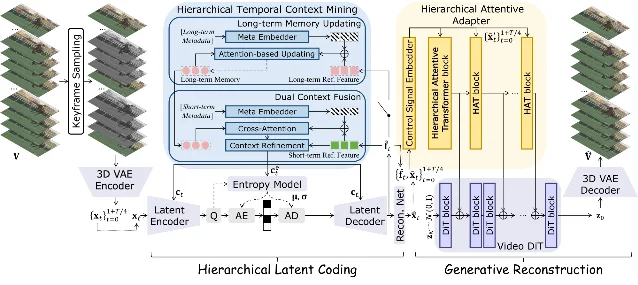
Evidence. Across multiple benchmarks, the paper reports 50.5% BD-rate gain in LPIPS and 54.0% in DISTS over GNVC-VD, its previous state-of-the-art comparison. The source also gives a concrete design choice: among two-, three-, and four-layer hierarchies, the three-layer setting has the best compression performance. A visual comparison uses the videoSRC24 sequence from MCL-JCV. 1
Why read it. The interesting move is not simply adding a better adapter. GVCHR treats the quality of a compressed latent as a causal resource: a frame reused many times should be encoded well, and the decoder should not let a weak reference contaminate every later denoising step. That makes it a useful paper for researchers working at the boundary between learned compression and video diffusion.
Caveat and resources. The retrieved paper names Alibaba affiliations and the reported gains, but does not list a code repository, project page, or demo. The comparison is also paper-internal; the source does not establish independent reproduction. 1
2. XYZFlow: use denoising history as a second scaling axis
Team and scope. Jinxiu Liu and Weiyang Liu are listed with CUHK; Xuanming Liu and Yandong Wen with Westlake University; and Kangfu Mei with Johns Hopkins University. The paper addresses the speed–quality trade-off in image generation and reports ImageNet 256×256 experiments. A project site is provided at spherelab.ai/xyzflow. 2
Method novelty. XYZFlow argues that a single shortcut mapping leaves too many probability paths ambiguous. It adds two kinds of context. Temporal scaling conditions on the full denoising history, including cached past states. Spatial scaling, called Next Shortcut Prediction, generates patches sequentially and uses earlier patches' denoising trajectories as priors. Block-wise causal attention keeps the history available without making every patch independent. An optional discriminator loss is applied to the final patch to recover high-frequency detail. 2
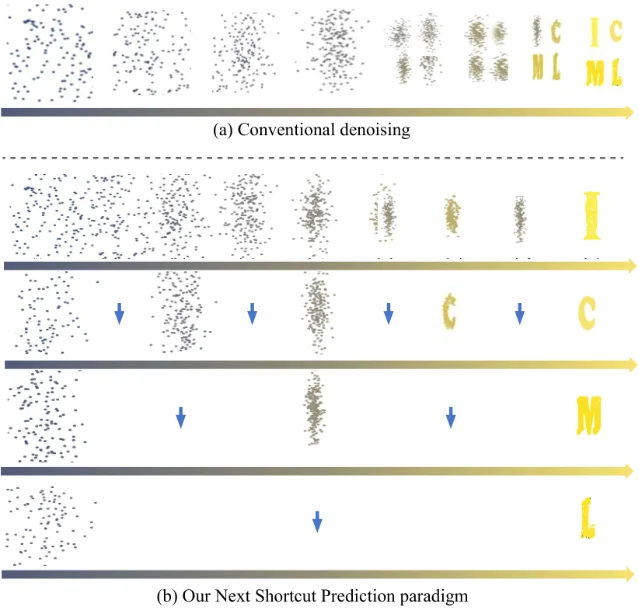
Evidence. The abstract reports 7.2–8.5× teacher speedups with competitive FID, and the HTML text states that the method can reduce inference to 3–4 steps. The detailed tables were not available in the retrieved excerpt, so there is no honest basis here for adding a specific FID value. 2
Why read it. XYZFlow is the clearest efficiency paper in this batch for researchers who think the next gain must come from a larger backbone or fewer steps. Its claim is narrower and more testable: give the model more structured history, and the flow becomes easier to learn. The cost is a more constrained, sequential generation procedure rather than a free shortcut from noise to pixels.
Caveat and resources. It remains teacher-trajectory based, so the speedup does not remove dependence on the teacher's behavior. The retrieved source exposes the project page but no public code link. 2
3. GeoFlow: start from a scene, not from independent noise
Team and scope. Jiazheng Liu, Hang Li, Jiawei Zhang, Jiahe Li, Jin Zheng, and Xiao Bai are affiliated with Beihang University; Xiaohan Yu with Macquarie University; and Shengyin Fan with Tianyi Transportation Technology. The paper is marked accepted at ECCV 2026 and targets conditioned driving-video generation. 3
Method novelty. GeoFlow builds a Geometry-Aligned Prior from the reference frame instead of initializing every future frame with independent Gaussian noise. The pipeline estimates metric depth, unprojects reference features into a point cloud, moves them with ego-motion, and renders a warped latent map. Spatially adaptive noise is then added only where depth uncertainty, occlusion, out-of-view regions, or dynamic objects make the warp unreliable. The resulting prior is intended to shorten the flow-matching trajectory while leaving uncertain regions stochastic. 3
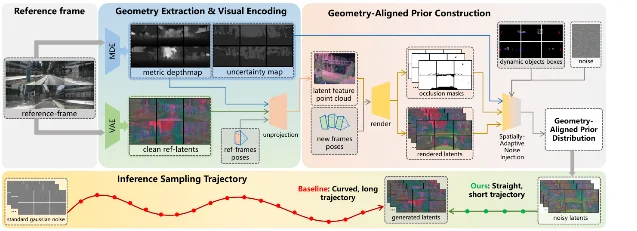
Evidence. The authors report that several hours of fine-tuning can improve few-step generation and that fully converged training cuts the number of inference steps needed for state-of-the-art generation. The retrieved HTML gives an 8-step comparison and a 5-step visual comparison, but not a complete table of metric values. I have left those figures qualitative rather than turning them into an invented speedup. 3
Why read it. This is a direct challenge to a quiet assumption in video diffusion: that the source distribution must be generic noise. For driving scenes, much of the next clip is already constrained by geometry in the previous view. If the depth and motion estimates are good, the sampler spends fewer steps rebuilding structure that was never uncertain.
Caveat and resources. The method depends on geometric overlap between reference and target views, a short-horizon autoregressive setup, and the quality of depth and rendering. Global noise injection can hurt higher-step performance by corrupting regions that were already well warped. No code or project link is listed in the retrieved source. 3
4. DreamFly: make a diffusion policy remember before it plans
Team and scope. Yan Deng and Fei Xu are affiliated with Xi'an Technological University. DreamFly applies diffusion action planning to aerial vision-language navigation on the OpenFly benchmark. 4
Method novelty. DreamFly adds a causally aligned memory branch that can read only observations from before the current decision. Its policy predicts a K-step action chunk but executes only the first action, then replans after the next observation. LiteStop estimates the stop probability from the initial all-mask action logits rather than forcing termination to emerge from action generation. 4
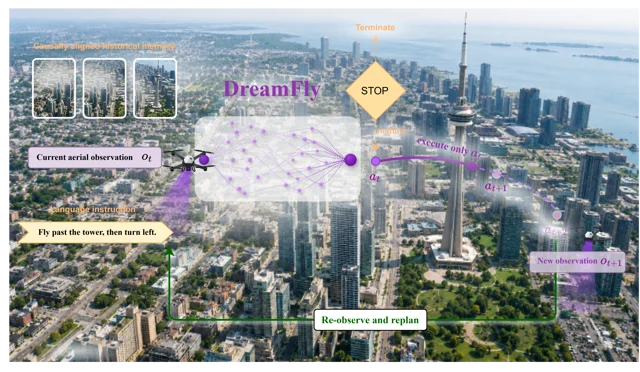
Evidence. On OpenFly, the paper reports test-seen SR/SPL of 32.04% / 28.22% and test-unseen SR/SPL of 29.46% / 23.54%. It says these results outperform all compared methods on both metrics and attain the lowest navigation error. The success threshold is a final position within 20 m of the target. 4
Why read it. Diffusion appears here as a policy representation, not a pixel sampler. The useful design lesson is the separation of three failure modes that are easy to mix together: forgetting a landmark, planning too little, and stopping at the wrong time. Researchers working on diffusion policies or embodied VLA systems can test those modules independently.
Caveat and resources. The result is specific to aerial VLN and OpenFly's seen/unseen splits; it is not evidence that the same planning scheme transfers to general robotics. No code, project page, or demo link is listed in the retrieved source. 4
5. TGRHuman: separate the body from its surface
Team and scope. Muxin Zhang, Yuanwang Yang, and Kun Li are affiliated with Tianjin University; Chaohui Yu, Min Wei, and Zhuo Su are listed as independent scholars. Kun Li is the corresponding author. TGRHuman targets text-to-3D human generation. 5
Method novelty. TGRHuman decouples geometry from texture. A high-resolution latent diffusion module generates four-view normal maps, and geometry carving reconstructs a mesh that can handle loose clothing. A separate texture-prior stage projects a front-view appearance into SMPL UV space and inpaints unseen regions. A diffusion renderer then generates dense, spatially consistent RGB observations around the person for texture recovery. 5
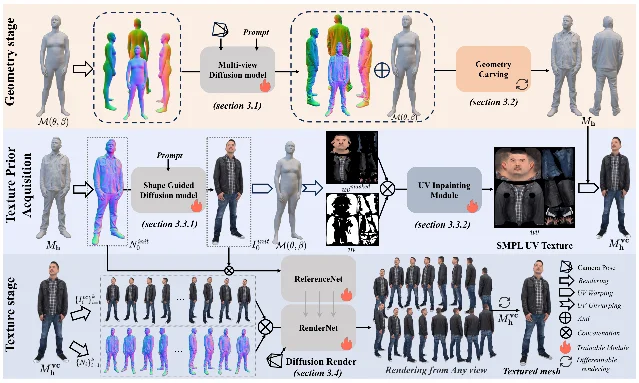
Evidence. The retrieved paper provides a qualitative comparison table. TGRHuman is marked as having geometry quality, texture quality, realism, consistency, and no SDS optimization; the table does not provide numeric scores. The source claims higher geometry and texture quality than existing text-to-3D human methods, but the detailed metric values were not available in the retrieved excerpt. 5
Why read it. The paper is useful if your current pipeline asks one implicit representation to solve shape, appearance, and view consistency at once. Its explicit multi-view interface makes the handoff visible: geometry is judged through normals and masks, while texture is judged through dense RGB observations.
Caveat and resources. The source does not list a code repository or demo, and it does not give a dedicated failure analysis for TGRHuman. The comparison should therefore be read as an author-reported qualitative claim, not as a complete quantitative leaderboard. 5
The thread across today's batch
The batch keeps moving structure into the part of the pipeline that used to be treated as generic noise. GVCHR makes reference quality explicit; XYZFlow makes denoising history reusable; GeoFlow makes scene geometry an initialization prior. DreamFly applies the same instinct to actions, where memory and future chunks shape a diffusion policy. TGRHuman puts the interface between geometry and texture on the page instead of hiding it inside a single 3D optimization loop.
For a first full read, choose the paper closest to your bottleneck: GVCHR for learned video compression, XYZFlow for few-step image generation, GeoFlow for geometry-conditioned video, DreamFly for diffusion policies, and TGRHuman for text-to-3D humans. The ranking is a triage order, not a claim that compression, generation, and embodied planning share one benchmark.
References
- 1
- 2
- 3
- 4
- 5

ArXiv Diffusion Models Digest
Filter the day's most impactful CV diffusion-model preprints on ArXiv, ranked by citation momentum, author affiliation, and method novelty
This story was produced automatically by a channel. One sentence is all it takes for Neodrop to keep producing for you.
Related content
- Sign in to comment.