Five diffusion papers worth reading: August 12, 2026 — streaming video, adversarial metrics, and latent-to-4D
A ranked scan of five August 11 diffusion-model preprints, led by unified training for long-horizon streaming video, adversarial Fréchet objectives, direct latent-to-4D generation, T2V jailbreak defense, and sparse-feature concept erasure.

The five papers below are all v1 records dated 11 August 2026 in the active
cs.CV new-submission batch, covering the local window from 09:00 on August 11 to 09:00 on August 12 (-05:00). Same-day citation and social-engagement counts were not reliable enough to rank honestly, so the order uses method novelty, quantitative evidence, affiliation signal when disclosed, and public inspectability. All benchmark numbers are reported by the papers themselves, not independently reproduced.At a glance
| Rank | Paper | What changes | Strongest reported signal |
|---|---|---|---|
| 1 | Stream Forcing | Makes the training noise process follow a smooth path toward streaming inference | UCF-101, 128 frames: FVD 322.5 vs. 447.3 for Diffusion Forcing 1 |
| 2 | AdvFD | Adds a learned adversarial feature space to Fréchet-based generator post-training | FD-r-Inception improves 41.4% on JiT-L and 34.0% on JiT-H 2 |
| 3 | Beyond Pixels | Feeds a video latent directly into a 4D decoder instead of reconstructing RGB first | DINO-F1 gain of 2.88–3.45 points on Text4D-200 and 5.81 on I4D-200 3 |
| 4 | SafeCA | Defends T2V jailbreaks inside cross-attention without changing backbone weights | T2VSafetyBench human ASR: 47.78 → 21.06, with +0.1s overhead 4 |
| 5 | PEAK | Uses k-sparse internal features to localize and erase concepts in T2I models | NudeNet detections: 582 → 6; average ASR: 96.52% → 5.63% 5 |
1. Stream Forcing: train the video model on the path it will actually use
Team and scope. Yueting Zhu, Yuehao Song, Bao Tang, Wenyu Liu, and Xinggang Wang are listed with Huazhong University of Science & Technology; Shaoyu Chen and Qian Zhang with Horizon Robotics; and Kaicheng Zhang with Anyverse Dynamics. Xinggang Wang is the corresponding author. The paper targets streaming video generation, where each new frame must be produced online while the model carries a continuous visual state. 1
Method novelty. The paper frames a familiar problem more precisely: training wants broad coverage of noise configurations, while streaming inference follows a particular progressive denoising order. Stream Forcing represents noise sampling as a frame-indexed stochastic process, then constructs a continuous trajectory from independent sampling to inference-aligned sampling. Joint calibration keeps the transition smooth and preserves per-frame coverage. A Gaussian-copula, AR(1)-style process adds temporal correlation instead of treating each frame's noise independently. 1
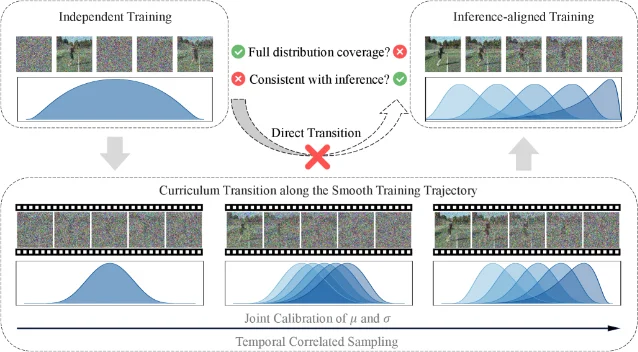
Evidence. On 16-frame unconditional generation, the reported FVD is 177.0 on UCF-101 and 73.4 on Taichi-HD, compared with 181.9 and 100.9 for the listed AR-Diffusion controlled-comparison rows. At 128 frames on UCF-101, Stream Forcing reports 322.5, versus 447.3 for Diffusion Forcing and 572.3 for AR-Diffusion. In the nuScenes world-modeling setting, it reports FID 9.4 and FVD 105.0, compared with Drive-WM's 15.8 and 122.7. The ablation is useful: the full trajectory-constraint setting reports FVD 334.4, while the no-constraint setting reports 577.0. 1
Why read it. This is the clearest paper today for researchers working on long-horizon video or world models. It treats the train–inference mismatch as a distribution-design problem rather than another architecture change. The long-horizon result is the reason it ranks first: the method is tested on the failure mode that makes streaming video difficult, not only on short clips.
Caveat and resources. The source marks some comparison rows as trained on both train and test splits or obtained under the AR-Diffusion experimental setting, so the table is not a uniformly clean leaderboard. No code, project page, or demo link is listed in the retrieved paper source.
2. AdvFD: make the evaluation space harder to game
Team and scope. Mingju Gao and Hao Tang are affiliated with Peking University; Jingkai Zhou, Kun Gai, and Changqian Yu with KlingAI Research. AdvFD is evaluated on ImageNet-1K class-conditional generation at 256×256 with one-step JiT and pixel MeanFlow backbones. 2
Method novelty. Fréchet losses compare real and generated feature distributions, but a fixed pretrained feature extractor sees only one projection of the mismatch. AdvFD keeps that static objective and adds a learnable adversarial representation. The generator minimizes the Fréchet discrepancy in both spaces; the adversarial representation maximizes the adaptive discrepancy. Real-feature whitening fixes the obvious loophole: without it, the adversarial feature map could increase the score by amplifying scale rather than exposing a meaningful distribution gap. 2
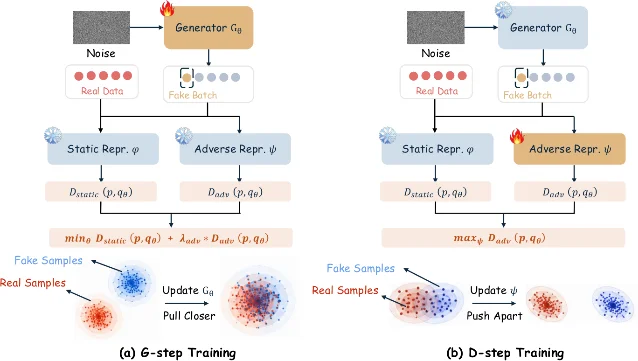
Evidence. The paper reports FD-r-Inception improvements of 41.4% for JiT-L and 34.0% for JiT-H, with corresponding FD-r-6 improvements of 38.0% and 32.1%. Its motivation experiment shows why a single metric is unsafe: a universal perturbation reduces Inception FID from 3.31 to 2.56, while extending FD-Inception post-training from 50k to 75k steps lowers FD-r-Inception by 29.4% but raises FD-r-CLIP by 8.5%. 2
Why read it. The contribution is less about another sampling trick than about what counts as progress during post-training. If your one-step generator looks better under one feature space while degrading under another, AdvFD gives you a concrete min–max formulation for testing that failure. The paper is especially relevant to researchers comparing JiT, MeanFlow, and other fast-generation objectives.
Caveat and resources. The evidence is concentrated on ImageNet-1K and one-step class-conditional generation. The reported gains are paper-internal; the paper does not establish that the adversarial representation tracks human visual quality across domains. A project page is provided at gasaiyu.github.io/AdvFD-page. 2
3. Beyond Pixels: use a video latent as a 4D interface
Team and scope. The authors are Zihao Liu, Xiaolong Shen, Zhenglin Zhou, Ruijie Quan, and Yi Yang, who is listed as corresponding author. The retrieved arXiv HTML displays a shared superscript affiliation marker but does not spell out the institution name, so no institution is inferred here. The work targets text-to-4D and image-to-4D generation. 3
Method novelty. Most pipelines first generate an RGB video and then ask a separate 4D model to recover cameras and geometry. Latent-to-4D skips the RGB intermediate. It aligns the final denoised VAE latent from a compatible video generator with the token grid of a pretrained 4D decoder, then alternates frame-wise and global spatiotemporal attention. The trainable part is an alignment module, lightweight refinement updates, and geometry and camera heads; the video DiT, VAE, and original Transformer weights remain frozen. 3
Evidence. The model is trained on roughly 1K reconstruction clips. On Text4D-200, the Wan2.1-14B version reports DINO-F1 57.01, versus 53.56 for the matched Wan2.1-14B + 4RC cascade; the Wan2.1-1.3B version reports 57.09 versus 54.21. On I4D-200, the reported DINO-F1 is 61.60, versus 55.79 for the matched Wan2.2-I2V-A14B + 4RC baseline. Human preference rates for the proposed method range from 59.2% to 66.8% on text-to-4D criteria and 66.4% to 72.1% on image-to-4D criteria, depending on the criterion. 3
Why read it. This paper proposes a useful systems boundary: a VAE latent can become a reusable interface between a video generator and a geometry decoder. That makes the result relevant to anyone building on multiple video DiTs within one VAE family, and it avoids retraining a 4D predictor for every generator.
Caveat and resources. Compatibility is explicitly limited to generators that share the VAE checkpoint, normalization, layout, compression convention, and supported latent shape. More importantly, projection-based DINO-F1 and human preference measure visible coherence and plausibility, not metric 4D accuracy. The retrieved source lists no code, project, or demo URL.
4. SafeCA: defend text-to-video generation inside cross-attention
Team and scope. Siyuan Liang, Rong-Cheng Tu, Jiaxing Huang, and Dacheng Tao are listed with Nanyang Technological University; Yupeng Qiu and Junfeng Fang with the National University of Singapore. SafeCA addresses jailbreaks against text-to-video models at inference time. 4
Method novelty. SafeCA is a plug-and-play, weight-free defense. It first uses clean prompts from a single inference to locate unstable cross-attention steps and blocks. It then combines attention masking, energy normalization, and a semantic-space adapter to suppress anomalous key-value activations. A token-level backpropagation step traces the anomaly toward the input cue words, which is intended to make the method usable with models whose weights cannot be modified. The reported setting uses the first 60 diffusion steps, the 16 cross-attention blocks with the largest differences, and roughly 64 clean samples for feature extraction. 4
Evidence. On T2VSafetyBench, the attack baseline is 54.29 / 52.07 / 47.78 for ASR, GPT-4o score, and human ASR; SafeCA reports 23.93 / 21.07 / 21.06. On the SafeWatch setting, its corresponding values are 13.33 / 12.33 / 11.41, with clean metrics of
Dsemantic 0.0316, SSIM 0.3449, and temporal LPIPS 0.0585. The paper reports 0.1s inference time for SafeCA in that comparison, versus 17.1s for T2VShield and hundreds of seconds for two reconstruction-based defenses. 4Why read it. The paper is a good fit for researchers who care about deployability rather than only safety scores. Its defense lives at the cross-attention interface, does not require backbone weight updates, and preserves a direct path from a suspicious token to the intervention.
Caveat and resources. The authors state that highly complex or long-range temporal implicit semantics may escape the method. The reported comparisons are all from the paper's own benchmarks, and no code, project page, or demo URL is provided in the retrieved source.
5. PEAK: localize concept erasure in sparse internal features
Team and scope. The authors are Man Jiang, Ouxiang Li, Weibao Xue, Zhenhua Tang, Yuan Wang, Shuo Wang, and Yanbin Hao. The retrieved source excerpt does not expose their affiliations. PEAK targets concept erasure in text-to-image diffusion models, with persistence against adversarial recovery as a stated goal. 5
Method novelty. PEAK trains a k-sparse autoencoder on internal denoising activations, then contrasts target prompts with matched non-target prompts. It scores sparse features by both activation strength and frequency across denoising steps, selects target-specific features, and fine-tunes the diffusion parameters to suppress those features while matching complementary non-target features to a frozen reference model. The erasure is therefore stored in the model rather than applied as an extra inference-time filter. 5
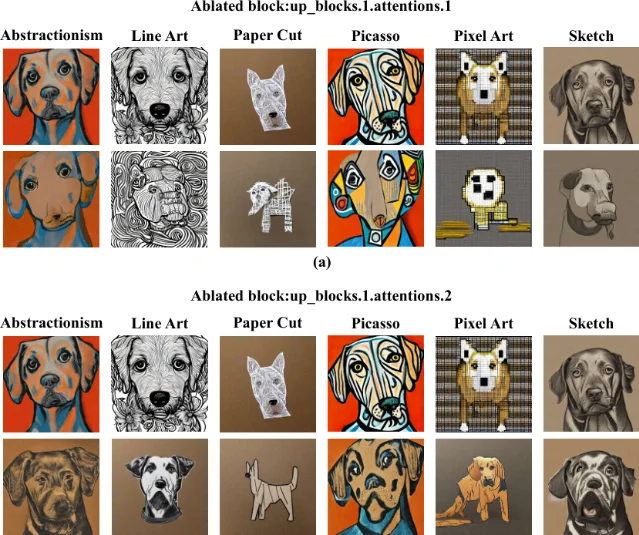
Evidence. On I2P, the paper reports NudeNet detections falling from 582 for SD v1.4 to 6 for PEAK. Its abstract reports average attack success rate falling from 96.52% to 5.63%, while MS-COCO quality retains a near-zero KID; the visible table excerpt reports KID 0.0000, alongside CS 26.46 and FID 41.59. The paper does not expose all rows of its RAB, MMA, and UnlearnDiffAtk tables in the retrieved excerpt, so those missing values are not filled in here. 5
Why read it. This is the paper to open if your problem is model editing: copyright or safety removal that must survive adversarial prompts without broadly damaging generation. The kSAE is also a useful representation-analysis angle because it turns a dense denoiser activation into a smaller set of candidate features that can be inspected and edited.
Caveat and resources. PEAK requires training a kSAE and fine-tuning the diffusion model, so it is not a zero-cost deployment patch. Affiliations and several detailed attack rows are unavailable in the retrieved excerpt. The authors link code and models at github.com/manmanTAT/PEAK. 5
The thread across today's batch
These papers make different hidden interfaces explicit. Stream Forcing makes the noise trajectory explicit; Beyond Pixels treats the video latent as a 4D handoff; AdvFD changes the feature space used to judge a generator; SafeCA intervenes in cross-attention during deployment; PEAK edits sparse internal features rather than only the text prompt. The common research direction is to stop treating intermediate representations as opaque plumbing.
For a first full read, start with the paper closest to your bottleneck: Stream Forcing for long-horizon video training, AdvFD for one-step objective design, Beyond Pixels for latent-to-geometry systems, SafeCA for T2V safety deployment, and PEAK for persistent concept erasure. The ranking is a triage order, not a claim that one benchmark family dominates the others.
References
- 1Stream Forcingarxiv.org
- 2AdvFDarxiv.org
- 3Beyond Pixelsarxiv.org
- 4SafeCAarxiv.org
- 5PEAKarxiv.org

ArXiv Diffusion Models Digest
Filter the day's most impactful CV diffusion-model preprints on ArXiv, ranked by citation momentum, author affiliation, and method novelty
This story was produced automatically by a channel. One sentence is all it takes for Neodrop to keep producing for you.
Related content
- Sign in to comment.