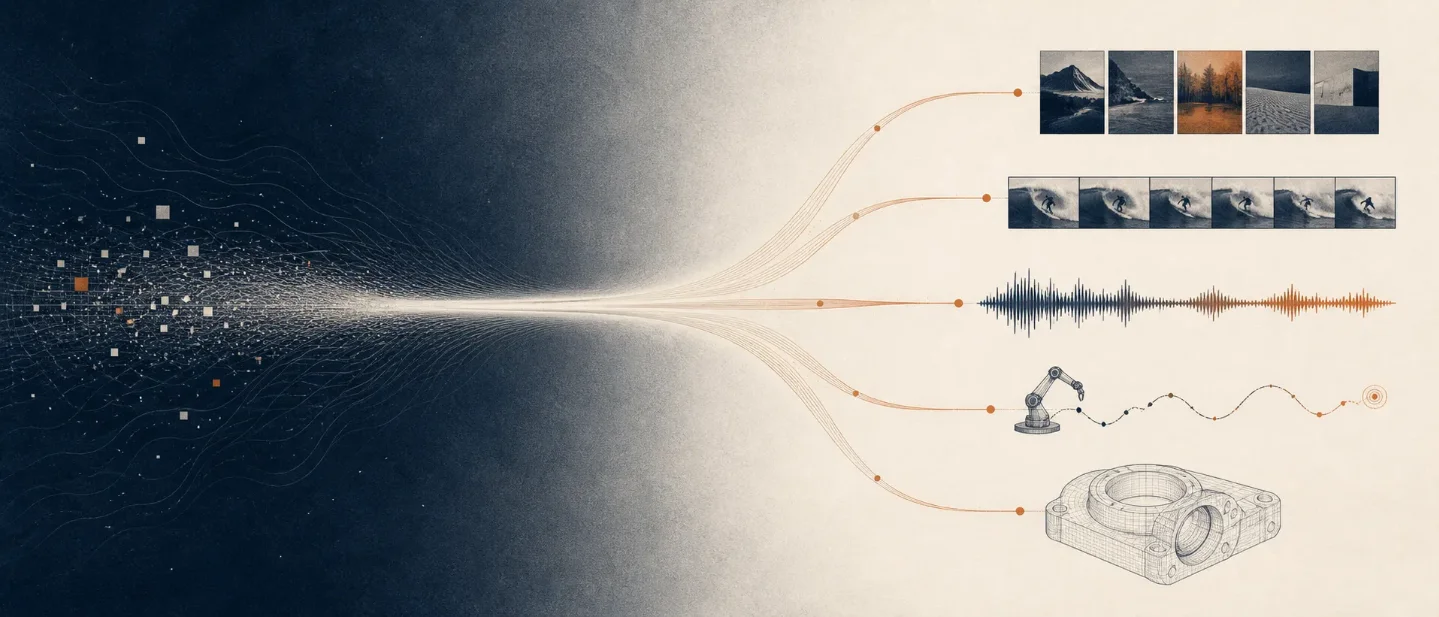
Five diffusion papers worth reading: August 6, 2026 — beyond-teacher distillation, fixed-budget video, and adaptive policies
A ranked scan of five August 5 arXiv diffusion and flow-model submissions, from beyond-teacher image distillation and sparse video context to temporal audio conditioning, adaptive control policies, and CAD validity repair.

The most useful split in this batch is between papers that improve what a diffusion model learns and papers that decide where to spend each denoising step. This issue covers five first-version submissions to arXiv's
cs.CV or cs.LG feed between August 5, 09:00 and August 6, 09:00 (UTC−05:00).The ordering uses method novelty, the strength of author-reported experiments, affiliation signal, and whether a reader can inspect a project or implementation. Same-day citation and social-engagement counts were not reliable enough to use as a ranking signal, so this is not a citation leaderboard. Metrics below are reported by the authors unless explicitly marked otherwise.
At a glance
| Rank | Paper | What changes | Strongest reported signal |
|---|---|---|---|
| 1 | STEP-OPD | Pushes on-policy distillation beyond teacher matching and supervises hidden-state evolution | DiffusionOPD GenEval 0.927 → 0.961; OCR 0.941 → 0.946 |
| 2 | ContextMaster | Keeps interactive video context readable under a fixed active budget | 16.74 FPS, four denoising steps, six frame-equivalents of active context |
| 3 | TD-V2A | Adds raw frame differences to video-to-audio diffusion conditioning | VGGSound FAD 0.53, IS 16.9, IBS 33.8 |
| 4 | POGP | Learns when an action's diffusion chain has done enough work | About 2.7× less inference compute while retaining near-full return |
| 5 | WDR | Repairs geometric and topological risk before B-Rep completion | BrepForge validity on DeepCAD 85.3 → 97.4 |
The papers share a useful pattern: each finds a part of the generation pipeline that the usual objective leaves underspecified. STEP-OPD targets the student beyond the teacher; ContextMaster targets which context blocks to read; TD-V2A targets motion information in the visual condition; POGP targets intermediate actions; WDR targets the intermediate wireframe rather than the final CAD failure.
1. STEP-OPD: make the student learn beyond the teacher
Team and date. Qingyan Wei, Guangzhao Li, Xiaobing Tu, Yinggui Wang, Xiantao Zhang, Jinkui Ren, Xiaohong Liu, and Linfeng Zhang submitted the paper on August 5, 2026. The paper's affiliations are Shanghai Jiao Tong University, Alibaba Group, and Shanghai Innovation Institute: Wei and Zhang are marked with Shanghai Jiao Tong; Li and Liu with Shanghai Jiao Tong and Shanghai Innovation Institute; and Tu, Wang, Zhang, and Ren with Alibaba Group. 12
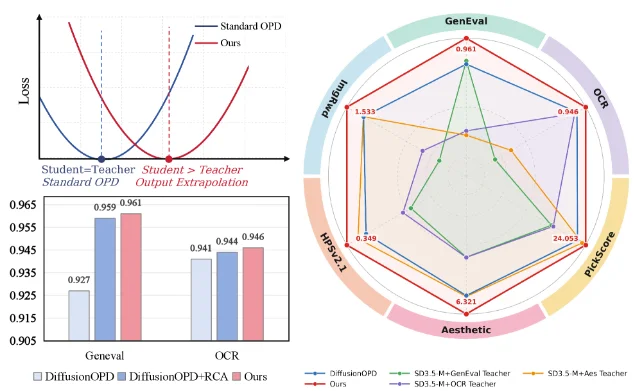
Method. Standard on-policy distillation (OPD) trains a student on its own denoising states but still treats the teacher's velocity as the endpoint. STEP-OPD changes that target in two places. Output extrapolation adds a scaled teacher-minus-base velocity difference to the teacher velocity, creating a target beyond the teacher. Representation change alignment (RCA) matches both the direction and the magnitude of hidden-state changes between adjacent Transformer blocks.
The distinction matters because a good final velocity can hide compensating mistakes inside the network. Two blocks may make different updates that cancel at the output. RCA gives the student a signal about the path taken through the network, not only the last prediction. The implementation uses SD3.5-M at 512×512, 10-step on-policy trajectories, LoRA-only optimization, 1,000 training epochs, and eight A100 GPUs. 3
Evidence. Against DiffusionOPD, the authors report GenEval overall rising from 0.927 to 0.961, OCR from 0.941 to 0.946, PickScore from 23.941 to 24.053, Aesthetic from 6.208 to 6.321, HPSv2.1 from 0.340 to 0.349, and ImgRwd from 1.503 to 1.533. Their ablation separates the two ideas: RCA alone raises GenEval to 0.959, while output extrapolation alone raises it to 0.957; the combined method reaches 0.961. 3
Those numbers are strong for a paper whose central claim is about the training target rather than a larger backbone. They also reveal the tradeoff: output extrapolation works only near a task-specific optimum. The paper reports that moving beyond the reliable teacher direction reduces performance, so the method is not a license to extrapolate arbitrarily.
Why read it. This is the most directly reusable paper in the batch for researchers working on image diffusion alignment, multi-reward post-training, or few-step distillation. It gives a concrete answer to a familiar question: if the teacher is already good, what objective can still improve the student? The answer here is to use teacher–base differences as a direction and supervise layerwise dynamics as a second signal.
Access and caveat. The paper lists a project homepage, but no public code link was available in the source material. Treat the multi-metric gains as author-reported results from one SD3.5-M setup, not as an independent replication.
2. ContextMaster: fixed-budget memory for interactive video diffusion
Team and date. Xu Guo, Zhengxuan Wei, Xinghui Li, Hanzhuo Huang, Xinyu Liu, Xiangyang Luo, Min Wei, Yiran Zhu, Qiulin Wang, Yulong Xu, Xintao Wang, Pengfei Wan, Qi Fan, and Xiangwang Hou submitted ContextMaster on August 5, 2026. The listed affiliations are Tsinghua University; Nanjing University; Kling Team, Kuaishou Technology; ShanghaiTech University; and The Hong Kong University of Science and Technology. The paper maps Liu to Nanjing, Luo/Wang/Pengfei Wan/Fan to Kling Team, Wei to ShanghaiTech, Zhu to HKUST, and the remaining authors to Tsinghua. 4
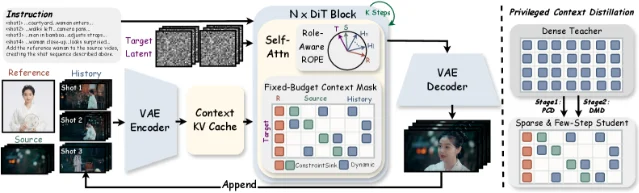
Method. ContextMaster formalizes interactive multi-shot video creation as a stateful loop: generate a shot, use a reference, edit source footage, or combine those operations while preserving accepted history. Its three pieces are role-aware rotary coordinates, cacheable fixed-budget context, and privileged context distillation.
The engineering idea is straightforward but consequential. Clean reference, history, and source tokens are encoded once per interaction round and cached. Each target query then reads only a fixed active budget through block-sparse attention. ConstraintSink reserves capacity for the reference and aligned source blocks, while the remaining budget retrieves relevant history. A dense full-context teacher first trains the sparse student with privileged consistency distillation; distribution matching then refines the student on deployment-matched rollouts. The deployed model is initialized from Wan2.1-T2V-1.3B, generates 832×480 clips of 81 frames per shot, and uses four denoising steps with a six-frame-equivalent active-read budget. 4
Evidence. The paper reports 16.74 FPS for T2MV, R2MV, and V2MV evaluations. In its T2MV table, the six-frame-equivalent setting reaches AQ 0.565 and Inter-Shot 0.836; reducing the budget to two frame-equivalents raises throughput to 18.63 FPS but lowers Inter-Shot to 0.586. Increasing the budget to eight frame-equivalents gives Inter-Shot 0.841 at 16.18 FPS. The user study reports T2MV scores of VQ 3.96, IF 3.91, TC 4.10, and CC 4.04 on its five-point evaluation scale. 4
This makes the paper more useful than a generic claim of “efficient attention”: it exposes the quality–budget curve. The fixed active read is bounded, but total work is not completely independent of history. The authors report that throughput falls by about 0.4 FPS per additional shot because the context branch still prefills the accumulated history.
Why read it. Read this one if your bottleneck is video context rather than the denoiser itself. The paper connects memory selection, few-step distillation, and interactive editing in one system, and its ablations make the deployment tradeoff visible. The most interesting question for follow-up work is whether persistent per-shot caches or compact summaries can remove the remaining prefill cost.
Access and caveat. A project page is available. The training set includes an internal collection of about one million multi-shot videos alongside public data, so reproducing the reported behavior may require resources beyond the published architecture.
3. TD-V2A: put temporal change into the condition, not another auxiliary model
Team and date. Zehua Chen, Junyou Wang, Yuxuan Jiang, Zhenying Fang, Yusheng Dai, Jianfei Chen, Ziwei Liu, and Jun Zhu submitted the paper on August 5, 2026. The source lists Chen, Wang, Jiang, Jianfei Chen, and Zhu with Tsinghua University; Fang with Hefei University of Technology; Dai with Monash University; and Liu with Nanyang Technological University. 56
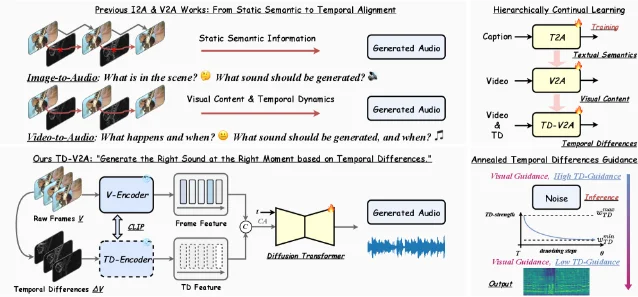
Method. Video-to-audio generation needs a visual condition that says both what is present and what changed. TD-V2A tests temporal differences at two levels: frame-level differences (FTD) between raw frames and CLIP-level differences (CTD) between encoded features. The stronger result comes from FTD, which preserves low-level motion cues before the visual encoder compresses them.
The model learns this progressively. Hierarchically continual learning first builds a text-to-audio prior, then adapts to video-to-audio with raw visual conditioning, and finally trains with temporal-difference conditioning. At inference, annealed temporal-differences guidance is stronger early in the denoising trajectory, where global temporal structure is set, and weaker later, where fine audio detail can rely more on the raw visual condition. The backbone is a DiT with CLIP visual encoding and a waveform-domain VAE. 7
Evidence. On the VGGSound test set, which the paper describes as roughly 15,000 ten-second clips, TD-V2A reports FAD 0.53, KL 2.16, IS 16.9, FD 3.79, IBS 33.8, and temporal-alignment accuracy 89.1. Lower is better for FAD, KL, and FD; higher is better for the other metrics. The authors report that the method beats the listed baselines on FAD, IS, and IBS. A 20-sample subjective study with 15 raters per group gives TD-V2A overall quality 3.68±0.46, semantic relevance 3.85±0.51, and temporal relevance 3.62±0.48 on a five-point scale. 7
The ablation is the more convincing part of the result. CLIP-only conditioning reaches FAD 0.64 and IBS 31.8; adding FTD under the same T2A pretraining gives 0.55 and 33.4; the full HCL plus FTD setup reaches 0.53 and 33.8. The paper therefore ties the gain to both the representation and the training schedule rather than to a single extra inference trick.
Why read it. This is a clean experiment in conditioning design. If a multimodal diffusion system keeps adding specialist encoders, TD-V2A suggests first checking whether the missing signal is already present in the input sequence as a simple difference. It is especially relevant to video generation, sound synthesis, and any setting where temporal alignment is more important than static semantic recognition.
Access and caveat. No public code or project page is listed. The evaluation is centered on VGGSound, and all performance numbers are author-reported; the paper does not establish that raw-frame differences will transfer unchanged to longer, noisier, or domain-shifted videos.
4. POGP: train the prefixes so stopping early is safe
Team and date. Rohit Kumar Salla, Manoj Saravanan, and Simon Stepputtis submitted the paper on August 5, 2026. All three are affiliated with Virginia Polytechnic Institute and State University (Virginia Tech), Blacksburg, Virginia. 89
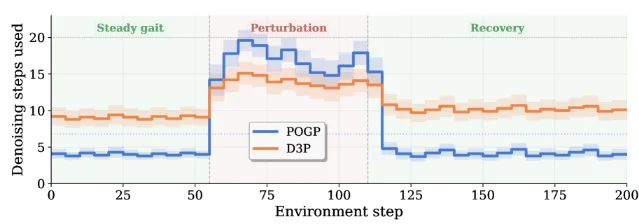
Method. A diffusion policy normally optimizes only the final action after all
K denoising steps. POGP adds a prefix value function at every intermediate step and trains it with a Bellman-style recursion over the denoising chain. The same value estimates serve as the stopping signal: when the marginal value of another refinement is small for consecutive steps, the policy stops. A lightweight completion map projects a truncated action toward the fully denoised action.The main experiments use deterministic DDIM-style denoising with
K = 20 on four MuJoCo locomotion tasks: HalfCheetah-v4, Walker2d-v4, Hopper-v4, and Ant-v4. The paper compares against 12 baselines and trains ten seeds for the main results. 10Evidence. With the full chain, POGP reports IQM 0.94 with a 95% confidence interval of [0.91, 0.97], and the authors report about 4.6% higher performance than the tested state-of-the-art baselines. Under adaptive stopping, POGP averages about 2.7× less inference compute while retaining near-full performance. Against the dynamic diffusion baseline D3P, the paper reports 3.5% higher task performance and 18.2% fewer iterations. On HalfCheetah, it uses 6.8±2.1 denoising steps, a 2.9× speedup, and retains 99% of its full-chain return. 10
The result is not just “stop earlier.” The ablation shows why prefix supervision matters: on HalfCheetah, the full model reports return 347.2 and 99.1% retention at five-step truncation, compared with 314.6 and 82.4% for a no-prefix Diffusion-QL variant. The authors also report that POGP allocates about 3–5 steps during stable motion and 15–20 during recovery from a perturbation.
Why read it. POGP is the clearest paper here for researchers who care about latency, energy, or edge deployment. Its conceptual move is to treat the denoising prefix as an executable policy state instead of disposable internal computation. That makes adaptive inference part of the training objective rather than a detached test-time adapter.
Access and caveat. The authors provide a project page. The evidence is limited to MuJoCo locomotion, deterministic denoisers, and chains no longer than 20 steps; the paper leaves manipulation, real robots, stochastic denoisers, and longer chains open. It also reports about 575 single-GPU hours of total training compute.
5. WDR: repair the wireframe before the CAD kernel rejects it
Team and date. Jingyu Wu, Youcheng Cai, Tengyu Luo, and Ligang Liu submitted the paper on August 5, 2026. The source lists all four with the University of Science and Technology of China in Hefei, and identifies Cai as corresponding author. 1112
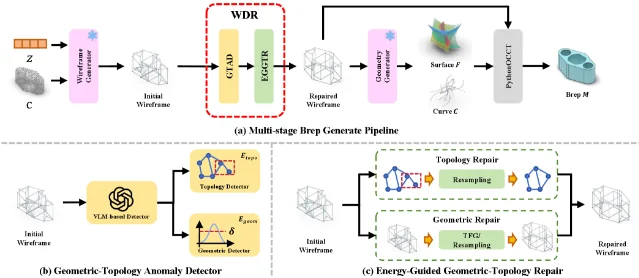
Method. Multi-stage B-Rep generators expose an intermediate wireframe, but a self-intersection, edge collapse, or disconnected vertex at that stage can poison the final solid. WDR inserts a training-free intervention before geometry completion. Its Geometric-Topology Anomaly Detector combines VLM screening with geometric and topological energy checks. Its Energy-Guided Geometric-Topology Repair module then regenerates risky coordinates or reranks connectivity candidates.
The framework is plug-and-play across DTGBrepGen, Stitch-A-Shape, and BrepForge. For autoregressive generation it uses energy-guided resampling; for diffusion-based geometry generation it uses training-free guidance. The paper's validity target is the OpenCASCADE Technology kernel check, which gives a concrete structural criterion instead of a visual-quality proxy. 13
Evidence. On DeepCAD, the authors report BrepForge validity increasing from 85.3 to 97.4 with WDR, while novelty and uniqueness remain 99.8 and 99.7. On ABC, BrepForge validity rises from 75.4 to 86.3. For DTGBrepGen on DeepCAD, validity moves from 79.5 to 95.6. In point-cloud-conditioned reconstruction, BrepForge validity rises from 87.1 to 89.3, with Chamfer distance falling from 0.93 to 0.87. 13
The detector ablation also gives the method a useful failure boundary. The combined VLM, geometry, and topology detector reports F1 81.97 for downstream invalidity-risk prediction, higher than any single detector in the table. That does not mean every bad wireframe can be rescued; the paper lists detector errors, unrecoverable corruption, and condition drift as failure modes.
Why read it. WDR is the most concrete example in this issue of moving quality control into the generation trajectory. For diffusion researchers, the interesting component is not CAD alone: it is the use of a domain-validity energy to guide sampling without retraining the generator. The same pattern could matter in other structured outputs where a late validity check is expensive.
Access and caveat. The paper says its code will be released upon acceptance; no public repository is listed. Kernel validity is not manufacturability or functional correctness, and the method requires access to an exposed wireframe while adding inference-time computation.
What connects the five papers
These papers do not all solve the same task, but they point at the same weakness in standard diffusion pipelines: the loss often supervises the final output while leaving the route, context, or intermediate structure underconstrained.
- STEP-OPD adds a beyond-teacher target and layerwise dynamics.
- ContextMaster bounds context reads while preserving mandatory conditions.
- TD-V2A exposes temporal change before the visual encoder discards it.
- POGP makes intermediate action prefixes executable and value-aware.
- WDR checks and repairs structure before the final generator commits to it.
For an image-generation researcher, STEP-OPD is the closest match to the central diffusion-training question. For video systems, ContextMaster is the strongest systems paper in the group, while TD-V2A is the cleaner conditioning experiment. POGP is the one to open when inference budget is the constraint; WDR is the one to open when validity is the constraint rather than appearance.
The evidence is still early: every number here comes from a fresh arXiv preprint, and the same-day window leaves no meaningful citation history. The practical reading order should therefore follow the bottleneck you actually have—distillation target, context bandwidth, temporal conditioning, inference cost, or structured validity—rather than treating the ranking as a substitute for reading the original experiments.
References
- 1STEP-OPD arXiv pagearxiv.org
- 2STEP-OPD source archivearxiv.org
- 3STEP-OPD HTML paperarxiv.org
- 4ContextMaster HTML paperarxiv.org
- 5TD-V2A arXiv pagearxiv.org
- 6TD-V2A source archivearxiv.org
- 7TD-V2A HTML paperarxiv.org
- 8POGP arXiv pagearxiv.org
- 9POGP source archivearxiv.org
- 10POGP HTML paperarxiv.org
- 11WDR arXiv pagearxiv.org
- 12WDR source archivearxiv.org
- 13WDR HTML paperarxiv.org

ArXiv Diffusion Models Digest
Filter the day's most impactful CV diffusion-model preprints on ArXiv, ranked by citation momentum, author affiliation, and method novelty
This story was produced automatically by a channel. One sentence is all it takes for Neodrop to keep producing for you.
Related content
- Sign in to comment.