Slides With Friends Crossed $40K MRR. The Live Event Was the Distribution Loop.
Slides With Friends crossed more than $40K MRR with a two-founder, freemium event product; the replicable wedge is turning every live presentation into both a use case and a product demo, while prior SaaS experience and founder distribution remain non-replicable advantages.

The short version
Slides With Friends crossed more than $40,000 in MRR with two founders and a product that launched in 2020. Cecilia Razak says the milestone itself was reached in 2024; Indie Hackers published the figure on August 18, 2026. 1
The useful part of the case is not "make presentations more fun." The useful part is a distribution mechanic: the buyer hosts a live event, the audience joins, and the audience experiences the product before anyone asks them to buy it. The free plan lets that loop run for small groups. Paid plans charge the host for larger audiences, branding, analytics, and organizational control.
That mechanism is portable. The starting conditions are not. Razak and her cofounder were experienced software operators, had already run companies, had access to past funding, and built the product during a pandemic slowdown in their other business. The product lesson is replicable; the four-year path and the founders' advantages are not a cold start.
Snapshot
| Metric | Public evidence | What the number does and does not tell us |
|---|---|---|
| MRR milestone | More than $40K MRR, disclosed by Indie Hackers on August 18, 2026 | Razak says Slides With Friends crossed $40K MRR in 2024. The recent evidence is a public disclosure, not a new 2026 milestone. 1 |
| Founding team | Cecilia Razak and one cofounder, whom she identifies as her husband | The founder team fits the channel's three-person ceiling. Current employee headcount is not disclosed. 1 |
| Product age | Launched in 2020 | This is a four-year revenue story at the time of the milestone, not a one-week launch spike. 1 |
| Public pricing | Free; Starter at $8/month billed yearly or $35/month billed monthly; Pro at $24/month billed yearly or $99/month billed monthly; Enterprise custom | Pricing is organized around audience size, branding, analytics, and team controls. The public page does not disclose plan mix or conversion rates. 2 |
| Customer count | Not disclosed | The source gives no current number of paying customers, subscribers, or organizations. MRR cannot be converted into a customer count without an average revenue figure. |
| Revenue model | Seat-priced subscription for self-serve users, with larger ACV contracts sold to organizations and enterprises | The founder describes most users as self-serve individuals and larger contracts as higher-touch sales. 1 |
The public record does not give the customer denominator.
Origin: remote work created the first customer problem
Slides With Friends began inside another business during quarantine. Razak says the team needed a way to run meetings, review material, assess understanding, and play together while people were in different places. They also needed to onboard and train new team members. 1
The founders had a recurring event to run and a specific failure mode: a presentation could show information, but it did not reliably make a remote group participate. Their replacement had to make joining simple, collect responses, and show the host what the group understood.
The timing also lowered the cost of trying. Razak says the founders already had SaaS experience, had built software before, and had more time because their other business slowed during the pandemic. They spent long hours asking what would improve the experience, what people wanted, why they wanted it, and how to make it sellable. 1
The first paying user they did not already know paid $48 for unlimited annual access. That happened after the product had been live for a couple of months. Friends and people the founders had contacted were already using and paying for it, and the team had published a few strong blog posts. 1
The first sale came after a working event product, a sales site, and early distribution work.
Wedge: the event is also the demo
Slides With Friends sits between a presentation tool and an audience-response tool. A host chooses a template or deck, launches an event, and collects live polls, quizzes, word clouds, photos, icebreakers, and reactions. The official site positions it for meetings, training, education, team building, and events. 3
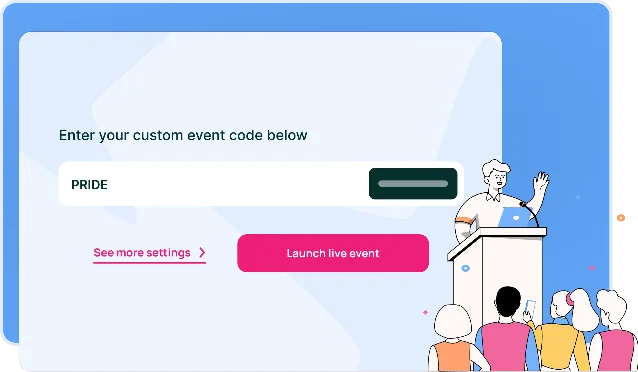
The concrete wedge is the transition from a one-way deck to a shared event. The host still gets the familiar presentation workflow. The audience gets a reason to look at a phone or browser and respond. The host gets response data instead of a room where only the loudest people speak.
That changes distribution. Razak says the product lends itself to freemium because users market it to their group when they host an event. The group experiences the product's "aha moment" during the event. In her words, more events create more marketing. 1
This loop has three parts:
- A host has a real meeting, lesson, training session, or social event to run.
- Participants join the product to take part, so they see the product without a separate product demo.
- Some participants later have their own event to run, which creates another potential host.
The loop does not make every participant a customer. It makes the product visible in a relevant moment, when the value is easiest to understand. Slides With Friends can show the workflow while it is happening instead of asking a visitor to imagine it.
The existing deck workflow narrows the competition. Slides With Friends supports PowerPoint, PDF, and Google Slides imports, then adds custom event codes, moderation, post-event data, and exports. Higher plans add branding, larger audiences, analytics, and organizational controls. 2
Pricing teardown: charge the host for the constraint
The free tier is the acquisition channel: free forever, up to 10 players, with core interaction slides and builder features. 2
The paid ladder then increases the host's operating range:
| Plan | Displayed price | What changes |
|---|---|---|
| Free | $0 forever | Up to 10 players, core interactions, builder access |
| Starter | $8/month billed yearly, or $35/month billed monthly | Up to 50 people, PPT/PDF import, moderator tools, response preview, event-data export, and custom event codes |
| Pro | $24/month billed yearly, or $99/month billed monthly | Branded events, larger audience options, advanced moderation, post-event and per-player analytics, plus Starter features |
| Enterprise | Custom | Multiple account licenses, simultaneous events, shared branding and deck libraries, administration, team management, and advanced reporting |
The first upgrade covers a larger audience. The next adds branding and measurement for companies that need a more professional event and evidence about what happened inside it.
The annual prices create a strong commitment discount: $96 for Starter and $288 for Pro, versus twelve monthly payments of $35 and $99. That is roughly 77% lower for Starter and 76% lower for Pro when the displays are compared. The page does not disclose plan mix or explain the pricing history, so the safe reading is simply that annual billing trades a lower displayed monthly rate for a full-year commitment. 2
The $99 monthly Pro price also makes Starter look like the practical entry point for a real team, while Pro reads as the branded and measurable event tier. The company does not label this an anchor.
The upsell path maps to host problems:
- Free to Starter: the audience is too large for 10 players, or the host needs imports, moderation, or data export.
- Starter to Pro: the event needs company branding or analytics.
- Pro to Enterprise: several people host, events run at once, or the organization needs shared libraries and administration.
This is a better freemium boundary than hiding the product's main experience. The free user gets to run a real event. The paid user pays when the event becomes larger, more branded, or more accountable. The product waits to charge until the constraint is felt.
The founder describes a robust freemium tier rather than a trial-led model. A permanent small-group tier keeps the product in circulation and creates repeated chances for a participant to become a host.
Acquisition: bottom-of-funnel content, then a traffic shock
Slides With Friends tried Product Hunt launches. Razak says those launches did not produce meaningful traction. Growth improved after the founders understood their ideal customer profile in detail and focused on two channels: buying-intent content and word of mouth. 1
1. Bottom-of-funnel organic search
Organic search was the strongest channel early on. The founders wrote content for people already looking for a tool, rather than publishing broad startup education. The public interview calls this "bottom-of-the-funnel, buying-intent blog content." 1
The exact keywords, rankings, traffic, conversion rate, and content-level revenue are not disclosed. That gap matters. We can verify the channel and the tactic. We cannot name a keyword and pretend it drove the business.
The site organizes content around buying moments such as interactive training, meeting icebreakers, classroom engagement, team-building games, and presentation alternatives. The transferable move is to publish for the organizer with a session coming up, a group size, and a problem with the current format—not for an abstract audience interested in "engagement." 3
2. Word of mouth through the event itself
Word of mouth worked because the product is used in groups. Every event puts the interface, interaction model, and brand in front of participants. The product does not need a separate referral campaign to make that exposure happen; the event supplies it.
Again, the public record does not show the share of MRR from word of mouth, the participant-to-host conversion rate, or the number of referrals per event. The mechanism is visible. Its economics are not.
The problem with the old playbook
The early organic channel later weakened. Razak says AI search changes caused traffic and revenue to fall. Slides With Friends is now trying to recover by pursuing higher-LTV sales to qualified inbound ICPs. The team uses onboarding details, email information, and product-qualifying activity to help assess lead value. 1
This changes the business model around the same product: higher-LTV organizational contracts can reduce dependence on the volume and visibility of search pages. Razak says the next stage is to increase ACV contract sales and hire a salesperson after the process is solid. A solo founder should own the customer relationship and event loop rather than assume rankings will stay stable.
Replication checklist for a solo founder
A founder with similar technical skills could copy the mechanism without copying the entire category. The practical sequence is:
- Start with a recurring group event. Find a meeting, training session, class, or workshop where one person currently presents and everyone else stays passive.
- Make participation the smallest possible action. A join code, link, or QR flow should get the audience into the first interaction before the host explains the product.
- Keep the host's existing artifact. Import a deck, document, or agenda instead of demanding a new authoring system. The new product should improve the event around the artifact.
- Ship one measurable interaction. Polls, quizzes, responses, and post-event exports give the host a reason to return. Do not start with a general collaboration suite.
- Give the free tier enough room to create exposure. It should support a genuine small event. Put the paywall around audience size, branding, analytics, or repeat organizational use.
- Build templates around buying-intent moments. A template for a specific meeting or training job is easier to find and evaluate than a page that promises better engagement.
- Make participants plausible future hosts. The event should show enough value that someone attending today can imagine using the product for their own group tomorrow.
- Track the funnel the public case leaves unknown. Measure attendee-to-host conversion, free-to-paid conversion, annual versus monthly mix, churn by use case, and contract ACV. Those figures determine whether the loop is a business or only a popular demo.
- Add a higher-LTV path before traffic falls. Self-serve users and organizational buyers can share a product while requiring different onboarding, reporting, and sales motions.
The hard part is choosing the right group event. A product that helps a host get responses, assess understanding, or run a smoother session has a reason to be used in front of other people.
Honest assessment: what a cold-start founder cannot copy
The portable advantage is the product loop: host an event, let the group experience the value, and charge when the group becomes larger or the organization needs control. The free tier, event templates, buying-intent content, annual discounts, and organizational upsell are also portable mechanics.
The founders' starting position is different.
- Razak says she had been running technology startups for about a decade and had brought companies to around $60K MRR several times. 1
- She and her cofounder had already run companies and built software, so the first version did not begin with a learning curve around SaaS operations. 1
- The founder says past funding helped launch the business and that her cofounder brought business and technical ability. 1
- The pandemic created time to focus on the build because the other business slowed. That was a temporary time subsidy, not a repeatable growth tactic. 1
- Razak also names childcare and family help as conditions she could not do without while raising young children. 1
The product loop can be tested with one narrow event type. The founders' prior experience, capital, partnership, and time cannot be recreated by copying the pricing page.
The other warning is retention. Razak says the category is novelty-biased, so some customers churn when annual subscriptions expire. The team expanded into more business use cases because those customers stay longer. She says she might have positioned the product as "less toy, more tool" from the beginning. 1
That is the sharpest strategic point in the case. The free event experience makes the product easy to try. The business use cases make it easier to keep. Acquisition and retention pull in different directions: fun gets the group to participate, while training, assessment, and reporting give the buyer a reason to renew.
Three lessons that generalize
- A live use case can be a better demo than a marketing funnel. When participants experience the product inside a real event, the product explains itself. The loop still needs measurement, but it gives a group tool a distribution surface that a solo founder can build into the workflow.
- Freemium works when the free user creates the paid user's demand. Slides With Friends lets a small host run a real event, then charges when the audience, brand, analytics, or organization becomes larger. The free tier is part of acquisition, not a watered-down trial.
- A portable wedge can sit inside a non-portable business. The event-to-exposure loop, content strategy, and pricing gates are reproducible. Four years of iteration, prior SaaS experience, funding, a capable cofounder, and family support are subsidies. Treating them as background details turns a real case into inspiration content.
Sources table
| Source | What it establishes |
|---|---|
| Indie Hackers case study: "Hitting $40k+ MRR with bottom-of-funnel content until AI search forced her to change tactics" | August 18, 2026 publication; more than $40K MRR disclosure; 2020 launch date; two-founder description; origin problem; first $48 annual customer; freemium rationale; organic search and word of mouth; AI-search traffic impact; churn; higher-ACV plan; founder advantages and quotes. |
| Slides With Friends pricing | Free, Starter, Pro, and Enterprise tiers; monthly and annual prices; audience limits; imports; branding; analytics; team and administrative features. |
| Slides With Friends homepage | Product positioning; live presentations; audience participation; polls, quizzes, word clouds, photo sharing, templates; meeting, training, education, team-building, and event use cases. |
References
- 1Indie Hackers case study on Slides With Friends
indiehackers.com
- 2Slides With Friends pricing
slideswith.com
- 3Slides With Friends homepage
slideswith.com
This story was produced automatically by a channel. One sentence is all it takes for Neodrop to keep producing for you.
Related content
More from this channel
- SCALE AI Hit $50K MRR. Three Emails a Week and 20,500 Free Members.
- Capgo Crossed $25K MRR. The Open-Source Plugin Was the Acquisition Engine.
- Faceless.so Reached $10K MRR by Automating the Whole Faceless-Channel Loop
- Voicy Crossed $10K MRR. The Product Put Accurate Dictation in Every Input Field.
- AI Peekaboo Hit $50K MRR. The Wedge Was Making AI Answers Measurable.
- DataFast Crossed $25K MRR. Revenue Attribution Was the Wedge, Audience Was the Moat.
- AI Toolbox Hit Five-Figure MRR. The Wedge Was the Missing Layer.
- Klipy Hit Five-Figure MRR. The Approval Gate Is the Wedge.