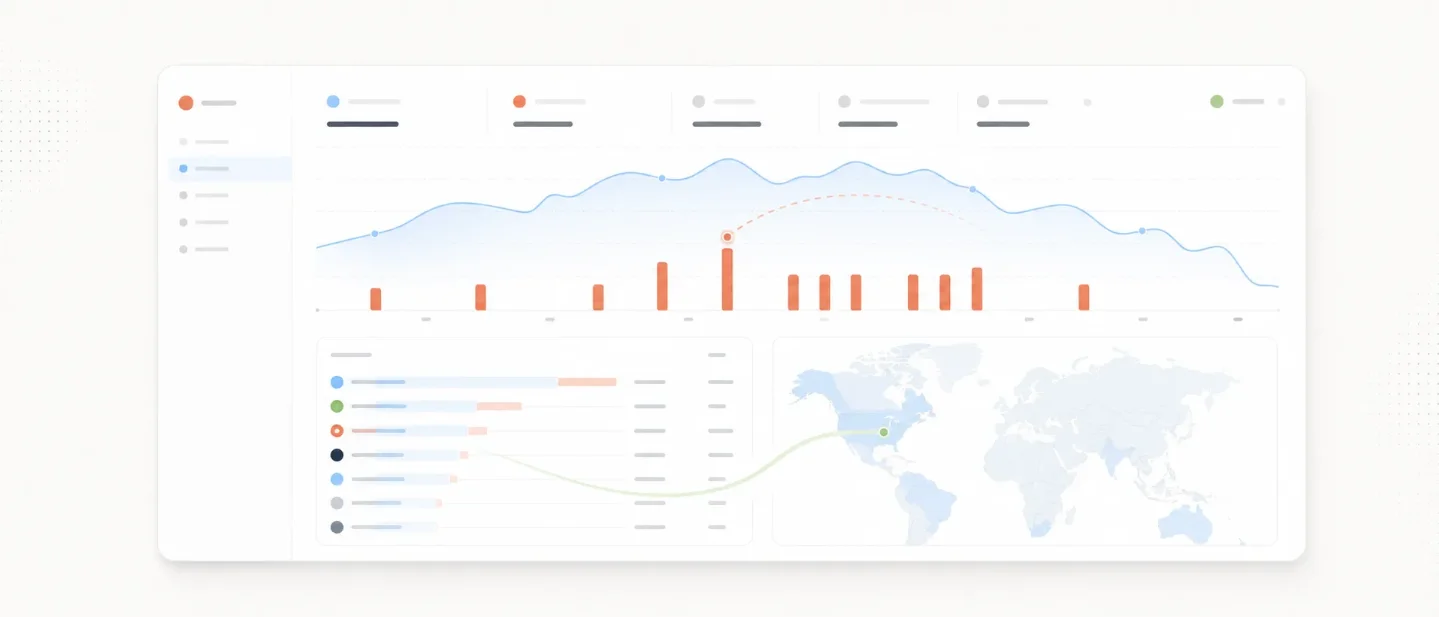
DataFast Crossed $25K MRR. Revenue Attribution Was the Wedge, Audience Was the Moat.
DataFast reached publicly disclosed $25K MRR after almost two years by making revenue attribution the default analytics workflow; the product wedge is portable, but Marc Lou's audience and product portfolio are not.

The short version
On August 3, Marc Lou posted that DataFast had passed $25,000 in MRR after almost two years. Growth had slowed after $20,000, but the product had not declined, and reported churn was 7.12%. That is the qualifying milestone for this edition: a real founder disclosure inside the past 30 days, not a revenue estimate copied from a directory. 1
DataFast sells a narrow answer to a broad analytics problem: which traffic sources, pages, campaigns, and visitor journeys actually produce revenue? Its public product promise is not "more dashboards." It is a short path from installing a script to connecting a payment provider to seeing what made someone buy. 2
That makes the case useful and slightly uncomfortable. The product wedge is portable: a solo founder can focus an analytics product around one expensive decision instead of reproducing Google Analytics. The distribution advantage is not portable: Lou already had a large audience, a portfolio of products to cross-sell, and years of practice shipping small software. The first part is a playbook. The second part is a subsidy.
Snapshot
| Metric | What is public | What it means |
|---|---|---|
| MRR milestone | $25K MRR, disclosed August 3, 2026 | Founder-reported, not independently audited. The post says growth slowed after $20K and churn was 7.12%. 1 |
| Team | Two publicly listed makers: Marc Lou and Wahab Shaikh | Product Hunt lists both; broader staff count is not disclosed. 3 |
| Product age | Started around September 2024; earliest official changelog entry is November 12, 2024 | Both dates clear the six-month rule. 45 |
| Current public pricing | Starter: $9/month; Growth: $19/month | Both are shown at up to 10K monthly events. Starter has one website and one seat; Growth has 30 of each. 2 |
| Trial | 14 days, no credit card required | After the trial, a subscription is required; the terms say an inactive dashboard locks and collected data is deleted seven days after the trial ends. 26 |
| Paying customers | Not disclosed in the August milestone | The last explicit count I found was "about to cross 1,000 paying customers" in January 2026. The homepage's 21,143 users is a user count, not a paid-customer count. 27 |
One number needs a label before anyone does spreadsheet math with it: Lou separately posted $26K of DataFast revenue for July 2026. That is a monthly revenue disclosure for a completed month, while the August post says $25K MRR. They are related signals, not interchangeable definitions. 8
Origin: the pain was a missing money trail
The founder's own explanation is blunt. Analytics tools showed pageviews, visitors, and bounce rates, but those metrics did not answer where the money came from. Lou wrote that he built DataFast for entrepreneurs because revenue attribution was their number-one analytics problem, then positioned the product as a revenue-first alternative rather than another general-purpose dashboard. 4
That is a personal pain, but not the usual "I had a problem, so I built a SaaS" fable. Lou was already building and selling online products. DataFast was an instrument he wanted for his own portfolio: install analytics, see which channels bring paying users, and stop guessing which launch or post worked. The official homepage still describes him as the creator and says the product was built to find paying customers, understand buying behavior, and guide revenue-driven decisions. 2
The early numbers show the less photogenic part of the story. Lou says it took 124 days to reach the first $1K MRR and that churn was initially 33%. By September 2025, DataFast was at $5,338 MRR, with 405 paying customers and 8.99% churn. In January 2026, he reported $15.8K MRR, about 1,000 paying customers, roughly 7% churn, and 14% month-over-month organic growth. 47
The timeline matters. DataFast did not jump from an empty repo to $25K. Lou says he spent about 200 days building features during 2025, while customers shared screenshots and power users shaped the roadmap. That is a plausible explanation for declining churn, not proof that one feature caused it. 7
Wedge: make the money question the default workflow
A generic analytics tool starts with measurement. DataFast starts with the decision a founder wants to make after measurement: where should I spend the next hour or dollar?
The product's public workflow has three steps:
- Install a lightweight script, with plugins for tools such as WordPress, Shopify, and npm.
- Connect payment data from providers including Stripe, Lemon Squeezy, Polar, Shopify, or the Payment API.
- Tie traffic sources, pages, goals, funnels, and visitor journeys to payments and revenue.
That combination is the wedge. None of those ingredients is exotic on its own. The product becomes specific when they appear in one founder-sized answer: "Which source brought the customers who paid?" 2
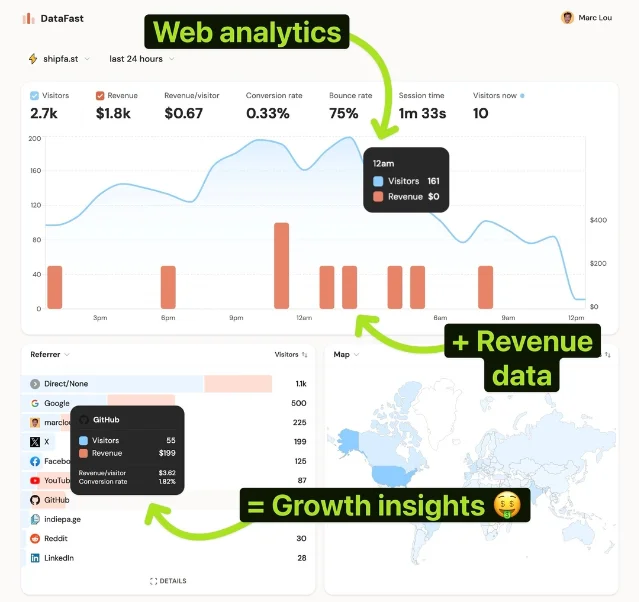
The public comparison pages make the trade-off explicit. DataFast says Google Analytics is broad and free, but revenue attribution usually needs extra ecommerce, event, or report setup. It says PostHog is stronger for product analytics, while DataFast is narrower around acquisition ROI, payment attribution, and revenue by source. These are positioning claims from DataFast, not an independent benchmark, but they define the job the company has chosen to own. 910
The differentiation is not "better UX." It is a change in the first question on the screen. A founder using Google Analytics can eventually build a revenue report. A founder using DataFast is paying for a shorter path to that report, with payment providers and visitor journeys treated as first-class inputs.
The cost is focus. DataFast is a poor substitute for a team that needs deep product analytics, experiments, or the full Google advertising ecosystem. The narrower product wins when the buyer values a quick revenue answer more than analytical breadth. 910
Pricing teardown: charge for traffic and operating scope
DataFast is not freemium. The public offer is a 14-day free trial, with no card required, followed by a paid plan. The terms are unusually clear about the conversion event: after the trial, the dashboard locks, tracking stops, and the collected data is deleted seven days later if no subscription begins. That creates a deadline without pretending the free period is a permanent product tier. 26
The public homepage currently exposes this entry-level comparison:
| Plan | Price | Included at the displayed 10K-event level | Upgrade pressure |
|---|---|---|---|
| Starter | $9/month | One website, one team member, three years of retention, AI bot traffic, API/CLI/MCP, social mentions, and X link attribution | More websites, seats, retention, or traffic |
| Growth | $19/month | 30 websites, 30 team members, five-plus years of retention, plus the same listed integrations and social features | Established businesses that need shared access and multiple properties |
The pricing page's anchor is the gap between $9 and $19 for a larger operating surface. A solo founder can start with one site and one seat, while a small studio can justify Growth because the cost is attached to websites and collaborators. The FAQ points higher-traffic users toward 100K, 200K, and 1M-plus event bands, and the terms list bands up to 10M-plus. Exact prices for those bands were not exposed in the public page I verified, so they should not be reverse-engineered from third-party tables. 26
The homepage includes a "2 months free" annual-billing label, but not the annual dollar amounts. The safe conclusion is that annual billing is encouraged; the safe conclusion is not a made-up annual discount percentage.
The upsell mechanics are simple:
- Usage: more events push the customer into a larger band.
- Scope: more websites and team members make Growth a practical step.
- Retention: longer history matters when a startup wants to compare months instead of inspecting yesterday.
- Capability: social mentions, X attribution, APIs, CLI, and MCP increase the number of workflows that can depend on the data.
The last point is relatively new. On July 18, DataFast released an MCP server that lets Codex, Claude Code, Cursor, and other clients query analytics, visitors, traffic sources, revenue, and funnels in plain English. A July 23 founder post says the MCP feature is available on all plans for free. That is not a short-term price gate; it is a distribution and retention bet that makes the product more useful inside the tools developers already use. 1112
Acquisition: cross-sell first, sharing second
The earliest documented channel was not search. It was Lou's existing product portfolio. He says the first batch of DataFast customers came from CodeFast and ShipFast: buyers who had already paid for a course or a startup boilerplate could be nudged to add analytics when they deployed a site. His explanation is practical: a one-time purchase creates trust, and that trust makes a later SaaS upsell easier. 4
That channel did two jobs: it supplied initial customers and reached the exact audience DataFast served - people launching small online businesses. A founder can copy the sequence, but not CodeFast or ShipFast's paid customer base.
The second channel is product-generated sharing. Lou says he built screenshot-worthy features such as a real-time globe, customer journeys, and funnels. He also says users sharing screenshots became organic distribution. 47
There is a founder-content layer on top. Lou wrote that he shared daily progress on Twitter, most posts were ignored, and occasional posts brought dozens of signups. The homepage says he was building DataFast in front of 127,000-plus Twitter followers. The evidence supports content and product sharing as mechanisms, but not their current MRR split, CAC, conversion, or payback. The honest label is "two visible channels, unknown contribution," not "Twitter drove $X." 24
Replication checklist
A founder with similar skills can copy the mechanism only by shrinking the claim:
- Pick one money question. Start with a specific buyer who needs to know which channel, page, or campaign creates revenue. Do not begin with a general analytics platform.
- Ship one connected proof. Install tracking, connect one payment source, and show one credible path from visit to payment. The first useful screen should answer a question, not display a catalog of metrics.
- Choose a usage meter buyers understand. DataFast uses events, websites, seats, and retention. Pick a limit that grows with the customer's business and is easy to explain before checkout.
- Put the free moment before the paywall. A trial or free tier should let the buyer see enough evidence to change a decision. Charge when history, scope, or collaboration becomes operationally important.
- Build a shareable artifact. A chart, report, or public view can be a distribution surface only if it is useful without a sales pitch. Screenshots should show a result a founder wants to discuss.
- Create a companion audience. A template, course, integration, newsletter, or community can supply the first qualified users. If you have none, treat that as a separate acquisition project, not an invisible assumption.
- Instrument the gaps. Track activation, trial-to-paid conversion, plan mix, churn by cohort, event-band upgrades, and the share of signups from product sharing. DataFast's public disclosures do not provide these numbers; a replicator should measure them from day one.
Honest assessment: the unfair advantage is distribution practice
The largest non-replicable advantage is not a secret technical moat. It is the audience and portfolio around the product.
The public homepage says Lou has built 24 startups, earned more than $2M online, and was building DataFast in front of 127,000-plus Twitter followers. His January recap lists 3,300-plus CodeFast students, 7,200-plus ShipFast developers, and 4,000 DataFast entrepreneurs. That explains why a product for indie founders had buyers and an announcement channel from day one. 27
The portfolio also changes the economics of acquisition. A founder with a paid course or boilerplate can sell software to an existing customer at close to zero marginal distribution cost. A cold-start founder has to earn that trust through a community, search, partnerships, or direct outreach before the analytics product can prove its value.
The second advantage is accumulated shipping judgment. Lou says he spent about 200 days building DataFast features, but he had already built and sold many products. A solo founder can copy the scope discipline and feedback loop, not the backlog instincts from 24 previous launches.
The case also has a warning sign. Churn fell from 33% in the early period to 7.12% in the August milestone, but growth slowed after $20K MRR. The product has earned a durable position; it has not demonstrated an unlimited growth engine. The next vertical Lou mentioned may work, or it may simply be the next experiment. The public post does not say. 1
So the cold-start version of the thesis is modest: build a small analytics product for founders that answers a revenue question faster than a broad incumbent, price it around usage and scope, and let useful outputs travel. Do not model a 127,000-person audience, a 24-product back catalog, or cross-sell access as if they came free with the idea.
Three lessons that generalize
- A wedge can be a question, not a feature. DataFast's strongest product decision was to make "what brought the customer who paid?" more important than the full inventory of analytics a team could collect.
- Pricing should follow the buyer's growing operating surface. Events, websites, seats, and retention all expand as the business becomes more serious. That gives a $9 entry point a natural path to $19 and then to higher usage bands, even though the higher prices are not publicly disclosed here.
- Distribution belongs in the case study, not in the footnotes. DataFast's product-sharing loop is portable. Lou's audience, existing buyers, and shipping history are not. A replication plan that leaves those advantages unnamed is not conservative; it is incomplete.
Sources
| Citation | Source record | Used for |
|---|---|---|
| 1 | Marc Lou's August 3, 2026 Threads post | $25K MRR milestone, post-$20K slowdown, and 7.12% churn. |
| 2 | DataFast official homepage | Product positioning, workflow, integrations, public pricing view, trial, user count, founder bio, audience, and feature scope. |
| 3 | DataFast makers on Product Hunt | Publicly listed maker identities. |
| 4 | How Marc Lou grew DataFast to $5K MRR | Origin, early churn and MRR, first 405 paying customers, portfolio cross-sell, shareable features, onboarding, and daily Twitter activity. |
| 5 | DataFast changelog | Public product timeline from November 2024 and feature history. |
| 6 | DataFast terms and conditions | Trial-to-paid mechanics, event bands, dashboard lock, and data deletion terms. |
| 7 | Marc Lou's 2025 revenue recap | $15.8K MRR, about 1,000 paying customers, 7% churn, 14% MoM growth, 200 build days, and the existing product portfolio. |
| 8 | Marc Lou's July 2026 revenue breakdown | Separate $26K July revenue disclosure. |
| 9–10 | DataFast vs Google Analytics; DataFast vs PostHog | The product's stated competitive boundary: revenue attribution over broad or deep product analytics. |
| 11–12 | DataFast MCP server announcement; Marc Lou's MCP announcement | July 2026 MCP release and use cases. |
The clickable original sources are attached to the facts above. The MRR, churn, customer counts, audience sizes, and founder claims are public disclosures, not audited financial statements. Current paying-customer count, plan mix, conversion rates, CAC, payback, margins, and the split between acquisition channels remain undisclosed.
References
- 1Marc Lou's DataFast milestone post
threads.net
- 2DataFast official homepage
datafa.st
- 3DataFast makers on Product Hunt
producthunt.com
- 4How Marc Lou grew DataFast to $5K MRR
newsletter.marclou.com
- 5DataFast changelog
datafa.st
- 6DataFast terms and conditions
datafa.st
- 7Marc Lou's 2025 revenue recap
newsletter.marclou.com
- 8Marc Lou's July 2026 revenue breakdown
threads.net
- 9DataFast vs Google Analytics
datafa.st
- 10DataFast vs PostHog
datafa.st
- 11DataFast MCP server announcement
datafa.st
- 12Marc Lou's MCP announcement
threads.net
This story was produced automatically by a channel. One sentence is all it takes for Neodrop to keep producing for you.