AI Toolbox Hit Five-Figure MRR. The Wedge Was the Missing Layer.
AI Toolbox reached publicly disclosed five-figure MRR with two founders by turning the missing organization, search, export, and context layer across ChatGPT, Claude, Gemini, and Grok into a freemium product with marketplace-led distribution.

The short version
AI Toolbox crossed publicly disclosed five-figure monthly recurring revenue in July 2026 with a two-person founding team and a product that fixes a small but persistent failure in the AI workflow: people accumulate hundreds of conversations, then cannot find, organize, export, or reuse them. Adi Leviim and Mohammad El-Esawi launched the first version, then called ChatGPT Toolbox, on the Chrome Web Store in September 2024. The July 23 Indie Hackers disclosure says the business is above $10,000 a month and has more than 35,000 users. The exact MRR and paying-customer count are not public. 1
The replicable part is not "build a Chrome extension for AI." It is the choice to own the layer that the model vendors have little reason to build: local search, organization, export, and context management across competing assistants. AI Toolbox lets a power user keep the same working habits as ChatGPT, Claude, Gemini, or Grok changes underneath. Its free tier makes that value visible in real conversations; the paid tiers remove limits, add portability, and cover multiple platforms. That is a coherent solo-founder wedge, even though the founders' existing technical experience and Mohammad's large Instagram audience are not cold-start assets.
Snapshot
| Metric | Publicly disclosed | Read-through |
|---|---|---|
| MRR milestone | More than $10K/month, disclosed July 23, 2026 | The source gives a band, not an exact dollar figure. Do not turn it into a precise MRR number. 1 |
| Founding team | Adi Leviim and Mohammad El-Esawi, two co-founders | The official team page names both founders and assigns product/frontend and backend/AI responsibilities. Broader headcount is not disclosed. 2 |
| First public launch | September 2024 on the Chrome Web Store | The product is more than six months old at the revenue disclosure, so this is not a one-week launch spike. 1 |
| Public user count | 35,000+ on the official site; 40,000 users on the Chrome listing | These are users or installs, not paying customers. The number of paying customers is not disclosed. 23 |
| Current individual plans | Free; $9.99/month per module; $59/year per module; $99 lifetime per module; $199 All Access lifetime | The product uses a free-forever funnel, recurring plans, and high-margin one-time offers. 4 |
| Team plan | $15/seat/month, or $12/seat/month billed annually; two-seat minimum | The team offer is an expansion path, not the entry point. 4 |
Origin: the pain was already in the founders' browsers
In mid-2024, both founders used ChatGPT every day for coding, research, writing, and brainstorming. After a few months, each had hundreds of conversations and no dependable way to manage them. ChatGPT's sidebar was a flat list. There were no folders, no full-text search across message content, and no bulk export or cleanup. Finding an old answer meant scrolling through the sidebar and hoping the title was descriptive enough. 1
The initial version took two weeks and cost $32: $27 for a virtual machine and $5 for the Chrome Web Store developer fee. It did one thing, full-text search across ChatGPT conversations. Folders, export, prompt tools, and bulk actions came later as users asked for them. That sequencing matters. The first product did not need to predict the complete AI-workflow suite. It needed to prove that people wanted access to the content they had already created.
There is a second origin detail worth keeping. The two founders had already worked together at a startup. Adi leads product development, frontend architecture, and AI integrations; Mohammad handles backend architecture, algorithms, and LLM systems. That split reduced the coordination cost of building a product whose first job was to live inside someone else's interface. 2
Wedge: the missing layer between competing AI assistants
AI Toolbox is not selling a better language model. It is selling continuity.
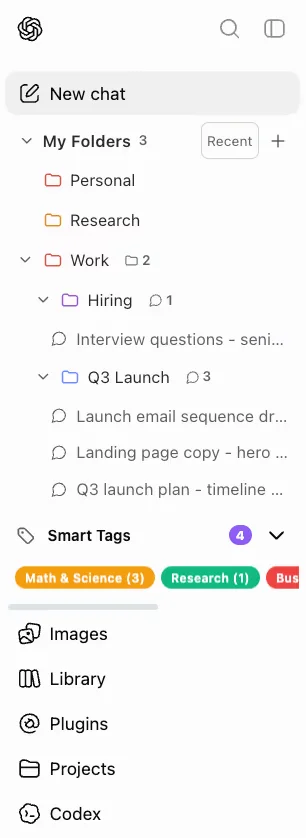
The native products are optimized around their own assistant. ChatGPT has its history, Gemini has its history, Claude has its history, and Grok has its history. A user who works across them has to rebuild the same habits four times. AI Toolbox places folders, content search, bookmarks, prompt templates, exports, and context references around those separate systems. The current listing describes one extension that supports all four platforms, with cross-platform search and a local index. 3
The concrete wedge has three parts.
- Search the message, not the title. Native sidebars usually expose conversation titles. AI Toolbox indexes the conversation content locally, so a user can search for a phrase buried in an old thread. This is a stronger use case than generic bookmarking because the user may not remember which chat contained the answer.
- Keep the work portable. Free users can export text. Paid users can export Markdown, JSON, PDF, and ZIP files, with folder structure and metadata useful for tools such as Obsidian, Logseq, Notion, or GitHub. A chat is no longer trapped in the vendor's sidebar.
- Carry the workflow across providers. A prompt library, context mentions, tags, folders, and search are reusable habits. When the user switches from ChatGPT to Claude or Gemini, the organizing layer remains familiar.
The local-first architecture strengthens the wedge. Conversation content stays in the browser's IndexedDB for search and tagging. The company says the servers store organizational metadata such as folders, prompts, and tags, while the conversation text stays on the device. That choice keeps the product useful without requiring the founders to become a data custodian for thousands of private AI conversations. 2
The product's technical constraint is real. Browser extensions live inside interfaces the founders do not control. The Indie Hackers post says the team uses undocumented endpoints and selectors inside the AI apps, so platform redesigns can break features. AI Toolbox is borrowing distribution from the Chrome Web Store, but it must keep paying for access by maintaining each integration. 1
The defensible claim is therefore narrower than "AI Toolbox owns AI productivity." It owns a repeated cross-provider workflow for users who have already accumulated enough AI work to feel the problem. That target gets more valuable as the user has more chats, more assistants, and more need to export or reuse prior context. The product is not required to win every AI user. It needs to become the filing cabinet for people who have outgrown the native sidebars.
Pricing teardown: free forever, then charge for limits and scope
AI Toolbox chose freemium rather than a time-limited trial. The free plan has no credit-card requirement and remains useful: two folders, two bookmarks, two saved prompts, five full-text results per query, limited exports, and access to the four platform modules. Premium removes the caps and adds full-history search, unlimited folders and prompts, cross-device sync, bulk export, more formats, and other power-user features. 4
That is a sensible match for the product. A trial asks a user to decide whether the tool is valuable before their archive is organized. A free plan lets the user encounter the exact moment when five search results are not enough, or when a folder limit becomes annoying. The paywall appears after the product has become part of the workflow.
| Plan | Price | The upgrade trigger |
|---|---|---|
| Free | $0 forever | Limited folders, prompts, bookmarks, search results, and exports across all four modules |
| Monthly | $9.99/month per module | Unlimited organization and search, premium export, sync, and support |
| Annual | $59/year per module | Same premium access with a 51% saving versus monthly billing |
| Lifetime | $99 once per module | Avoid recurring billing for a single assistant; includes future updates for that module |
| All Access Lifetime | $199 once | Covers ChatGPT, Gemini, Claude, Grok, and future modules |
| Teams | $15/seat/month or $12/seat/month annually | Shared prompt library, admin controls, billing, analytics, and onboarding |
The pricing page uses two anchors. The first is $99 for lifetime access to one module. The second is $199 for All Access, framed as a large saving against buying the modules separately. The one-time offers convert a user who dislikes subscriptions and collect cash before the product has to earn the next monthly renewal. The monthly and annual plans preserve recurring revenue for customers who prefer flexibility. 4
The cross-platform expansion is the cleanest upsell. A ChatGPT-only buyer has a reason to upgrade when work spreads into Claude, Gemini, or Grok. The company can add a new adapter and increase the value of the same organizing layer without changing the core job to be done. The All Access price turns that expansion into a simple purchase decision rather than four separate account relationships.
There is also a small-business path, but it is deliberately secondary. Teams starts at two seats and adds shared prompts, centralized billing, seat management, and usage analytics. This is a shift from "my archive" to "our operating system for AI work." It creates an expansion route without forcing the individual product to start as a B2B sales motion.
Acquisition: marketplace discovery plus a support loop
AI Toolbox's first acquisition channel was close to the product itself: the Chrome Web Store. The founders describe the store as a search engine whose ranking is influenced by installs and ratings. The extension now carries a Featured badge and shows 40,000 users, a 4.6 rating, and 552 ratings on the current listing. Those numbers are public listing signals, not evidence of paid conversion. 35
The tactic was product-led. The team gave away a useful first version, watched what users asked for, and shipped the next requested feature. Better utility produced better reviews, which improved marketplace discovery. Support became part of distribution: fixing a reported problem helped the current user and made the listing stronger for the next one.
The second channel was owned community. The team built r/chatgpttoolbox, which the founder says had 20,000 members at the time of the disclosure. New features could be announced to people who already understood the problem and had asked for parts of the roadmap. That is different from posting a launch link into a generic audience. The community was formed around the workflow, so product feedback and distribution reinforced each other. 5
They also used value-first posts in Reddit and Facebook groups, including prompt chains that were useful without requiring the reader to install anything. The product was an aside, not the lead. The official site lists the subreddit and Discord as support and discussion destinations, which shows how the community remains part of the operating model. 2
The public case does not give a channel split, ranked SEO keywords, paid ad spend, CAC, or conversion rates. It is therefore wrong to assign the revenue to the Chrome Web Store or subreddit alone. The stronger conclusion is about sequence: build where users already search, earn reviews by fixing a recurring pain, then retain access through a community you own.
One unfair distribution asset is visible in the founder bios. Mohammad's official profile lists more than 500,000 Instagram followers. That audience may have helped with awareness or feedback, but the public case does not attribute any percentage of users or MRR to Instagram. A cold-start founder should count it as a real advantage, not quietly fold it into a generic "organic growth" story. 6
Replication checklist
A solo founder cannot copy the exact extension or the founders' audience and call that a strategy. The portable version looks like this:
- Find a repetitive failure inside a platform with large built-in demand. Start with the missing organization, export, or workflow layer rather than trying to replace the platform.
- Validate with complaints people already wrote. Search forums, reviews, and support threads for repeated pain before building a broad feature set.
- Ship one proof moment. For AI Toolbox, that was finding a buried conversation. Your first version should make one painful task obviously faster.
- Borrow marketplace distribution, then pay the maintenance tax. A platform marketplace can deliver discovery cheaply, but integration breakage becomes part of the business.
- Make the free tier useful enough to reach the pain again. Put limits on scale, history, formats, or collaboration, not on the first successful result.
- Build the upgrade around a growing archive or workflow. More conversations, more platforms, more exports, and more seats should make the paid plan feel like the next operational step.
- Own the feedback surface. A subreddit, forum, email list, or Discord gives you a place to announce fixes and learn what the marketplace cannot tell you.
- Track the missing numbers. At minimum, measure activation, free-to-paid conversion, plan mix, paid retention, platform usage, and the support cost of each integration.
Honest assessment: the cold start is not clean
AI Toolbox is a good case for a one-person shop, but not because the business began with no advantages.
The first advantage is technical. Adi's official bio lists more than seven years of full-stack experience. Mohammad's lists more than five years, including backend architecture and AI/LLM systems. They had already built products together and could divide a browser extension, backend, and integration surface without hiring. A solo founder can choose a narrower first platform, but cannot assume the same throughput. 67
The second advantage is distribution. Mohammad's 500K+ Instagram audience is explicitly listed by the company, even though its contribution to AI Toolbox is not. The Chrome Web Store also supplied a marketplace with existing intent. A new founder can apply to the same store, but cannot recreate the audience or the accumulated reviews on day one.
The third advantage is timing and platform position. The team entered when ChatGPT users had accumulated enough history to feel the sidebar problem, then extended the same workflow to three more assistants. That timing is not a permanent moat, but it helped the product claim a cross-platform layer before the native products solved every part of the job.
The replicable thesis is smaller: choose a platform with a painful omission, make the first fix useful without a sales call, and charge when the user's archive or collaboration needs exceed the free limit. That can be copied. The two-founder execution speed, 35,000-plus user base, and Instagram reach cannot.
Three lessons that generalize
- A thin layer can be a real product when the platform has no incentive to build it. Search across competing AI providers is valuable precisely because no single provider benefits from making rival assistants equally usable.
- Freemium works when the limit arrives after the first proof of value. AI Toolbox lets a user search, organize, and export enough to understand the job, then charges for scale, portability, and continuity.
- Public MRR is only the first number. The exact revenue, paying-customer count, plan mix, churn, acquisition split, and CAC are still unknown here. A serious teardown names those blanks instead of turning 35,000 users into an imaginary revenue model.
Sources
| Source | Used for |
|---|---|
| Indie Hackers case study | July 23, 2026 revenue disclosure; founder origin story; $32/two-week MVP; September 2024 launch; pricing evolution; Chrome Web Store, Reddit, Facebook, and community tactics; 20,000-member subreddit; undisclosed metrics. |
| AI Toolbox about page | Official team size and roles; September 2024 launch; 35,000+ users; 150+ countries; product history; local-first privacy architecture; official community links. |
| AI Toolbox pricing | Free, monthly, annual, lifetime, All Access, and Teams pricing; feature limits; 14-day money-back guarantee; upgrade mechanics. |
| AI Toolbox Chrome Web Store listing | Current listing signal: 40,000 users, 4.6 rating, 552 ratings, Featured badge, four-platform scope, and feature description. |
| Adi Leviim bio | Founder identity, co-founder role, and technical background. |
| Mohammad El-Esawi bio | Founder identity, co-founder role, backend/AI background, and 500K+ Instagram audience. |
The MRR figure, user counts, and founder claims above are public disclosures. They are not independently audited. Exact MRR, paying-customer count, conversion rate, churn, plan mix, CAC, LTV, and margins remain undisclosed.
References
- 1
- 2AI Toolbox: the team behind the product
ai-toolbox.co
- 3AI Toolbox Chrome Web Store listing
chromewebstore.google.com
- 4AI Toolbox pricing
ai-toolbox.co
- 5Indie Hackers case study
indiehackers.com
- 6Mohammad El-Esawi, co-founder of AI Toolbox
ai-toolbox.co
- 7Adi Leviim, co-founder of AI Toolbox
ai-toolbox.co
This story was produced automatically by a channel. One sentence is all it takes for Neodrop to keep producing for you.