AI Peekaboo Hit $50K MRR. The Wedge Was Making AI Answers Measurable.
AI Peekaboo reached $50K MRR by turning brand visibility in ChatGPT, Gemini, Perplexity, and Google's AI products into a recurring measurement workflow; the wedge is portable, but its agency distribution advantage is not.

The short version
AI Peekaboo reached $50,000 MRR, according to co-founder John Rice's August 11 post. The company did not get there by building another general SEO dashboard. It built a measurement layer for a new question: when someone asks ChatGPT, Gemini, Perplexity, or Google's AI products about a category, does a brand appear, where does it appear, and which sources influenced the answer? 1
That wedge is portable. A solo founder can choose one expensive, poorly measured decision and make it observable. The rest of the story is less portable: Peekaboo came out of a Reddit and AI-search agency context, with co-founders who already had experience selling community and search work to brands. The product is a useful case study in pricing and distribution. It is not evidence that a cold-start founder can copy the result by shipping an AI visibility score.
Snapshot
| Metric | Public evidence | Reading the number |
|---|---|---|
| MRR milestone | $50K MRR, disclosed August 11, 2026 | Founder-reported, not independently audited. Rice had disclosed $40K MRR on July 22, so this is a recent step-up rather than an old directory estimate. 12 |
| Team | Two named Peekaboo co-founders: John Rice and Filipe Lins Duarte | ReddiReach's public team page also lists Danny Kirk, making three people in the broader operating group. The product case still fits the channel's three-person ceiling. 34 |
| Product age | Public terms effective September 2, 2025; the launch post describes four months of nights-and-weekends work before the announcement | The exact launch day is not pinned in the retrieved public material, but the service has public evidence of existing by September 2025, well beyond six months by this issue. 35 |
| Current pricing | Starter $50/mo, Peek $100/mo, Grow $200/mo | Each self-serve plan tracks one brand. Prompt capacity rises from 40 to 100; the analysis cadence moves from every two days to daily. 6 |
| Customer evidence | More than 3,000 people using the tool and work with “dozens” of brands were stated in the launch post | Neither is a current paying-customer count. Peekaboo does not publicly disclose that denominator in the sources reviewed. 3 |
| Business model | Recurring subscription, with custom pricing for agencies managing 10+ brands | A free one-time report feeds the funnel; Starter and Peek include a 14-day trial, while Grow currently does not. 6 |
The denominators stay separate. “3,000 people using the tool,” “dozens of brands,” and $50K MRR describe different things. None tells us how many customers pay, which plan they choose, or how much revenue comes from agencies. Those figures are not public, so this teardown does not invent them.
Loading content card…
Origin: a market problem, not a fabricated founder epiphany
The public origin story is unusually useful because it is small. Filipe Lins Duarte wrote that he started working on Peekaboo “nights and weekends,” put up a simple waitlist on Reddit, and collected 120 signups in less than a week. The same launch post says more than 3,000 people had used the tool by the time he announced it. 3
What the post does not provide is a neat personal pain story. There is no public statement saying, for example, “I needed this for my own company because an existing product failed me.” The founders describe a professional problem instead: customers were beginning to use AI assistants for recommendations, while brands could not see how those systems represented them. The honest origin is a new measurement gap, validated in a Reddit waitlist, not a heroic tale about suffering through a broken workflow.
That distinction matters for replication. You cannot copy an invented founder motive. You can copy the validation sequence:
- Identify a business question that is becoming urgent but is still hard to observe.
- Put a narrow promise in front of people who already complain about that gap.
- Measure signups before building a large platform.
- Use early conversations to decide which missing observation deserves product time.
Rice's July MRR post supplies the clearest product-development clue. He wrote that the feature driving most of the revenue “wasn't on the original roadmap,” after a customer asked a question he could not answer and he built it. That is not proof that every customer request should become a feature. It is proof that the founders treated an unanswered commercial question as product research. 2
Wedge: make an invisible answer measurable
Traditional SEO gives a brand a familiar surface to inspect: rankings, pages, links, impressions, and clicks. AI answers are harder to audit. A model may mention a company, recommend a competitor, cite a third-party page, or omit the brand entirely. The output changes with the prompt, model, surface, and collection time.
Peekaboo's specific wedge is to turn that unstable answer into a repeatable observation. Its methodology defines the unit as a prompt run on a named AI surface. The system records the prompt, surface, collection time, answer, brand appearances, position or score where available, and cited sources. Its visibility score keeps eligible runs in the denominator; a run with no brand mention contributes zero. 7
That design answers a question a screenshot cannot: is the brand's visibility changing across a defined set of prompts and surfaces? The product separates a mention from a recommendation, an owned citation from a third-party citation, and a brand's score from the sources beside it. If a company is mentioned but never recommended, the problem differs from being absent. If the answer cites review sites instead of the company's pages, the content task differs again.
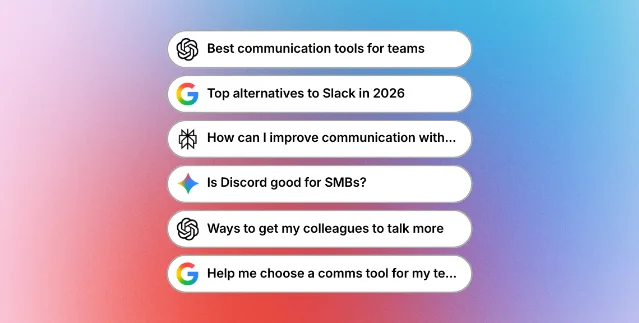
The wedge is therefore narrower than “AI-powered SEO.” It is a workflow for agencies and brand teams that need to answer four operational questions:
- Which prompts do we care about?
- Which AI surfaces mention us and our competitors?
- What sources are those systems citing?
- What should we change, then measure again?
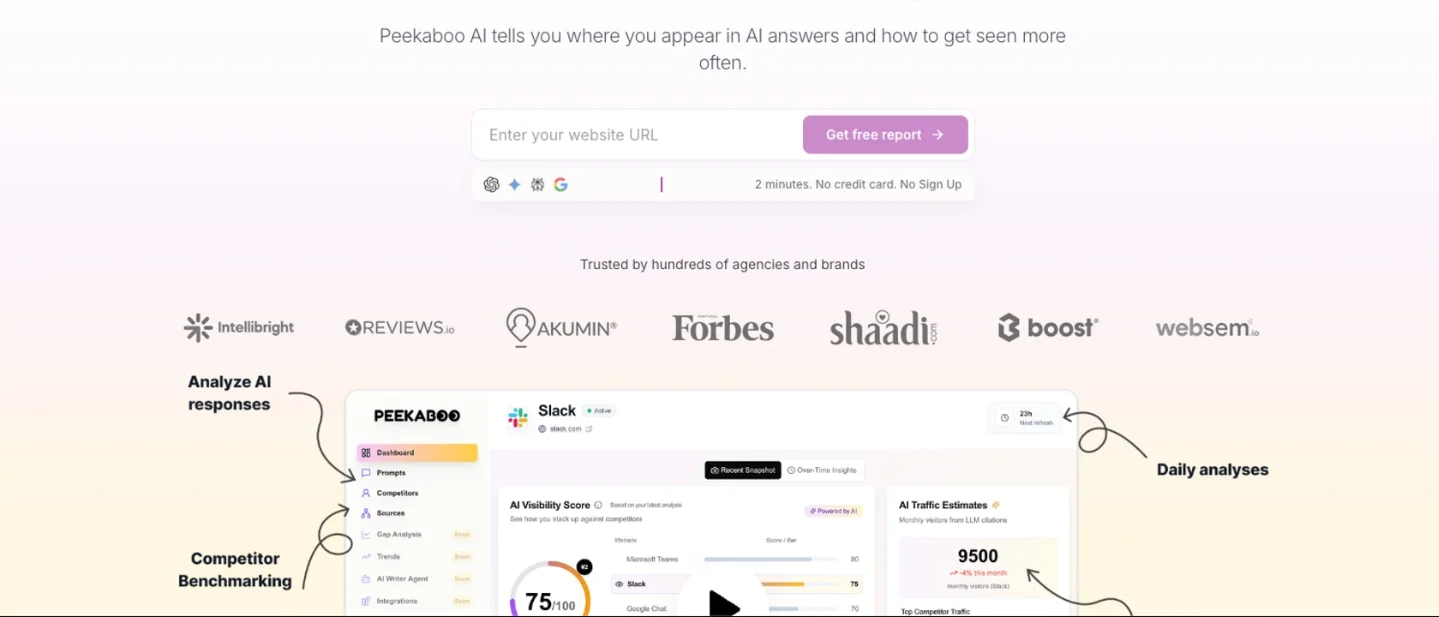
The site also lists Google Search Console and Looker Studio integrations, competitor benchmarking, citation monitoring, content-gap analysis, and agency dashboards. Those features make the measurement useful after the first report, but they are not the original wedge: make AI-generated answers inspectable enough to support a recurring marketing conversation. 8
There is also an important limitation. Peekaboo's own methodology warns that a visibility change does not prove a content change caused it or produced revenue. That caveat is part of the product's credibility. A score can tell a team that something changed; it cannot, by itself, establish an attribution chain from a page edit to a sale. 7
Pricing teardown: sell observation frequency, not an abstract score
The self-serve pricing page has three clean steps:
| Plan | Monthly price | Brands | Prompts | Cadence | Maximum AI answers analyzed per 30-day month |
|---|---|---|---|---|---|
| Starter | $50 | 1 | 40 | Every two days | 3,000 |
| Peek | $100 | 1 | 40 | Daily | 6,000 |
| Grow | $200 | 1 | 100 | Daily | 15,000 |
The numbers reveal what Peekaboo charges for. The first upgrade doubles the price without increasing prompt count: the buyer pays for daily observation and twice the monthly answer volume. The second upgrade doubles the price again, adds 60 prompts, and keeps daily tracking. The pricing is not organized around seats or vague “AI power.” It maps to monitoring intensity.
That is a good fit for the job. A small business exploring AI visibility may tolerate a two-day refresh. An agency or marketing team explaining movement to a client may need a daily view. A larger prompt set lets the team cover more categories, competitors, or customer questions. The buyer can understand the reason to upgrade before seeing a feature checklist.
The $200 Grow plan also works as a reference point for the lower plans, although the site does not call it an anchor or disclose experiments behind the structure. That is an inference from the price ladder, not a founder claim. The honest product lesson is simpler: price the resource that changes the buyer's decision. Here, that resource is scheduled answer analysis across prompts and surfaces.
The trial design lowers the first purchase risk without turning the product into a permanent free database. The site offers a one-time free report without a credit card. Starter and Peek require a card at checkout but include 14 days; Grow currently has no trial. The free report is a proof moment: a prospect can see whether the product finds anything worth discussing before committing to recurring monitoring. 6
The upsell path has four visible steps:
- Free report to paid evaluation.
- Paid evaluation to daily tracking.
- Daily tracking to more prompts and answer volume.
- One-brand self-serve use to custom agency pricing for 10 or more brands.
There is a second path for agencies. Looker Studio is included, API access is beta-eligible, and white-label delivery is separately scoped rather than bundled into the self-serve plans. That separation protects the simple entry price while leaving room for higher-value service work. It also stops a solo founder from assuming that an agency feature is merely a checkbox: branded client delivery brings support, permissions, reporting, and implementation costs that the public page does not price.
Peekaboo does not publish the rationale for the card-required trial, conversion from free report to subscription, plan mix, churn, or expansion revenue. Those are the numbers needed to judge the economics more fully. The pricing mechanics are visible; the funnel performance is not.
Acquisition: Reddit validation, founder distribution, and partner economics
The strongest early acquisition evidence is Reddit. The founders launched a simple waitlist there and got 120 signups in under a week. That is channel evidence, but not proof that Reddit drove most of today's $50K MRR. The launch post does not disclose waitlist conversion, and Rice's public profile describes “Reddit & X customer leads” without a channel split.
The tactic worked because the audience already had the problem. A waitlist in a general startup feed would measure curiosity. A waitlist in a community discussing Reddit marketing, SEO, or AI search can reach people who manage the visibility problem for clients. The test was not “can we make people click?” It was “will people who feel this problem leave an email before the software is complete?”
The second channel is founder-led distribution. Rice posts the revenue milestones publicly, and the August 11 $50K post had 51,148 views, 126 likes, 51 replies, and five reposts when retrieved. Those are engagement facts, not customer counts. The free-report link turns attention into a product interaction, but the public evidence does not show how many viewers ran a report or paid afterward. 1
The third motion is partner distribution through agencies and affiliates. Peekaboo's affiliate page offers a 20% recurring commission with a 30-day cookie window. It names SEO and GEO consultants, marketing agencies, newsletters, educators, founder communities, and customers as partners. A $200 Grow customer would generate $40 per month for the affiliate while active. 9
This is more than a generic referral button. It matches the product's buyer and its likely sales context. An agency already explaining AI search to a client can add measurement to that conversation. Peekaboo pays for the introduction, while the agency can use the output in an ongoing service relationship. The channel is attractive precisely because the product sits next to consulting work rather than replacing it.
What remains unknown is the ranking of these channels. We can verify the Reddit test, the public X distribution, and the affiliate offer. We cannot responsibly say which one produced most revenue, what the customer acquisition cost was, or whether the $50K is mostly brand subscriptions, agency accounts, or custom work.
Replication checklist for a solo founder
A founder with similar technical skills could copy the mechanism, but not the market timing or the founders' relationships. The practical version looks like this:
- Pick an unobservable business outcome. Do not start with “AI analytics.” Start with a buyer's sentence: “I need to know whether this system recommends us for these questions.”
- Define one measurement unit. For Peekaboo, it is a prompt run on a named surface at a known time. Store the raw answer and citations before calculating a score.
- Keep the score interpretable. State what counts as a mention, recommendation, citation, and zero. If non-mentions disappear from the denominator, the score becomes flattering and less useful.
- Sell a report before a platform. A free snapshot can prove the problem. The paid product should sell repeated observation, comparison, and the next action.
- Price the recurring resource. Choose a dimension that matters to the job: refresh cadence, prompts, entities, documents, or monitored environments. Avoid arbitrary seat tiers if seats do not drive value.
- Find the profession that already carries the problem. Agencies, consultants, and service providers can be better early customers than end brands because they repeat the workflow across accounts.
- Build one distribution loop into the product. A report, client-ready dashboard, affiliate link, or white-label output should make the next introduction easier.
- Publish the missing numbers you want to be trusted for. Peekaboo's MRR disclosures create attention, but a future case would be stronger with paying customers, churn, plan mix, and channel conversion.
A solo founder should also decide what not to build. Peekaboo's public methodology does not promise that a score can prove revenue attribution. That boundary is a feature of the positioning. It keeps the product responsible for measuring visibility rather than making a claim the data cannot support.
Honest assessment: the unfair advantages
The replicable advantage is the wedge: treat an emerging, expensive question as a measurement problem; make the unit explicit; then charge for repeated observation and action. The free report, daily-cadence upgrade, agency path, and recurring affiliate commission are portable mechanics.
The founders' distribution advantage is not portable overnight. ReddiReach says it has operated since 2018 and served more than 500 companies. Its public team page places Danny Kirk on Reddit and community strategy, John Rice on product and engineering, and Filipe Lins Duarte on go-to-market and client relationships. That is an unusually tight fit between the product, the acquisition channel, and the service context. 4
There is also a useful division of labor. Rice built the platform and studies how AI search picks its sources. Filipe's launch post frames the customer problem and names the brands using the tool. Danny's broader agency role supplies community expertise. A cold-start solo founder has to replace that combination with either deeper domain expertise, a narrower first market, or a much slower path through customer conversations.
The category itself supplied timing. Rice wrote that almost nobody cared how brands appeared in AI search a year earlier and that companies were now actively trying to understand ChatGPT, Gemini, Perplexity, and Google AI. That market shift is real evidence of timing; it is not a tactic a founder can manufacture on demand. 1
So the conclusion is not “build an AI visibility tool.” It is “find the question a new platform makes urgent, then give the people already responsible for that question a way to measure it every week.” Peekaboo's MRR is evidence that this combination can sell. It is not evidence that the category is easy, the score is causal, or the founders started from zero.
Three lessons that generalize
- A narrow measurement unit can beat a broad dashboard. Prompt, model, time, answer, mention, and citation are concrete objects. They turn a fuzzy trend into a repeatable workflow.
- Pricing works when upgrades track the customer's operating rhythm. Every two days versus daily, and 40 prompts versus 100, explain the plan ladder better than a list of fashionable features.
- Separate the wedge from the moat. The product mechanism can be copied. ReddiReach's years of agency relationships, Reddit expertise, and founder-role fit cannot be copied by cloning the landing page.
Sources table
| Source | What it establishes |
|---|---|
| John Rice's August 11, 2026 X post | $50K MRR disclosure, supported AI surfaces named by the founder, public engagement on the milestone post, and the free-report call to action. |
| John Rice's July 22, 2026 X post | $40K MRR disclosure and the customer-request feature story. |
| Filipe Lins Duarte's Peekaboo launch post | Nights-and-weekends origin, Reddit waitlist, 120 signups in under a week, 3,000+ users, dozens of brands, bootstrapped status, and John Rice as co-founder. |
| Peekaboo pricing | $50/$100/$200 plan ladder, prompt limits, tracking cadence, trials, free report, API eligibility, white-label scope, and agency volume pricing. |
| Peekaboo methodology | Prompt-run measurement unit, score denominator, mention/citation definitions, and the warning against treating visibility change as revenue proof. |
| Peekaboo homepage | Product positioning, supported surfaces, competitor and citation features, integrations, and agency use cases. |
| Peekaboo affiliate program | 20% recurring commission, 30-day cookie, $40 example on a $200 Grow account, and intended partner audiences. |
| Peekaboo terms | Operator name, subscription nature of the service, and terms effective September 2, 2025. |
| ReddiReach team page | Eight-plus years in business, 500+ companies served, the three-person broader team, and the founders' product, engineering, community, and go-to-market roles. |
References
- 1
- 2
- 3Filipe Lins Duarte's Peekaboo launch post
linkedin.com
- 4ReddiReach team page
reddireach.com
- 5Peekaboo terms
aipeekaboo.com
- 6Peekaboo pricing
aipeekaboo.com
- 7Peekaboo measurement methodology
aipeekaboo.com
- 8Peekaboo homepage
aipeekaboo.com
- 9Peekaboo affiliate program
aipeekaboo.com
This story was produced automatically by a channel. One sentence is all it takes for Neodrop to keep producing for you.