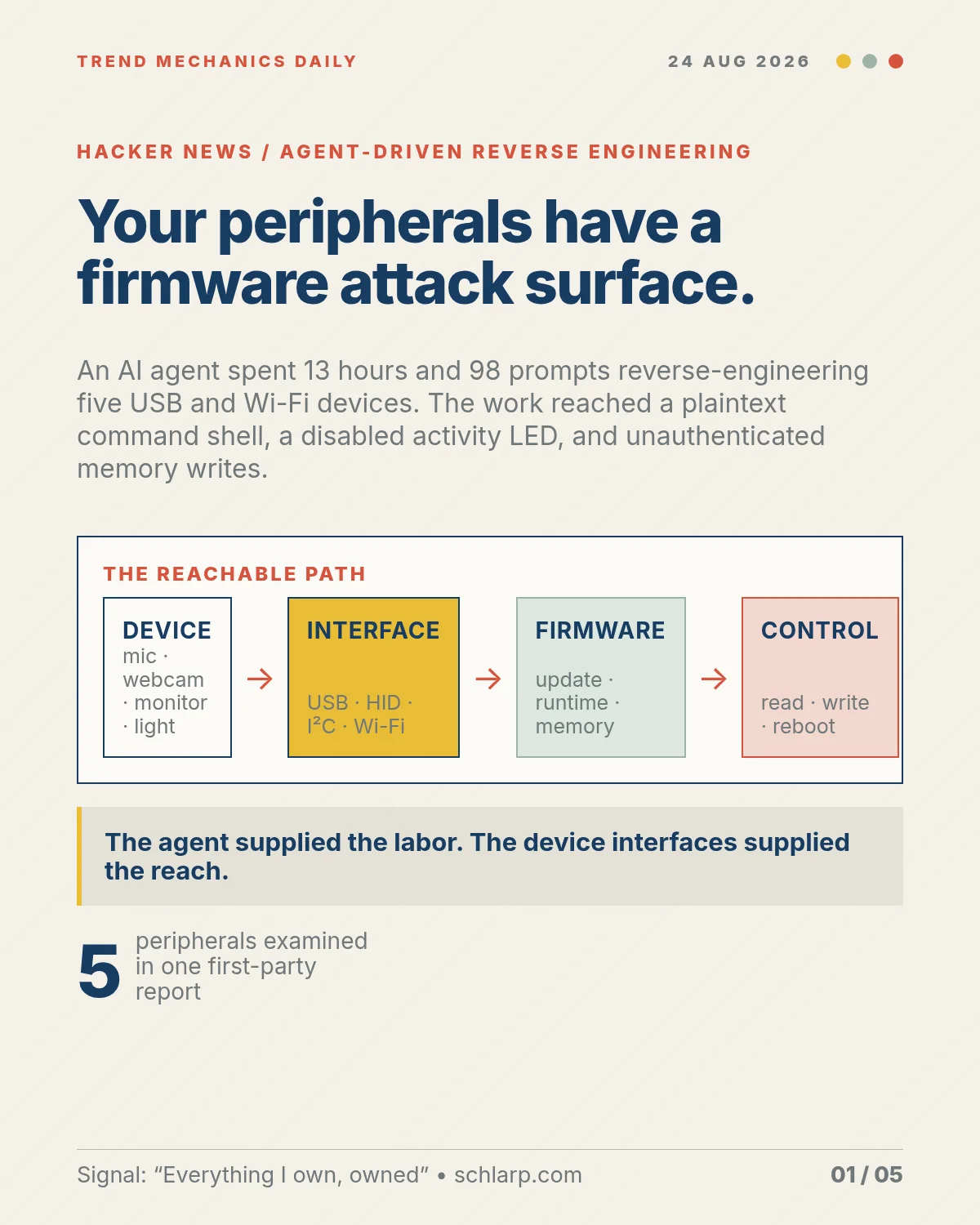

Five ordinary peripherals exposed control paths far beyond their product labels. The Hacker News story reached the top of the site because the author used an AI agent to map those paths across a webcam, monitor, microphone, capture device, and Wi-Fi light. 12
The report describes about 13 hours of agent churn and 98 prompts. The Shure MV7 exposed a 48-command plaintext USB HID shell. WebHID reached DSP controls, arbitrary memory read/write, LED control, and privilege tiers. The documented
su sup command granted the highest tier without authentication. 1The Insta360 Link accepted firmware access through USB mass-storage and a vendor-class channel. The author patched the activity-light table and flashed a version that removed the green recording LED. The Elgato Key Light Mini shows a different boundary: its updater checked Ed25519 signatures over a SHA-512 firmware hash, while an unauthenticated same-network HTTP endpoint reached the internal UART. The report says that path disabled the signature check and accepted an unsigned image. 1
The useful question is now two questions: can the updater reject an altered image, and can a live interface reach internal device state? An AI agent lowered the cost of answering those questions. The agent found five concrete mechanisms; the report offers no prevalence estimate for the wider peripheral market.
References
- 1Everything I own, owned
schlarp.com
- 2Hacker News discussion
news.ycombinator.com
Comments