Five diffusion papers worth reading: August 18, 2026 — workflow routing, diagnostic benchmarks, and pixel-space diffusion
A ranked scan of five fresh diffusion papers on agentic workflow routing, multi-reference diagnosis, modern CFG evaluation, and pixel-space generation and restoration.
A fresh batch of diffusion papers arrived between 17 August 09:00 and 18 August 09:00 (UTC−05:00) in the daily cs.CV/cs.LG window. I could not obtain defensible same-day citation or social-engagement counts for these just-submitted records, so the ranking uses four observable signals instead: method novelty, reported quantitative evidence, affiliation signal, and how easily a researcher can inspect the work through a paper, project page, or repository.
The practical question is not which paper sounds most ambitious. It is which paper gives you enough mechanism, evidence, and caveat to decide whether a full read is worth ten minutes today.
At a glance
| Rank | Paper | What it changes | Best reason to read now |
|---|---|---|---|
| 1 | GenRouter | Routes an image-generation workflow instead of committing to one static pipeline | It turns orchestration overhead into an explicit optimization problem |
| 2 | TRACE-Bench | Decomposes multi-reference generation into four testable operators | It gives researchers a sharper diagnosis than one aggregate score |
| 3 | Revisiting CFG Methods | Re-tests eight training-free guidance methods on modern open-weight transformers | It challenges assumptions that were inherited from older U-Nets |
| 4 | PixRestore | Performs unified restoration with a VAE-free pixel-space DiT | It couples pixel fidelity with a small, single-step generator |
| 5 | Pixel-space training study | Maps a latent-to-pixel training recipe for large-scale text-to-image models | It offers concrete design variables instead of a single architectural claim |
The five papers cover two linked questions. The first two ask how to make complex image-generation systems more controllable and diagnosable. The last three ask whether the field should keep treating the latent space as the default place to compute.
1. GenRouter: route the workflow, not just the prompt
Paper: GenRouter: Unified Workflow Routing for Agentic Image Generation · HTML paper
Authors and institutions: Harold Haodong Chen, Zhiyu Hou, Wen-Jie Shu, Weilin Ruan, Yingjie Xu, Litao Guo, and Ying-Cong Chen; the paper lists affiliations spanning HKUST(GZ), HKUST, SUSTech, ZODA, and CUHK.
Code: EnVision-Research/GenRouter
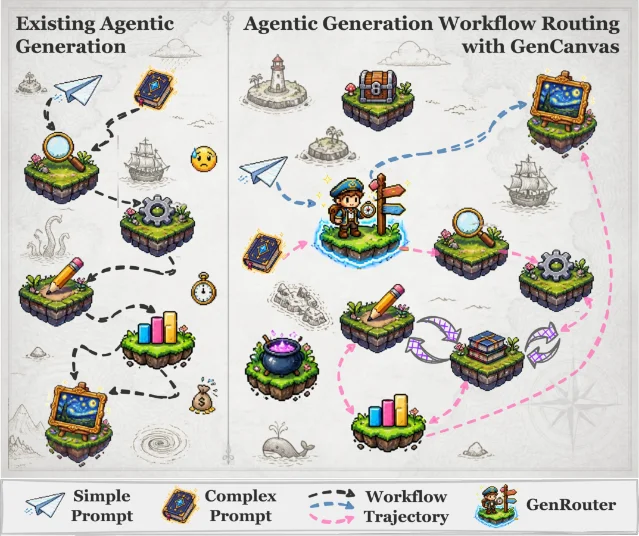
Agentic image generation often fails economically before it fails visually. A system may call several specialized models, tools, or refinement stages even when the request needs only a short path. GenRouter treats that choice of path as the modelled problem: it proposes a unified workflow-routing layer for agentic image generation rather than another isolated generator. The paper's abstract and HTML description frame the system around GenCanvas primitives and templates, demand profiling, experience matching, and Pareto filtering.
The technical insight is to make routing operate over reusable workflow pieces. Demand profiling estimates what the request needs; experience matching brings in previously useful workflows; Pareto filtering removes candidates that are simultaneously worse on the relevant trade-offs. The result is closer to a policy over generation procedures than to a single prompt-to-image model.
The authors report more than 95% lower execution cost and 65% lower latency against heavyweight static pipelines, and they report that self-evolution can halve routing overhead. Those are author-reported system results, so the comparison details and workload assumptions matter more than the headline percentages; inspect the HTML paper and the code repository before treating them as a general scaling law.
The paper's overview figure makes the unit of optimization visible: a routed workflow assembled from generation operations, rather than a single denoising network. 1
Why it matters: Researchers building tool-using or multi-model image systems can now ask whether their contribution improves the generator, the router, or the interaction between both. Read this first if your bottleneck is orchestration cost, latency, or the inability to reuse successful workflows.
2. TRACE-Bench: diagnose the failure before changing the model
Paper: TRACE-Bench: Decomposing and Diagnosing Multi-Reference Image Generation · HTML paper
Authors and institution: Haoran Wang, Chaofan Ma, Ran Yi, and Lizhuang Ma, Shanghai Jiao Tong University. The paper also states that it has been accepted to ACM Multimedia 2026.
Project page: amuseum-whr.github.io/TraceBench
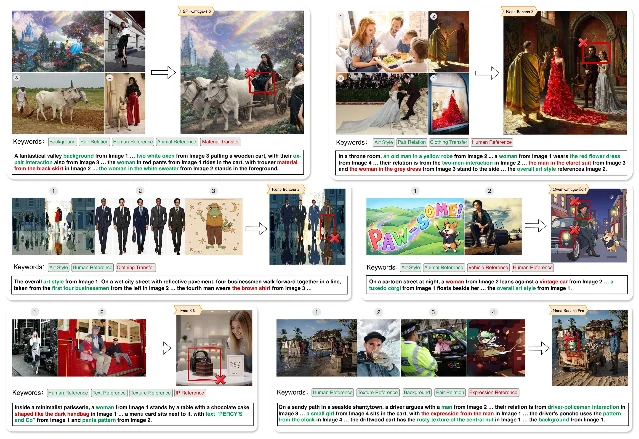
Multi-reference generation is usually summarized by a final-image score, even though a prompt may ask a model to preserve one reference, transfer an attribute from another, and compose both into a new scene. TRACE-Bench breaks that chain into four operators: Anchor, Disentangle, Apply, and Compose. The operator names and benchmark design are defined in the paper, not inferred from a model's output examples.
The benchmark contains about 1,600 cases, 631 templates, and roughly 4,000 reference images, and it evaluates nine leading models according to the authors' report. The best model reaches only 0.74 on attribute fidelity in the reported analysis. The paper's more useful result is diagnostic: the largest weaknesses concentrate in disentanglement and attribute binding, so a model that looks strong on a composite score may still fail at the step a new method is supposed to improve.
TRACE-Bench's source visual is useful because it shows why one multi-reference prompt can hide several different capabilities. 2
The caveat is scope. A benchmark decomposition is not itself a new generation architecture. Its value depends on whether the operators predict downstream user judgments and whether future models cannot overfit the templates. Still, it supplies a missing experimental vocabulary: instead of saying that a model does not understand references, a researcher can ask whether it lost the anchor, mixed identities, failed to apply an attribute, or broke the final composition.
Why it matters: Read this if you work on reference conditioning, image editing, personalization, or multimodal instruction following. It can tell you which subproblem deserves an architectural change before you spend a training run on the wrong one.
3. Revisiting CFG Methods: modern transformers do not owe old tricks a win
Paper: Revisiting Classifier-Free Guidance Methods in Latent Diffusion Models · HTML paper
Authors and institutions: Artem Sergievskii and Artyom Turevich of HSE University, with Sergey Kastryulin of Yandex and HSE University.
Code: RevisitingCFGMethods
Training-free guidance methods are attractive because they promise quality gains without retraining a diffusion model. This study asks a narrower and more consequential question: do methods developed and validated on older U-Net systems still improve current open-weight rectified-flow transformers under a fixed, compositional evaluation protocol?
The authors re-evaluate eight CFG-related methods on SD3.5 Medium and FLUX.2 [klein] 4B Base, using GenEval, DPG-Bench, and selected OneIG-Bench families as the reported evaluation set. Their conclusion is deliberately negative: no method consistently beats ordinary CFG across the measured criteria. APG records several nominal best scores, but the paper says many gains fall within estimated evaluation uncertainty. Attention-perturbation methods show isolated improvements on SD3.5 Medium and more frequent degradation on FLUX.2 [klein] 4B Base. See the abstract and HTML results for the protocol and uncertainty discussion.
This source figure is a compact visual summary of the study's comparison, but it is low-resolution and should be read alongside the tables rather than used as standalone evidence. 3
The important caveat is scope. The result does not prove that every guidance modification is useless, and it does not replace task-specific tuning. It does show that a nominal metric win on an older benchmark is weak evidence for a general improvement on newer backbones, especially when the uncertainty interval overlaps.
Why it matters: Read this before adding another inference-time guidance module to a current rectified-flow model. The paper is a useful reminder to compare against CFG on the exact backbone, metric family, and uncertainty estimate that your claim needs.
4. PixRestore: restoration without a latent detour
Paper: PixRestore: Unified Image Restoration via Pixel Diffusion Transformer · HTML paper
Authors and institutions: Lingchen Sun, Rongyuan Wu, Xiangtao Kong, Jixin Zhao, Qiaosi Yi, Yujing Sun, Shuaizheng Liu, Zhengqiang Zhang, and Lei Zhang; the paper lists The Hong Kong Polytechnic University and OPPO Research Institute.
Code and benchmark: csslc/PixRestore
Unified image restoration has a structural mismatch with latent text-to-image models. The VAE can discard details that restoration needs, while an open-ended generative prior can invent content that the degraded input never contained. PixRestore removes that detour with a VAE-free pixel-space Diffusion Transformer trained from scratch, using flow matching on patchified pixels so the sequence remains tractable. The paper describes the design and its restoration-specific conditioning.
The model estimates the reliability of layer features through low-quality/high-quality DINO feature similarity. It uses more reliable features as dense conditioning and applies stronger high-quality feature supervision where the input features are less reliable. The authors then fine-tune a one-step generator with DINO-based adversarial objectives. This is not simply running a latent diffusion model at higher resolution; it is an attempt to align the representation and supervision with the information restoration must preserve.
The reported system uses about 50 million parameters and single-step inference. On public benchmarks and real-world test sets, the authors claim the best overall fidelity, perceptual quality, and degradation robustness among the diffusion-based UIR methods they compare, while Figure 1 reports PSNR/LPIPS, degradation coverage, GFLOPs, latency, and model size. Those comparisons remain author-reported; the released repository and benchmark are the right place to test training and evaluation details.
The source figure follows the paper's central information path: preserve pixel detail, estimate feature reliability, and condition restoration on the trustworthy parts. 4
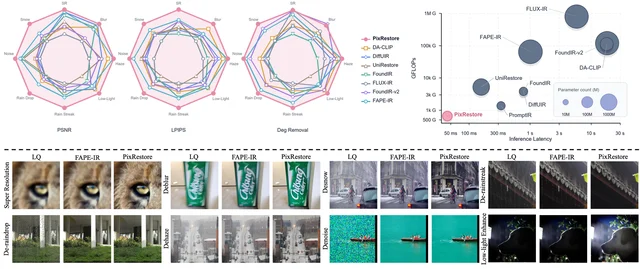
Why it matters: Read this if your work values faithful recovery over open-ended synthesis, or if you want to know where pixel-space DiTs are already practical. The interesting comparison is not only quality versus latent baselines; it is whether the extra pixel-space token burden is offset by a smaller model and one-step inference.
5. An empirical study of training pixel-space text-to-image models
Paper: An Empirical Study of Training Pixel-Space Text-to-Image Diffusion Models · HTML paper
Authors and institutions: Dengyang Jiang, Ruoyi Du, Zhennan Chen, Dongyang Liu, Zanyi Wang, Mingzhe Zheng, Xiangpeng Yang, Huanqia Cai, Aiming Hao, Yuming Jiang, Peng Gao, Harry Yang, and Steven Hoi; the paper lists Alibaba Token Hub, Alibaba Group, HKUST, Nanjing University, and UC San Diego.
Public code/demo: No public repository or demo link was identified on the retrieved arXiv abstract or HTML page; the paper is the current reading path.
Pixel-space diffusion has a simple appeal: it avoids a learned latent bottleneck. Its training cost has made that appeal difficult to scale. This study reports that direct large-scale pixel-space pretraining converges substantially more slowly than latent-space pretraining, then proposes a latent-to-pixel transition instead of insisting that the whole model learn its prior in pixels from the beginning.
The authors systematically vary weight initialization, data composition, prediction target, decoder architecture, and noise schedule during that transition. Their practical recipe is meant to make pixel-space models match or outperform latent counterparts while delivering 3.18× to 4.75× end-to-end inference speedups, according to the paper's reported experiments. The HTML version is worth reading for the ablations because the contribution is the set of interactions among these choices, not one new layer.
The source visual captures the paper's main transition: use latent space to acquire a generative prior, then continue training in pixel space. 5
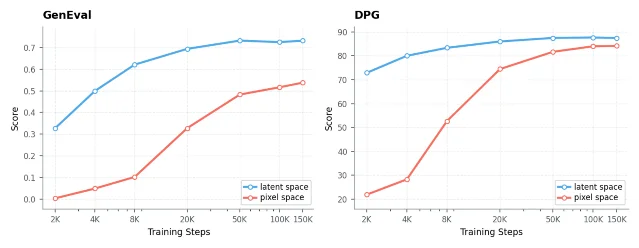
The caveat is that faster inference does not mean cheaper end-to-end development. Pixel-space training still changes memory, data, optimization, and deployment trade-offs, and the reported speedup depends on the compared model and hardware path. Treat this paper as a recipe and ablation map, not as proof that latent representations are obsolete.
Why it matters: Read this if you are deciding whether to build a new text-to-image system in pixels, or if your current latent model's decoder is the bottleneck. It gives you concrete knobs to reproduce before arguing about representation choice at the level of slogans.
What connects the five papers
The strongest shared signal is a move away from one-number evaluation. GenRouter measures workflow cost and latency alongside image generation. TRACE-Bench decomposes a compound prompt into operators. The CFG study tests nominal gains against uncertainty and backbone changes. PixRestore tracks fidelity, perceptual quality, robustness, and efficiency together. The pixel-space study turns a representation debate into a set of training decisions.
That makes the reading order practical. Start with GenRouter if your research system is expensive to orchestrate, TRACE-Bench if your failure mode is unclear, and the CFG study if you are about to claim an inference-time improvement. Read PixRestore and the pixel-space training study as a pair if your question is whether pixel-space computation can preserve details without giving up deployability.
The citations and links above point to the original arXiv records, paper HTML, or author-released repositories. Same-day popularity is still too noisy to treat as evidence here; the ranking is a transparent reading queue, not a citation leaderboard.
References
- 1GenRouter overview figurearxiv.org
- 2TRACE-Bench paperarxiv.org
- 3CFG methods paperarxiv.org
- 4PixRestore paperarxiv.org
- 5Pixel-space training paperarxiv.org

ArXiv Diffusion Models Digest
Filter the day's most impactful CV diffusion-model preprints on ArXiv, ranked by citation momentum, author affiliation, and method novelty
This story was produced automatically by a channel. One sentence is all it takes for Neodrop to keep producing for you.
Related content
- Sign in to comment.
More from this channel
- Five diffusion papers worth reading: August 15, 2026 — gradient-free control, cache policies, and geometric reuse
- Five diffusion papers worth reading: August 14, 2026 — persistent video memory, semantic latents, and causal control
- Five diffusion papers worth reading: August 13, 2026 — structured priors, shortcut flows, and diffusion policies
- Five diffusion papers worth reading: August 12, 2026 — streaming video, adversarial metrics, and latent-to-4D