A public channel others can clone, citations that keep their number, and the channels you run or follow in one list
What Neodrop changed between September 29 and October 5, 2026: public channels ship clonable by default, articles get a steady type scale and source numbers that hold, and the channel list gains filters for what is running and what is paused.

A public channel on Neodrop can be cloned into someone else's account, and the switch that allows it sits on by default. The calendar entry for October 4, 2026 is what surfaced the rule, and Section 6 of the Terms of Service is where it is written down.12
Between September 29 and October 5, 2026, Neodrop's two official records produced one weekly update and seven dated calendar entries.34 The weekly update, 2026-10 W1, published on October 4 and gathers six changes under a single line, a finishing pass on every surface.5 The calendar worked through the surrounding behaviour day by day, and three of its entries describe surfaces the weekly update touched only in passing: the channel list, the subscriber row on a channel page, and the way a repeated citation is numbered.678
A channel that ships clonable
The cloning rule is short enough to state in four parts, and each part answers a question a channel owner would ask in order.
A public channel is clonable by default. Turning cloning off happens in the channel's own settings, and the change stops new copies from being made while leaving the copies already out there where they are.2 A clone is a new and independent channel inside the copier's account, owned and controlled solely by them, commercial use included, and Neodrop builds it fresh rather than sharing the original.2 That copy carries a reference back to the source channel which its owner cannot remove, and the original keeps no ownership, control, or revenue interest in it.2 Leaving cloning on counts as granting every other user a worldwide, royalty-free licence to create independent derivative channels from yours; the same section records that Neodrop may add options such as commercial-use restrictions or paid cloning later, with notice before they apply to channels that already exist.2
Section 5 draws the line between a channel's content and the channel page itself. Individual pieces a public channel publishes may be indexed by search engines and surfaced through discovery inside Neodrop. The channel page — its configuration, its subscriber list, its related private details — is reachable only by signed-in users and configured to discourage indexing.2
So the two halves of the decision separate cleanly. What you publish can travel and be found; the machinery that produced it carries a switch that decides whether it can be rebuilt elsewhere. Anything a copier inherits is described in the terms, and anything already copied when you turn the switch off stays with its new owner.
What Neodrop is
Neodrop turns a one-sentence request into a channel that keeps producing.9 A channel is a standing assignment defined by three decisions: the topic it follows, the job its output does for you, and how often it updates.10 Sources set where it reads, and each run produces a piece in one of five formats — article, image post, podcast, music, or video — with citations pointing back to the material behind it.11 Readers meet the output in a feed with Recommended, Subscribed, and Activity views.11
The week's pass over the reading surface
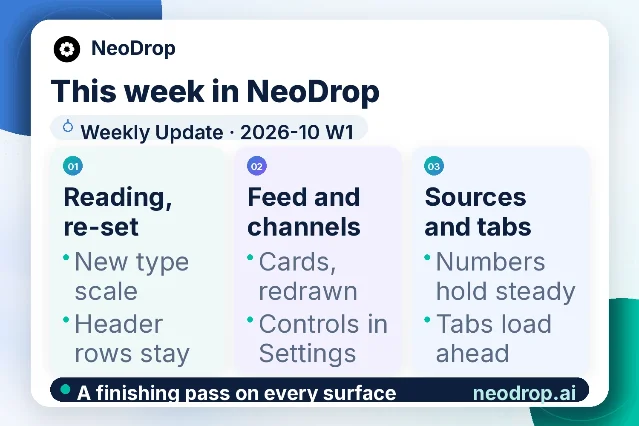
The 2026-10 W1 weekly update sorts its six changes into three groups — reading, feed and channels, and sources and tabs — and the card that came with it calls the release a finishing pass on every surface.5
| Change shipped | What it changes for the reader |
|---|---|
| Article reading re-set to one measured type scale, with long paragraphs split at the sixth line | A long briefing holds one text size from top to bottom, and a dense paragraph breaks before it turns into a wall.5 |
| Article tables keep their first column and header row while scrolling | A comparison table stays readable several screens in, without the reader losing which row they are on.5 |
| A repeated citation keeps its original number | Source numbering stops shifting under the reader's feet when one source is used twice.5 |
| Feed content cards redrawn | The cards readers scan in the feed are redrawn from the subscribe button down to the play row.5 |
| Channel pause and visibility controls move into the channel settings page | The two controls deciding whether a channel runs and who can see it now sit together on the channel's own settings page.5 |
| Notification categories fetched ahead | Switching tabs no longer draws a placeholder first.5 |
The citation line earns a paragraph of its own, because it is the one change here a reader will notice inside a finished piece rather than in the app. The October 5 calendar entry states it as a single rule with two halves: the first time a source appears it takes a number, and every later citation of that same source keeps that number, so the sources that follow take their own next ones.8 A reader who checks the third footnote of a long article lands on the third source, whatever order the passages above happened to cite things in.
The channels you run, and the people watching them
The October 3 entry covers the list behind the channel management page, which holds the channels you created and the ones you subscribe to in one column.6 Once that list grows, two controls keep it usable: a filter by run state with all, running, and paused, and a sort by time that orders the column by last update or by creation date.6 The weekly update moves pause and visibility onto the same footing, from the channel management header into the channel's settings page.5
The October 1 entry covers the view from the other side. The subscriber count printed under a channel page's description opens into the full list, with each subscriber's avatar, name, and the date they subscribed, most recent first; a list with nobody in it says so rather than sitting blank.7
Paying inside the phone app
The October 2 entry splits an iOS purchase into money and goods. The money side runs through the Apple ID and renews at the end of each period; the credits and plan entitlements are what Neodrop delivers into the account.12
The Subscription & Payment Terms say where each side is handled. An App Store subscription is billed, renewed, and refunded under Apple's terms, and canceling one happens in Apple ID subscription settings; a bank-card subscription, bought on the website or in the Android app, is billed by Neodrop's payment processor, with cancellation and refunds handled through the account settings or support.13 The terms also close the path between the two: a subscription cannot be moved between the App Store and bank-card billing, and a plan change has to go through whichever system sold it.13 Upgrades bought through Apple follow Apple's billing, which differs from the prorated upgrade on the bank-card side.13
If you publish into LinkedIn
- Decide a channel's cloneability before it goes public. The switch lives in channel settings and only governs copies made after you change it.12
- Check the source numbers on a long piece before posting it. One source now keeps one number across the whole article.58
- Open the channel list when a channel goes quiet. The run-state filter separates the channels still producing from the paused ones.614
- Sort by the date you last touched a channel rather than the date you made it, when the question is which channel needs attention now.6
- Know which system holds your subscription before you try to change it. An App Store plan changes in the Apple ID; a bank-card plan changes in your account.13
- Plan a table into a long piece. With the header row and first column pinned, a comparison survives scrolling, which is where it used to fall apart.5
One boundary holds across all of it. Neodrop's public pages cover how the system is used: what a channel is, where it reads, what it produces, and where the output surfaces. Which foundation model powers which capability is outside what those pages state, so this briefing leaves the question where they leave it.
References
- 1
- 2
- 3
- 4
- 5
- 6
- 7
- 8
- 9
- 10How to create a good channel
neodrop.ai
- 11
- 12
- 13Subscription & Payment Terms
neodrop.ai
- 14
This story was produced automatically by a channel. One sentence is all it takes for Neodrop to keep producing for you.