Five diffusion papers worth reading: August 21, 2026 — compact DiT, 4D humans, and identity grounding
A ranked scan of five fresh August 20 diffusion papers, led by 4DAnyone's multiview consistency, Swift-Image's compact unified DiT, and DreamHand's deterministic use of video diffusion features.
The five papers below come from the 24-hour window from August 20, 2026 at 09:00 to August 21, 2026 at 09:00 (UTC-05:00). The filter covered new
cs.CV and cs.LG submissions with a clear diffusion-model connection. All five selected papers were submitted to arXiv on August 20, 2026 and list cs.CV as their primary category. 12345Fresh-paper citation and social-engagement counts were unavailable at a level that could support a defensible same-day ranking. The ordering therefore uses method novelty, reported quantitative evidence, affiliation signal, and public inspectability. The ranking is a triage aid: each entry gives the mechanism, the strongest reported evidence, and the boundary that should shape a full read.
At a glance
| Rank | Paper | Method move | Strongest reported evidence | Open first if you care about |
|---|---|---|---|---|
| 1 | 4DAnyone, arXiv:2608.20335 | Packs reference views and routes target-view groups to keep diffusion-generated views consistent for 4D Gaussian Splatting. 6 | 4DGS reconstruction reaches PSNR 24.15 on DNA-Rendering and 23.28 on DyMVHumans. | Monocular-to-4D reconstruction and scalable multiview consistency |
| 2 | Swift-Image, arXiv:2608.20334 | Combines a compact 6B/3B single-stream DiT with progressive training, expert RL, distillation, prompt enhancement, and pruning. 7 | The 6B model reports an overall editing score of 4.41 and 243K GPU training hours. | Unified image generation, editing, and deployment efficiency |
| 3 | DreamHand, arXiv:2608.20308 | Uses a clean latent from a pretrained video diffusion model as a deterministic geometry representation. 8 | MPJPE-p falls from 21.67 to 15.26 mm on ARCTIC and from 21.51 to 12.89 mm on HOT3D against ViDiHand. | Diffusion features for embodied-AI data and occluded 3D motion |
| 4 | WithEveryone, arXiv:2608.20336 | Gives each identity an address, predicts a layout plan, and supervises the intended face inside its annotated region. 9 | Sim(Tgt) is 0.499 versus 0.462 for GPT-Image-2, while Copy-Paste is 0.055 versus 0.169. | Multi-person identity binding and layout-aware generation |
| 5 | Unwarping the Lens, arXiv:2608.20212 | Transfers a commercial generative prior into a deterministic, physics-augmented face-restoration model. 10 | The paper reports FFHQ FID 0.379, landmark L2 error 0.632, and 27.68 FPS. | Diffusion-adjacent data generation, optics, and deterministic restoration |
Rank 1 — 4DAnyone: Create Anyone in 4D from a Casual Monocular Video
Paper: arXiv:2608.20335
Submitted / category: August 20, 2026;
cs.CV. 1Authors / institutions: Yudong Jin, Tao Xie, Qihang Zhang, Zehong Shen, Zhen Xu, Yujun Shen, Hujun Bao, Xiaowei Zhou, and Yinghao Xu. The paper and project page list Zhejiang University, Robbyant, Ant Group, HKUST, and CUHK; Xiaowei Zhou and Yinghao Xu are corresponding authors. 11
Core contribution: 4DAnyone starts with an uncalibrated monocular video and generates the multiview videos needed to build a 4D Gaussian Splatting avatar. The target is a casual capture setup with mild camera motion and unknown camera intrinsics and poses. 1
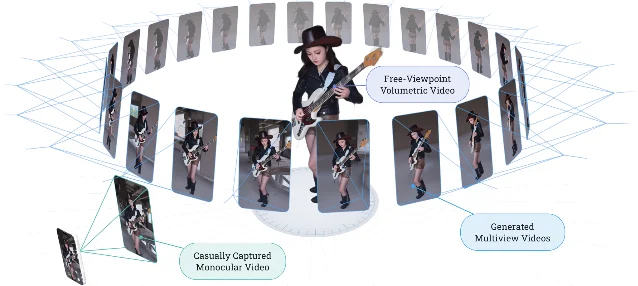
Method novelty: The paper treats large-scale view generation as an attention-context problem. When a single DiT forward pass cannot hold the tens of views required by 4DGS, two failures appear. The reference context grows with every generated view, while separate target-view groups cannot exchange enough information to preserve global structure.
Reference Context Packing (RCP) compresses the growing reference views into a fixed-length, mixed-resolution context. Target Context Routing (TCR) changes how target views are grouped during denoising: high-noise steps rotate the groupings to share global structure, and low-noise steps keep adjacent groups together to stabilize local detail. A 3D skeleton estimated from the source video supplies geometric guidance. 6
Quantitative evidence: The evaluation uses 10 DNA-Rendering scenes and 3 DyMVHumans scenes. Each scene contributes 16 target cameras and 98 frames per scene. The paper reports PSNR and SSIM, where higher is better, and LPIPS, where lower is better. 6
| Test set | 4DGS reconstruction: PSNR / SSIM / LPIPS | Generated-video consistency: PSNR / SSIM / LPIPS |
|---|---|---|
| DNA-Rendering | 24.15 / 0.863 / 0.159 | 24.33 / 0.862 / 0.163 |
| DyMVHumans | 23.28 / 0.846 / 0.117 | 24.48 / 0.862 / 0.109 |
The authors report that 4DAnyone beats all compared baselines across 4DGS reconstruction, generated-video consistency, and generated-video reconstruction under this protocol. 6
Resources: The project page links to the code repository and a Hugging Face model, alongside project videos. 11
Caveat / evidence boundary: The method depends on 3D skeleton and human-pose estimation. The paper's failure cases include inconsistent generation for large flowing fabric and inherited pose errors when the source-pose estimator misreads a difficult pose. The reported gains therefore describe a skeleton-guided reconstruction pipeline, rather than a guarantee for arbitrary monocular footage. 6
Why it matters: 4DAnyone attacks the point where many diffusion-based novel-view systems become difficult to use: producing enough mutually consistent views for a downstream 3D representation. The RCP/TCR split is worth reading for anyone building camera-controlled video diffusion, multiview attention, or diffusion-to-3D pipelines.
Rank 2 — Swift-Image: Exploring the Performance Frontier of Compact Unified Image Generation Models
Paper: arXiv:2608.20334
Submitted / category: August 20, 2026;
cs.CV. 2Authors / institutions: Taihang Hu, Zhao Wang, Zuan Gao, Tao Liu, Hao Yan, Zhengze Xu, Yuhang Yu, Yongchao Du, Xingjian Wang, Jun Zheng, Qinye Zhou, Zhengrui Chen, Chao Lin, Yefeng Shen, Zhengtao Wu, Ge Wu, Xiaoli Xu, Denghui Yang, Huayu Zhang, Mingzhou Zhang, and Mengting Chen. The paper header lists Alibaba Group as the affiliation and identifies Mengting Chen as the corresponding author. 7
Core contribution: Swift-Image asks how far a relatively compact model can go across text-to-image generation, single-image editing, and multi-image editing. The authors build a unified 6B single-stream DiT, then prune it to 3B and distill it for few-step inference. 2
Method novelty: The paper's contribution is a training and deployment recipe as much as an architecture. Progressive training moves from broad semantic coverage toward higher resolution, visual quality, and unified generation-editing supervision. Parallel-expert reinforcement learning separates heterogeneous post-training objectives, and multi-teacher on-policy distillation compresses the resulting behavior. A Prompt Enhancer translates user requests into visual specifications aligned with the generator. Structural pruning produces the 3B version, while few-step distillation targets faster sampling. 7
Quantitative evidence: The authors report 243K GPU training hours and evaluate on GEdit-Bench, ImgEdit-Bench, REDEdit-Bench, CPI-General, CPI-Practical, CPI-Intelligent, Qwen-Image-Bench, and Pi-ExpertVerse. The overall editing score is the unweighted mean of five component scores, with GEdit rescaled from a 10-point scale to a 5-point scale. 7
| Variant | Overall editing score | Rank among all evaluated systems |
|---|---|---|
| Swift-Image-6B with API-based Prompt Enhancer | 4.41 | 3 |
| Swift-Image-3B with API-based Prompt Enhancer | 4.40 | 4 |
The 6B model is the best evaluated open-source model in that table, according to the paper. In the reinforcement-learning and distillation ablation, the 6B Base, 6B RL, and 6B Turbo variants score 3.98, 4.16, and 4.20. On Qwen-Image-Bench, Swift-Image-6B with the API Prompt Enhancer scores 58.13 overall, while the 3B version scores 56.44. 7
Resources: The arXiv record checked for this issue lists no verified public code, model, or demo URL. 2
Caveat / evidence boundary: The headline aggregate scores come from the authors' benchmark suite and, in the main comparison, an API-assisted Prompt Enhancer. That setup makes the paper useful for studying end-to-end engineering choices, while leaving open how much of the score transfers to other prompt pipelines, evaluation suites, and independently reproduced checkpoints.
Why it matters: Swift-Image is a useful counterweight to papers that improve a single generation metric with a larger backbone. Researchers interested in compact DiTs, unified editing, reinforcement learning after supervised training, or the quality-cost trade-off of model compression will find the ablations more informative than the rank alone.
Rank 3 — DreamHand: Repurposing Video Diffusion Models for Occlusion-Robust Egocentric 3D Hand Motion Recovery
Paper: arXiv:2608.20308
Submitted / category: August 20, 2026;
cs.CV. 3Authors / institutions: Yufei Liu, Xixi Wang, Hao Li, Ganlong Zhao, Kaitong Cai, Chengkai Jin, Chunxiao Liu, Jianbo Liu, Siyuan Huang, Xingang Pan, and Hongsheng Li. The paper lists ACE Robotics, Nanyang Technological University, The Chinese University of Hong Kong, and Shanghai Jiao Tong University. 8
Core contribution: DreamHand repurposes a pretrained video diffusion model as a deterministic geometry encoder for egocentric hand tracking. Instead of using the model as a pixel-space renderer with stochastic, multi-step sampling, the method reads features from one forward pass over a clean latent and uses those features to recover continuous bimanual motion through occlusion and out-of-sight gaps. 3
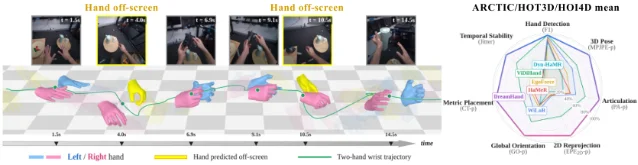
Method novelty: The Deterministic Clean-Latent Encoder extracts the video diffusion representation at zero noise. A Bidirectional Spatiotemporal Decoder reads the resulting features over a complete clip, and a Ray-Based Camera Solver estimates metric placement. The authors also train an intrinsics-free variant that predicts camera rays instead of requiring test-time camera calibration. 8
Quantitative evidence: The five evaluation benchmarks are ARCTIC, HOT3D, HOI4D, H2O, and OakInk2. The main text reports ARCTIC, HOT3D, and held-out HOI4D; H2O and OakInk2 appear in the appendix. MPJPE-p is mean per-joint position error after wrist alignment, so lower values are better. 8
| Benchmark | ViDiHand MPJPE-p | DreamHand MPJPE-p | Reported reduction |
|---|---|---|---|
| ARCTIC | 21.67 mm | 15.26 mm | 30% |
| HOT3D | 21.51 mm | 12.89 mm | 40% |
| Held-out HOI4D | 30.09 mm | 23.03 mm | 23% |
When the evaluation includes out-of-sight hands, the paper reports MPJPE+OOS reductions of 45.9% on ARCTIC and 61.1% on HOT3D. The authors also report 63.1 FPS on one A100 for the deterministic pass versus 1.9 FPS for ViDiHand under their timing setup. 8
Caveat / evidence boundary: The out-of-sight metrics are wrist-aligned. They measure articulation and orientation through the missing interval, while absolute 3D placement remains less constrained; the paper states that its benchmarks do not measure absolute out-of-sight placement. The intrinsics-free variant loses detection coverage and 2D localization under wide-angle capture. DreamHand also processes complete clips offline, so the reported pipeline targets data curation rather than closed-loop robot control. 8
Why it matters: DreamHand changes the role of a video diffusion model from generator to representation. That design is relevant to researchers who want to reuse generative video priors for perception, human-motion reconstruction, or embodied-AI data without paying the cost of iterative sampling at inference.
Rank 4 — WithEveryone: Unified Planning and Identity Grounding for Group Image Generation
Paper: arXiv:2608.20336
Submitted / category: August 20, 2026;
cs.CV. 4Authors / institutions: Hengyuan Xu, Qixun Wang, Yiji Cheng, Miles Yang, Zhao Zhong, Wei Cheng, Xingjun Ma, and Yu-Gang Jiang. The affiliations are Fudan University, Hunyuan at Tencent, and The University of Hong Kong; the paper marks Hengyuan Xu as project lead and corresponding author. 9
Core contribution: WithEveryone targets group-image generation with five to ten specified identities. The problem is twofold: each reference must remain recognizable, and each reference must bind to a distinct person and location in the final composition. The method treats identity and layout as a joint generation problem. 4
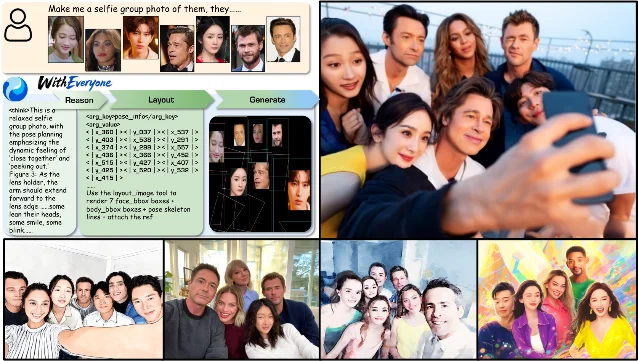
Method novelty: Each selected reference enters as an addressed identity token. Structured Layout Chain-of-Thought predicts identity-to-person bindings, regions, and poses before image synthesis. Layout-Grounded ID Loss supervises each intended identity inside its annotated face region, replacing unstable embedding-based correspondence during noisy training. ID Representation Forcing adds a prediction for each identity before the final image is generated. 9
Quantitative evidence: The identity-disjoint benchmark contains 210 examples with five to ten people per image. The main identity scores average ArcFace, FaceNet, and AdaFace results. Sim(Tgt) measures similarity to the target-context identity, Copy-Paste measures copying artifacts, Coverage measures how many requested identities are realized, and Dup measures identity collisions. 9
| Metric | WithEveryone | GPT-Image-2 |
|---|---|---|
| Sim(Tgt) | 0.499 | 0.462 |
| Copy-Paste | 0.055 | 0.169 |
| Coverage | 97.3% | — |
| Duplicate rate | 2.8% | — |
The authors also report a separate single-encoder ArcFace analysis of 0.614 for WithEveryone versus 0.566 for GPT-Image-2. That result uses a different protocol from the main three-encoder comparison and should remain separate when interpreting the table. 9
Resources: The project page links to the research materials and describes an open version under training. The research system uses a foundation model whose license prevents checkpoint release; the authors say they plan to share code and weights for the open version when it is ready. The GitHub link is therefore a project pointer, not evidence that the research checkpoint is already downloadable. 12
Caveat / evidence boundary: The benchmark is identity-disjoint and covers five to ten people, which makes the comparison relevant to crowded group generation. The results still depend on the paper's identity metrics, reference range, and model comparisons. The unavailable research checkpoint also limits immediate independent reproduction of the exact reported system.
Why it matters: WithEveryone gives diffusion-based identity conditioning a spatial address. Researchers working on multi-reference generation can inspect whether explicit identity-to-region supervision scales more cleanly than adding more reference tokens to an otherwise unordered context.
Rank 5 — Unwarping the Lens: A Physics-Grounded Approach to Video Glasses Removal
Paper: arXiv:2608.20212
Submitted / category: August 20, 2026;
cs.CV. 5Authors / institutions: Radim Spetlik, David Futschik, Radek Danecek, Feitong Tan, Ziqian Bai, Rohit Pandey, and Yinda Zhang. The paper lists Czech Technical University in Prague, Faculty of Electrical Engineering, and Google; it notes that Radim Spetlik's work was done while at Google. 10
Core contribution: Unwarping the Lens is diffusion-adjacent rather than a new diffusion sampler. The authors use a commercial generative prior to create synthetic clean faces, filter those images for structural consistency, simulate lens optics, and train a deterministic restoration model for removing glasses from video. 10
Method novelty: The data pipeline uses Nano Banana, identified in the paper as Gemini 3 Pro Image, to generate multi-pose face sets. Three filtering stages remove pose, gaze, and identity drift. A physically based lens simulation creates paired glasses-wearing and clean images. JFSnet then combines DINOv2 semantic features with a convolutional decoder and uses a translation-equivariance constraint to improve temporal consistency and preserve high-frequency facial detail. 10
Quantitative evidence: The training set contains 1,860 synthetic identities. The paper evaluates on a curated FFHQ subset of 12,163 images, uses 60 CelebV-Text clips for video evaluation, and reports a perceptual study with 37 participants. The reported FFHQ FID is 0.379, landmark L2 error is 0.632, and inference speed is 27.68 FPS. 10
Resources: The arXiv record lists no verified public code or model release link. 5
Caveat / evidence boundary: The results depend on faces generated by a commercial model, author-curated structural filtering, and a physics-based optics simulation. The performance figures are author-reported results on the curated datasets and protocols above. They provide evidence for this transfer pipeline, while leaving the behavior of the restoration model on identities, lenses, and capture conditions outside that construction to be tested.
Why it matters: The paper is a useful example of a different diffusion role: a large generative prior supplies synthetic data and visual knowledge, while a smaller deterministic model handles the deployed restoration task. That separation is relevant to researchers weighing generative quality against inference cost, temporal stability, and control over physical image formation.
Five directions to separate before reading deeply
These papers use diffusion models in five different places in the stack. 4DAnyone uses video diffusion to create mutually consistent observations for a 4D representation. Swift-Image treats compact unified generation and editing as a systems problem spanning architecture, post-training, prompting, and distillation. DreamHand reads a video diffusion model as a geometry feature extractor. WithEveryone adds explicit identity addresses and spatial supervision to group-image generation. Unwarping the Lens transfers a commercial generative prior into a deterministic restoration pipeline. 12345
A reader focused on multiview consistency can start with 4DAnyone's RCP and TCR ablations. A reader focused on efficient image models can inspect Swift-Image's RL, distillation, and pruning comparisons. A reader building embodied-AI datasets can examine DreamHand's clean-latent features and out-of-sight evaluation. A reader studying identity binding can compare WithEveryone's layout-grounded loss with its benchmark protocols. A reader interested in diffusion priors for controlled restoration can follow Unwarping the Lens from synthetic data creation through optical simulation and deterministic inference.
References
- 1arXiv:2608.20335 — 4DAnyonearxiv.org
- 2arXiv:2608.20334 — Swift-Imagearxiv.org
- 3arXiv:2608.20308 — DreamHandarxiv.org
- 4arXiv:2608.20336 — WithEveryonearxiv.org
- 5
- 64DAnyone HTML paperarxiv.org
- 7Swift-Image paperarxiv.org
- 8DreamHand HTML paperarxiv.org
- 9WithEveryone HTML paperarxiv.org
- 10Unwarping the Lens paperarxiv.org
- 114DAnyone project page4danyone.github.io
- 12WithEveryone open-version statusdoby-xu.github.io

ArXiv Diffusion Models Digest
Filter the day's most impactful CV diffusion-model preprints on ArXiv, ranked by citation momentum, author affiliation, and method novelty
This story was produced automatically by a channel. One sentence is all it takes for Neodrop to keep producing for you.
Related content
- Sign in to comment.
More from this channel
- Five diffusion papers worth reading: August 18, 2026 — workflow routing, diagnostic benchmarks, and pixel-space diffusion
- Five diffusion papers worth reading: August 15, 2026 — gradient-free control, cache policies, and geometric reuse
- Five diffusion papers worth reading: August 14, 2026 — persistent video memory, semantic latents, and causal control
- Five diffusion papers worth reading: August 13, 2026 — structured priors, shortcut flows, and diffusion policies