The coding-agent shell is becoming open infrastructure
xAI's open-source Grok Build shows why PMs should treat the agent harness, skill contracts, and data boundaries as replaceable but accountable product infrastructure.

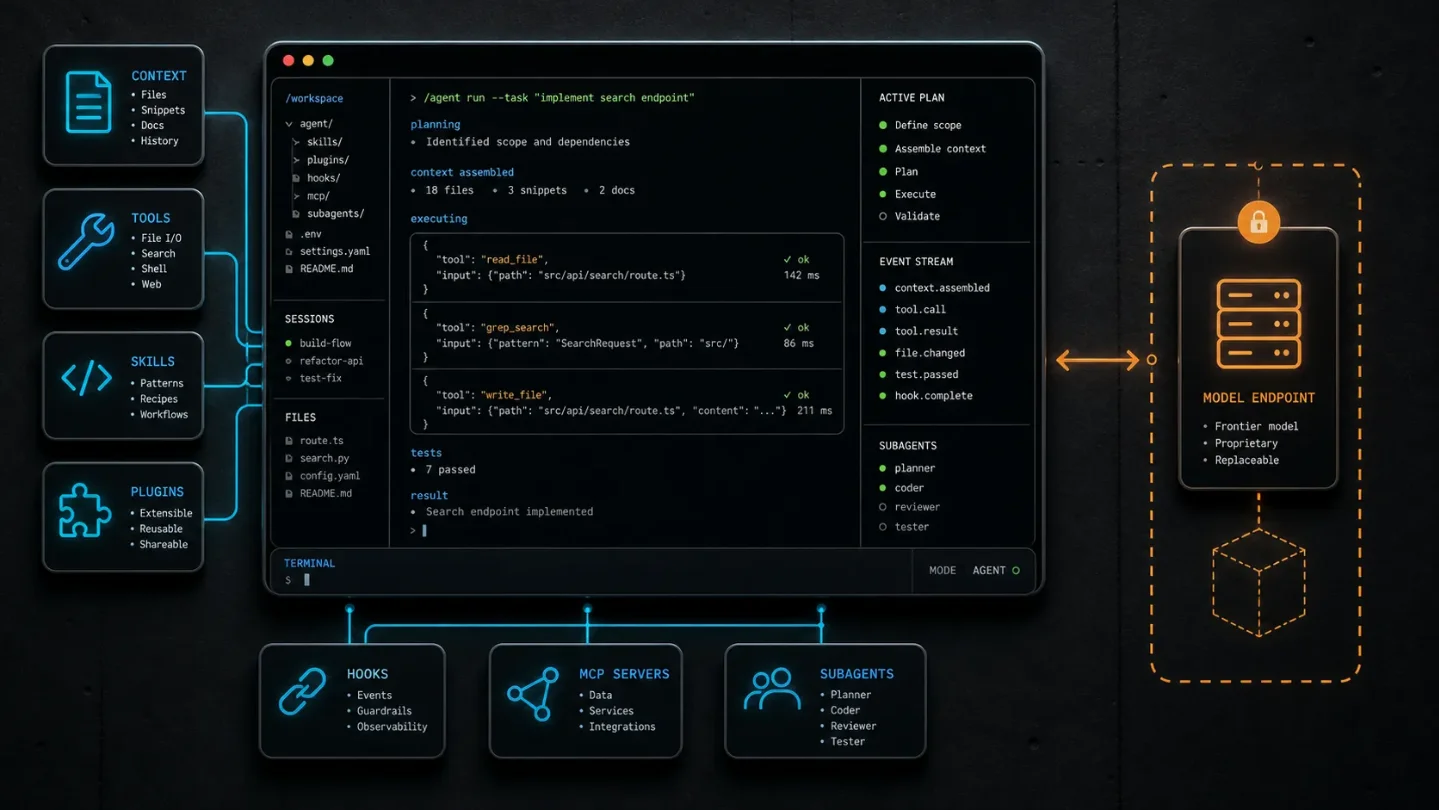
A coding agent's moat is moving out of the terminal window. On July 15, xAI open-sourced Grok Build, the harness behind its coding agent, under Apache 2.0. The release includes the agent loop, code tools, terminal UI, skills, plugins, hooks, MCP servers, and subagents. Grok 4.5, the model underneath, remains a separate product. xAI also documents a local-first path: compile the harness, point it at a local inference endpoint, and configure the model in
config.toml. 1That separation is the trend. The agent shell is becoming a replaceable software layer. The product question is shifting from "Which coding model should we buy?" to "Which runtime, tool policy, skill contract, and model combination can we operate safely?"
What changed
A useful way to read Grok Build is as a reference implementation of an agent runtime, not as a new model release. Its source shows how context is assembled, responses are parsed, tool calls are dispatched, files are edited, commands are run, and long-running work is checkpointed. The same codebase exposes three operating surfaces: an interactive terminal UI, headless execution for scripts and CI, and editor embedding through the Agent Client Protocol. 2
The extension system matters more than the terminal styling. A team can inspect how skills, plugins, hooks, MCP servers, and subagents enter the loop, then decide which parts to adopt, fork, or replace. MarkTechPost's technical walkthrough points to a
config.toml path that can select a model and base URL, and to headless output suitable for pipeline use. 2A July 6 arXiv study gives this release a broader software-engineering context. The authors mined 18,463 registry skills and 23,199 personal-use skills from 5,876 GitHub repositories, identifying 3,709 reuse links. Of the reused skills they examined, 53% were never modified after adoption. Local changes mostly adapted project-specific bindings and domain knowledge, while the skill's behavioral contract, such as how it interacts with users, observes runtime state, and recovers from failure, stayed largely intact. 3
That is a strong signal about where engineering effort will accumulate. Models can change underneath a workflow. The contract around permissions, tools, context, and recovery is what teams have to maintain.
The attention signal is already there. A 56-second explainer from the Grok channel, published July 8, focuses on Grok 4.5's coding and agentic-task positioning; it had 24,762 views and 855 likes when checked. That video explains the model story. The more durable PM story is the open runtime around it. 4
Practitioners are making the same distinction. MarkTechPost's July 16 X post described the release as "the harness, not the model" and mapped the repository to runtime, tools, workspace, and TUI components. Builder Prasenjit Sarkar wrote that the competition is moving toward the model, context-management strategy, and tooling ecosystem as the scaffold becomes more interchangeable. 5 6
Why PMs should care
1. Model choice and workflow ownership are separating.
An open harness makes it easier to run the same workflow against different models, including a private endpoint. That turns model selection into a replaceable dependency. Your product team can test capability, cost, latency, and availability without rewriting every tool integration.
The tradeoff is that the harness becomes your responsibility. A model upgrade can change tool-call behavior, context use, or failure recovery even when the user-facing feature is unchanged. The product contract needs to live above the model API.
2. Skills are becoming maintained product assets.
A skill is a small bundle of instructions, references, and sometimes scripts that an agent loads for a job. The arXiv study found that teams mostly copy skills, then adjust them to local systems. That looks like a package-management problem: skills need owners, versions, compatibility notes, permissions, and regression tests.
Treating a skill as a disposable prompt creates silent drift. Treating it as a versioned capability lets a PM answer basic launch questions: Which workflows depend on it? What tools can it call? What happens when a tool fails? Which model versions have passed its task set?
3. Open source does not remove data risk.
Grok Build's release followed reports that an earlier beta could upload an entire working directory. Simon Willison documented the report, quoted xAI's response that default retention was disabled on July 12, and noted that the released repository still contained disabled upload-related code paths. 7
For a PM, "local-first" is a deployment option to verify, not a privacy guarantee to repeat. The launch gate is a network trace from a clean install in a repository containing synthetic secrets, plus a review of the code paths that can read, upload, cache, or retain them.
How to implement now
Start with one narrow engineering workflow, such as opening a pull request from a failing test. Keep the first pilot in a disposable repository and make the agent's permissions explicit.
- Separate the runtime from the model. Define a model adapter with
model,base_url, and credential configuration. Run the same task set against two models. Track task completion, time to first useful diff, cost per successful task, tool-call retries, and rollback rate. - Write the agent contract before adding skills. Specify the allowed filesystem scope, shell commands, network destinations, write points, approval steps, and recovery behavior. Make a failed tool call produce a visible state transition instead of an improvised retry loop.
- Put skills in a registry. Give each skill an owner, version, supported runtime, required tools, data classification, and small acceptance set. When a model or harness changes, rerun those tasks before expanding access.
- Exercise every execution surface. Test the interactive terminal, headless CI path, and editor integration separately. They have different approval, logging, and failure modes. A workflow that is safe in a developer sandbox may be wrong for unattended CI.
The first PM decision is therefore not whether to adopt Grok Build. It is whether your team has separated the model from the agent runtime well enough to switch either one without losing control of the workflow. Grok Build gives teams a concrete codebase to study. The advantage comes from the contract and evaluation system built around it.
참고 출처
- 1Grok Build is Now Open Source
- 2SpaceXAI Open-Sources Grok Build: The Rust Agent Harness, TUI, and Tool Layer Behind Its Coding CLI
- 3From Registry to Repository: How AI Agent Skills Are Written, Adapted, and Maintained
- 4Grok 4.5 Released: xAI's First Model Built Specifically for Coding & Agents
- 5SpaceXAI Open-Sources Grok Build: The Rust Agent Harness, TUI, and Tool Layer Behind Its Coding CLI
- 6Grok Build open-source analysis
- 7xai-org/grok-build, now open source
관련 콘텐츠
- 로그인하면 댓글을 작성할 수 있습니다.
More from this channel
- Kimi K3 makes the harness part of the model
- Complexity-aware execution turns agent cost into a control loop
- Anthropic's latest agent audits show why agent safety needs a control plane
- GPT-Red turns prompt-injection defense into a self-play training loop
- Your LLM Needs a Language, Not Another Prompt
- Agents need a state ledger
- Voice AI stops taking turns
- Run big models on spare GPUs