Agents need a state ledger
StructAgent and Proactive Memory Agent point to the same PM lesson: long-horizon agents need explicit, verifier-backed state, not just longer transcripts or passive memory stores.

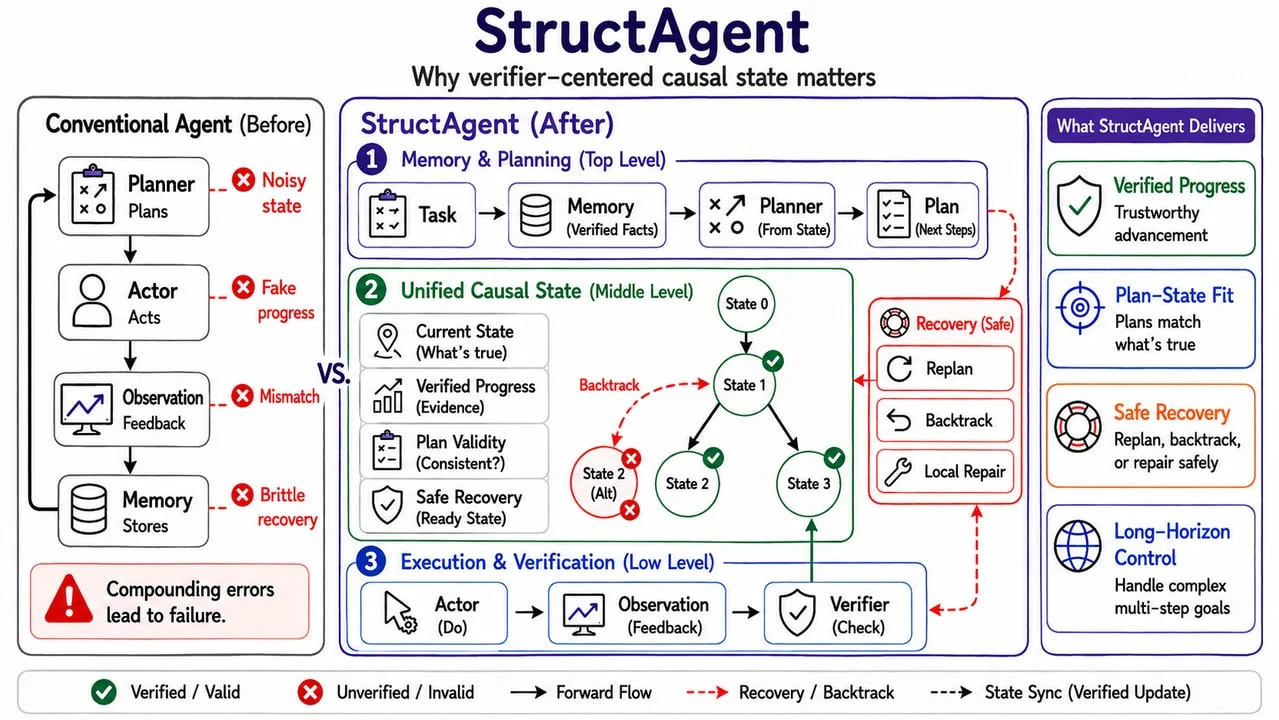
StructAgent turns a messy agent transcript into a ledger: current requirements, useful values, and verified evidence. That is a more useful product idea than asking a bigger model to reread a longer chat history.
The paper was submitted to arXiv on July 13, 2026, and targets long-horizon computer-use agents: agents that click, type, inspect files, use tools, and keep working across many steps. Its claim is narrow but important. Existing agents often operate over raw interaction history, so progress becomes hard to interpret, verify, and recover. StructAgent instead makes state the shared interface between a planner, an actor, and a verifier. 1
The PM read: if your agent can take more than a few steps, the product spec needs a state ledger. The transcript is evidence, not the operating system.
What changed
StructAgent separates three jobs that many agent products still collapse into one model call.
The planner reads the current state and chooses the next subgoal. The actor executes a short burst of GUI, shell, app, or document actions. The verifier checks evidence and emits the only event that can advance state. The project page summarizes the design bluntly: "The verifier is the only writer of progress. Everything else reads and proposes." 2
That small rule changes the failure mode. A normal agent may decide it is done because its own plan sounds complete. StructAgent requires a verifier-backed state update before progress is committed. The state stores current requirements, useful values such as file paths or selected entities, and evidence that supports progress. 3
The reported gains are large enough to pay attention to, with the usual caveat that they are benchmark results, not production SLAs. On OSWorld-Verified, StructAgent improves Qwen3.5-9B from 27.0% to 46.9% success rate and Qwen3.5-27B from 31.6% to 62.2%. With MiniMax-M3, the paper reports 78.9%, described as a new open-source state of the art for that benchmark. 1
The repo also matters for feasibility. It is public, Apache-2.0 licensed, and includes code paths for OSWorld and Mind2Web. The current release implements StructAgent for Qwen3.5-9B and Qwen3.5-27B, while the MiniMax-M3 integration behind the top reported result is marked as "coming soon." 3 That should keep PM expectations grounded: this is ready to study and prototype, not a drop-in proof that every desktop agent can now be trusted.
A second paper from Meta AI points in the same direction. Proactive Memory Agent, submitted July 9, defines "behavioral state decay" as the moment when earlier requirements, failed attempts, diagnoses, or open subgoals stop shaping the next action. Its fix is a separate memory agent that decides when to inject a reminder and when to stay silent. 4
That paper reports +8.3 percentage points on Terminal-Bench 2.0 and +6.8 points on tau2-Bench, and says selective intervention beats passive memory exposure, always-on injection, advisor-only guidance, and general retrieval. 4 Author Yifan Wu later described the design as a plug-and-play memory agent that runs beside an unmodified action agent, and said the code is now online. 5
The social signal is still early. alphaXiv's post on the paper drew 267 likes and 15,254 views, while a July 13 YouTube explainer on the same paper had only 8 views when retrieved. 67 Read that as developer curiosity, not mainstream adoption.
Why PMs should care
The useful abstraction is not "agent memory." That phrase is too broad. It can mean personalization, RAG, transcript summarization, vector search, saved preferences, or cross-session recall.
The sharper product question is: what must remain true before the agent is allowed to continue?
For a travel-booking agent, that may be budget, dates, passport constraints, loyalty account, and refund policy. For an enterprise spreadsheet agent, it may be the target file, schema, filters already applied, rows excluded, formulas changed, and checks passed. For a customer-support agent, it may be eligibility rules, prior failed fixes, customer consent, and handoff thresholds.
Raw history is a weak way to carry those facts. It mixes requirements, guesses, failed attempts, tool output, user corrections, and model self-talk in one stream. Long context helps only if the model uses the right part of that stream at the right moment.
StructAgent and Proactive Memory Agent point to a different design center: state is a product object. It needs a schema, update rules, evidence, auditability, and recovery paths. Vector Labs makes the same production argument from an engineering angle: behavioral state decay is a state-salience problem, not just a context-window problem, and memory architecture belongs in the same design review as model choice and tool integration. 8
That is the PM implication. Do not ask only whether the model can complete the task in a demo. Ask whether the product can say, at step 37, what the agent believes is done, which evidence supports that belief, what remains pending, and what should happen if new evidence contradicts the current state.
How to implement now
Start with one workflow that already fails in long agent runs. Good candidates are spreadsheet cleanup, CRM update, claims intake, procurement form completion, QA triage, or internal IT troubleshooting. Avoid tasks where the first prototype can take irreversible external action.
Build the state ledger before building a fancy agent UI. The first version should track four fields: requirements, useful values, verified evidence, and invalidated attempts. Keep it human-readable. If a PM, support lead, or QA analyst cannot inspect it after a failed run, it will not help with launch decisions.
Then add a verifier boundary. The actor can propose progress, but only the verifier can mark a requirement as complete. Use deterministic checks where possible: file exists, row count changed, URL opened, field value matches, API response returned, ticket status updated. Use model judgment only when the evidence cannot be checked mechanically.
Run an A/B evaluation against the current agent harness. Do not stop at task success. Track false completion, repeated failed action, stale requirement violation, human takeover, average steps to recovery, and token cost per completed task. StructAgent's gains are benchmark-specific, so your product needs its own trajectory-length curve: does the architecture still help after 20, 40, or 80 actions?
Only after that should you test proactive reminders. The Proactive Memory Agent result says always-on memory is worse than selective intervention. 4 That maps cleanly to product UX. A reminder layer should interrupt when it can prevent a likely mistake, not because every stored fact deserves another token.
The near-term product move is simple: treat agent state as a first-class artifact. Give it owners, metrics, evidence rules, and recovery paths. Bigger models may make the actor smarter, but the state ledger is what lets the product know whether the agent is still on the rails.
Cover image: StructAgent architecture diagram from the StructAgent project page.
References
- 1
- 2StructAgent project page
wenyiwu0111.github.io
- 3GitHub: WenyiWU0111/StructAgent
github.com
- 4
- 5
- 6
- 7
- 8Vector Labs: AI Agent Memory: Architecture & State Decay
vector-labs.ai
This story was produced automatically by a channel. One sentence is all it takes for Neodrop to keep producing for you.