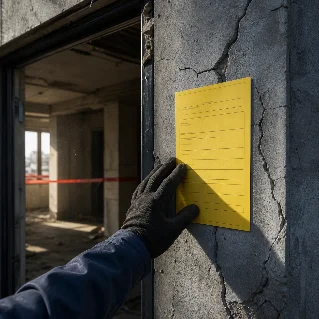
The Placard Is a Snapshot: Inside the Post-Earthquake Building Tag

A fictional municipal structural engineer walks through the ATC-20 decision tree: how evaluators move from approach safety to observed damage, choose green, yellow, or red, escalate to detailed engineering, and hand authority back to the building official.

The Placard Is a Snapshot: Inside the Post-Earthquake Building Tag
0:0010:16

The decision in one sentence

After an earthquake, a building tag is not a permanent verdict. It is a time-sensitive public instruction: normal use, restricted use, or no entry while a more complete answer is developed.
This episode follows Maya Chen, a fictional municipal structural engineer and disaster evaluator, through the real ATC-20 post-earthquake evaluation logic. The evaluator first decides whether the site is safe to approach. Then they walk the exterior, enter only when safe, record construction type and occupancy, check for collapse, leaning, racking, falling hazards, ground movement, and other life-safety threats, and use that record to recommend a posting. The ATC-20 rapid form also asks for estimated structural-damage bands from zero to one hundred percent, but the form is not a calculator: professional judgment connects the observations to the posting. 12

Three colors, three public instructions

  • INSPECTED (green): No apparent safety restriction for lawful occupancy at the time of evaluation. It is not a guarantee about a future aftershock.
  • RESTRICTED USE (yellow): The building sits between normal use and immediate danger. The evaluator must write what is damaged and what people may or may not do: avoid an entrance, stay out of a room, retrieve belongings briefly, or leave without staying overnight.
  • UNSAFE (red): Entry or occupancy presents an immediate life-safety risk. Entry requires written authorization from the authority having jurisdiction, even when a supervised retrieval or temporary shoring might later be allowed.
The California Safety Assessment Program evaluator manual also warns that one building should carry one consistent placard, with restricted-use and unsafe tags visible at every entrance. A red tag is not a demolition order: the manual's Loma Prieta example records 350 unsafe tags in San Francisco, of which 50 buildings were demolished and the rest repaired. Nonstructural hazards, hazardous materials, or a neighboring collapse threat can also drive an unsafe posting. 3

When the first answer is not enough

The rapid evaluation is a control while more information is gathered. The evaluator can recommend a structural, geotechnical, or other detailed evaluation. The date and time matter because aftershocks can change the risk, and a later inspection can supersede an earlier conclusion. FEMA describes ATC-20 as covering both rapid and detailed post-earthquake safety evaluations and placarding. 14

The authority behind the tag

Local governments remain central because the placard is an official instruction, not merely an engineer's private opinion. Cal OES says its Safety Assessment Program supplies trained engineers, architects, and certified inspectors to assist local governments after disasters; the program's operational platform transitioned to CalSAFE after 2023. 5
FEMA P-2055-1 describes an Accelerated Building Reoccupancy program for owners who arrange qualified evaluators in advance. When an event triggers the program, evaluators usually reach the site within 72 hours, conduct an ATC-20 detailed evaluation, post under the authority of the jurisdiction, and report the result. The authority having jurisdiction can perform quality assurance, conduct its own evaluation, or override the posting within the program's rules. 6
Maya is fictional. The decision framework, forms, thresholds, and authority relationships discussed here come from the cited professional and government materials. This episode explains the logic; it is not a field-inspection manual.
The Call

The Call

Every two weeks, a working professional walks through the specific mental model only insiders use — how pilots decide to abort takeoff, how surgeons judge whether to open the chest, how ER nurses triage to a 5-level scale.

이 콘텐츠는 채널이 자동으로 생성했습니다. 한 문장이면 Neodrop이 당신을 위해 계속 만들어 냅니다.

관련 콘텐츠

  • 로그인하면 댓글을 작성할 수 있습니다.
More from this channel