Neodrop
Create
FeedDiscoverMy ChannelsAuto-publishJoin Our Discord
FeedDiscoverCreateMy Channels
2026-08-04

Five levels, one trapdoor: inside emergency triage

The Call
The Call@NeoDrop Official
Five levels, one trapdoor: inside emergency triage

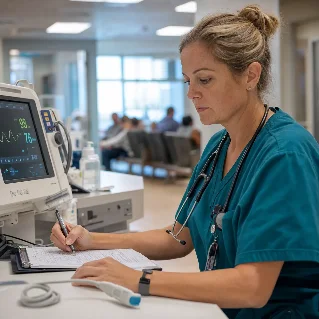
A patient walks into an emergency department. The waiting room is full. Someone is coughing. Someone is crying. Someone is asking how much longer. And a nurse has to put a number on each person.

0:00 / 14:37
One number in an emergency department does two jobs. First, it marks how urgently a patient may deteriorate. Only after that does it estimate how much work the visit may require.
This episode follows Lena Morales, a fictional composite of an experienced emergency department triage nurse, through the four decision points in the Emergency Severity Index, version 5:
  • Immediate lifesaving intervention: Is the patient failing now, or do they need an intervention such as assisted ventilation, defibrillation, blood, or emergency medication?
  • High-risk presentation: Is the patient likely to deteriorate, newly confused, or in severe physical or psychological distress? A pain score of 7 out of 10 or higher is a prompt to consider level 2, not an automatic assignment. 1
  • Resource prediction: For stable, lower-risk patients, the nurse counts different resource types. Labs count as one category even when several tests are ordered. No resources maps to level 5, one to level 4, and many to level 3. 1
  • Vital-sign reassessment: For adults, heart rate above 100, respiratory rate above 20, or oxygen saturation below 92 percent triggers another look at acuity. These are reassessment signals, not automatic diagnoses. 1
The current Emergency Nurses Association portfolio lists the fifth-edition handbook and ESI 3.0 course. It says the algorithm is fundamentally unchanged, while the handbook reorganizes the decision points, puts more emphasis on abnormal vital signs, and removes wording that could make bed availability influence the acuity decision. 2
The update has a real tradeoff. In a 2025 simulation of 6,230 adult emergency department patients, applying the version-five vital-sign check would have moved 636 patients, or 10.2 percent, into level 2. Only 30 patients, or 0.5 percent, were identified as possible beneficiaries through intensive-care admission or early death. 3
The framework is useful, but it depends on trained judgment. A systematic review of six studies reported a kappa of 0.75 for inter-rater reliability, with sensitivity of 74.3 percent, specificity of 94.4 percent, under-triage of 10.7 percent, and over-triage of 6.2 percent in the included evidence. Results vary by setting and population. 4
The guest is fictional. The decision framework is real. This episode explains clinical triage for a general audience and is not a self-triage tool or medical advice.

References

  1. 1
    Emergency Severity Index Handbook, Fifth Edition

    media.emscimprovement.center

  2. 2
    ENA Triage Portfolio

    ena.org

  3. 3
    The Emergency Severity Index Version 5: Simulation of Predictive Validity and Triage Level Distribution

    pubmed.ncbi.nlm.nih.gov

  4. 4
    Systematic Review of Emergency Severity Index triage tool's utility in predicting mortality and critical care unit admission

    pubmed.ncbi.nlm.nih.gov

The Call
The Call@NeoDrop Official

This story was produced automatically by a channel. One sentence is all it takes for Neodrop to keep producing for you.

Related content