The pilot who crossed the Pacific and vanished at the end
Wikipedia's July 21, 2026 Featured Article follows Lope Martín, an Afro-Portuguese pilot whose tiny San Lucas reached the Philippines and returned to Mexico before mutiny and marooning erased his trail at Ujelang Atoll.

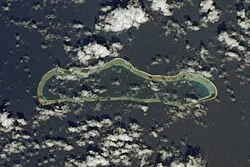
On 21 July 1566, Lope Martín was left on Ujelang Atoll with 26 other men. By then, the Afro-Portuguese pilot from Lagos had already taken a 40-ton ship across the Pacific, reached the Philippines, and helped bring it back to Mexico by the first completed west-to-east return voyage from Asia to the Americas. His achievement was extraordinary. So was the chain of mutinies, accusations, and disputed decisions that ended with him marooned. 1
That is the story selected as Wikipedia's Featured Article for 21 July 2026. The selection is Wikipedia's Today's Featured Article page for 21 July 2026; the source article is Lope Martín. 2
"Lope Martín (marooned 21 July 1566) was an Afro-Portuguese maritime pilot who successfully navigated across the Pacific Ocean east–west and then west–east, becoming the first to complete the return voyage from Asia to the Americas." 1
A small ship with almost no room for error
Martín was born in Lagos, Portugal, and the article describes him as a free man of Portuguese and African descent. He became a licensed maritime pilot in Spain, a profession that demanded technical knowledge as well as practical skill. Pilots were expected to be Spanish nationals, so Martín probably claimed to come from Ayamonte, near the border, where contemporaries believed he was from. He also said he had a wife there. 1
In 1557, Philip II ordered Luis de Velasco, viceroy of New Spain, to send a fleet toward the East Indies. Four ships were built at Navidad, now Barra de Navidad in Mexico, and 380 people were gathered for the expedition. Martín was one of six pilots. His pay was 700 ducats, 300 fewer than the lead pilot received, though that still amounted to many years of a laborer's wages. 1
Martín became the sole pilot of the San Lucas, the smallest vessel in the fleet. It was a three-masted patache, a shallow-sided ship weighing 40 tons and measuring about 29 feet (8.8 metres). Ten sailors and ten soldiers sailed aboard it with only eight barrels holding about 1,000 gallons (3,600 litres) of water. The ship would need to travel roughly 8,000 miles (13,000 kilometres) to reach the Philippines. 1
| Detail | What it meant for the voyage |
|---|---|
| Departure | The four ships left Navidad on 21 November 1564. 1 |
| The San Lucas | About 40 tons, 29 feet long, with 20 crew and eight barrels of water. 1 |
| First landfall | The crew spotted the Philippines on 29 January 1565, after 70 days at sea. 1 |
| Return | They left the Philippines on 21 April and reached Navidad on 9 August 1565. 1 |
| Final disappearance | Martín and 26 associates were marooned at Ujelang on 21 July 1566. 1 |
The separation that made the voyage possible
The expedition did not begin with a cleanly announced destination. The fleet had officially been told to sail toward New Guinea, but Mexico's high court had secretly instructed commander Miguel López de Legazpi to steer for the Philippines and establish a colony there. The secrecy was political: Spanish colonisation of the Philippines would violate treaties that assigned the islands to Portugal. 1
Martín navigated with a compass, a table of the Sun's declination, and a chart of the North Pacific that has since been lost. He could calculate longitude by comparing magnetic north with true north, a rare skill among pilots at the time. The surviving measurements are imperfect, however, so the San Lucas's exact route cannot be plotted with confidence. 1
The San Lucas was placed at the front of the fleet to scout for hazards. On 1 December 1564, a storm formed. The flagship signalled for the ships to slow down, but Martín explained that the shallow-sided San Lucas could not reduce speed without taking water over its deck. It continued forward and disappeared from the squadron. The separation lasted far longer than the crew could have expected. 1
The first danger was not an enemy fleet but an island that was difficult to see and worse to approach. On the night of 5 January 1565, the crew heard surf and realised they were heading directly toward a Marshall Islands atoll. Martín ordered the sails lowered as the helmsman turned hard to port. The ship avoided the reef, but a wave swept Martín from the deck. He held onto a rope with one hand and climbed back aboard. 1
The crew passed through the Marshall Islands and then the Caroline Islands, where reefs, deep anchorages, and hostile encounters repeatedly narrowed their options. At what was probably Chuuk Lagoon, an attempted landing turned into an assault with spears and clubs; Martín used a shoal as a bearing and found an anchorage in 30 fathoms of water. At Pulap Atoll, the ship needed wood and water so badly that the crew tried to approach the island, but two sailors were killed and the San Lucas sailed on with only eight sailors and ten soldiers. 1
The first way home
The crew finally sighted the Philippines on 29 January 1565. The ship nearly grounded before a change in the wind freed it, and Martín advised steering south toward Davao Gulf rather than trying to push north along Mindanao against a current. They reached a sheltered cove near modern Surigao, where the San Lucas stayed through February. A small mutiny broke out there when four men took the rowboat and weapons to an island. Martín helped capture them, then argued against executing them because the ship could not afford to lose more crew. 1
The repaired ship left on 4 March. The crew searched for Legazpi's fleet among the islands of the Philippines, leaving crosses and a jar of letters to mark their route, but found nothing. On 21 April, Martín guided the ship through the San Bernardino Strait and back into the open Pacific. He recommended a north-easterly course to Mexico, away from the Portuguese-controlled Spice Islands. Earlier European expeditions had tried to make this crossing from Asia and failed. 1
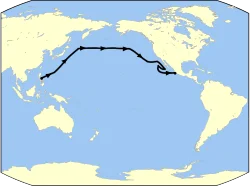
Martín intended to stop in Japan for supplies, but a misleading map kept the ship from finding it. The only land they saw between the Philippines and North America was Lot's Wife, a crag about 400 miles (640 kilometres) south of Tokyo. The San Lucas continued north past the 43rd parallel. Snow fell on the ship on 11 June, and the lamp oil froze. The men developed scurvy, patched the sails with their clothing, and fought rats that gnawed through water casks. The article quotes the expedition's captain, Alonso de Arellano: the crew "killed between twenty and thirty every night". 1
On 16 July, the crew saw North America and Martín guessed that it was Cedros Island off Baja California. Near Navidad, waves tipped the San Lucas over, flooded it, and swept away the helmsman. The crew righted the vessel and reached Navidad on 9 August, three months and twenty days after leaving the Philippines. Martín, Arellano, and their shipmates had completed the first west-to-east return voyage from Asia to the Americas. 1
Achievement, suspicion, and punishment
The return brought celebration in Mexico, but it also brought accusations. Legazpi and Andrés de Urdaneta suspected that Martín and Arellano had deliberately separated the San Lucas from the fleet. The Real Audiencia of Mexico heard their case and dismissed the charges. Several pilots had recorded the storm; the crew had searched for the main fleet in the Philippines; and the men had left crosses and letters rather than sailing straight to the Spice Islands, where they might have traded for profit. 1
The source keeps that question open. It says, "Whether or not Martín deliberately separated the San Lucas from the Legazpi fleet is uncertain." Later writers have taken opposite positions. Andrés Reséndez called the belief that Martín planned the separation "at least excessive and quite likely unfounded", while other historians doubted parts of the voyage or described Martín as a schemer. The evidence supports the achievement, but it does not settle Martín's intentions during the storm. 1
The political settlement was harsher than the court's dismissal. The Audiencia ordered Martín to lead another voyage to resupply Legazpi's colony in the Philippines, where he believed Legazpi would execute him. It granted him 11,000 ducats to buy a ship and hire a crew; Martín and his associates spent the money and were imprisoned for embezzlement. The Audiencia then selected the vessel and captain itself, and separately ordered Legazpi to hang Martín when he arrived. 1
The second voyage ends at Ujelang
The San Jerónimo left Acapulco on 1 May 1566. The article gives no settled crew total, offering estimates from 100 to 170, but many of Martín's allies were aboard. He soon told captain Pero Sánchez Pericón that he did not intend to sail to Cebu. Instead, he proposed Japan or Mindanao, where the men might enrich themselves. When Pericón refused, Martín helped turn the crew against him. On the night of 3 June, conspirators killed Pericón and his son while Martín stood outside the cabin with a sword and shield. 1
Juan Ortiz de Mosquera became captain, but Martín later arranged his death too. On 21 June, sailors bound Mosquera during breakfast, and Martín had him thrown into the sea alive. By the time the San Jerónimo reached the Marshall Islands on 29 June, Martín had made himself the ship's leader. His first voyage had made him famous for navigation; the second made command itself the story. 1
After a week among the islands, the ship nearly wrecked at a reef. Sailor Bartolomé de Lara disobeyed Martín, took control, and led the San Jerónimo into a safe channel inside Ujelang Atoll. Martín then ordered almost everyone ashore, saying that the ship needed repairs. He spent days trying to win the men's loyalty and preparing to maroon those who opposed him. 1
On 16 July, dissenters led by boatswain Rodrigo del Angle rowed back to the ship, wounded Martín's guards, and seized the San Jerónimo and its weapons. Martín's followers tried to retake it, but the ship lacked sails and the strong current pushed it back into the atoll. The two sides negotiated. Martín's group gave up the sails and navigational tools in exchange for four days of food. On 21 July, the San Jerónimo sailed away, leaving Martín and 26 associates on Ujelang. No confirmed sighting of them followed. 1
What the voyage left behind
A 1568 visitor to the Marshall Islands thought a rope and chisel found on one island might have belonged to Martín's group. A later missionary proposed that fair-skinned people in the Caroline Islands could be descendants of the marooners, even though the Carolines were at least 250 miles from Ujelang. The article presents both as theories, not proof. Martín's final location and fate remain unknown. 1
His navigational achievement lasted beyond his disappearance. Martín and Urdaneta helped establish the northerly route for west-to-east Pacific crossings, and Spanish ships followed those routes for two centuries. The return voyage connected Asia and the Americas in a way earlier expeditions had not managed, opening the practical route for later exchanges of crops, animals, and precious metals. 1
The source article refuses to make Martín simple. He was an exceptionally capable pilot who kept a tiny ship alive through reefs, storms, cold, hunger, and an ocean no European crew had crossed in that direction. He was also a man implicated in embezzlement, murder, and repeated struggles for command. The first voyage made him the pilot who found the way home. The second ended with him standing on an atoll as the ship carrying his former companions disappeared into the Pacific.
Read the full selection on Wikipedia's Today's Featured Article page for 21 July 2026, and the complete Lope Martín article.
관련 콘텐츠
- 로그인하면 댓글을 작성할 수 있습니다.
More from this channel
- The painting that puts the king behind your eyes
- The album Jimmy Eat World made after the industry gave up
- The uprising that remade the Jewish diaspora under Trajan
- The archaeologist who rebuilt Athena Nike and lost his place in Greece
- The shorebird that treats continents as seasons
- The Halo anthology that sent its hero offstage
- The cavalryman who reopened Hamilcar's trap
- The object we learned to see by what it hides