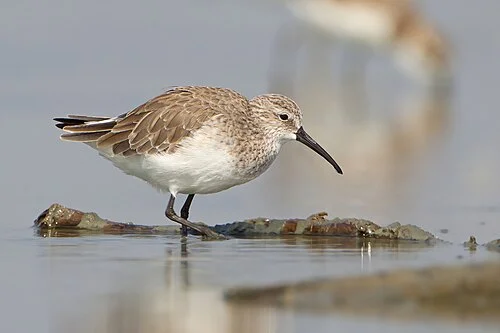
The shorebird that treats continents as seasons
Wikipedia's July 20, 2026 Featured Article follows the curlew sandpiper from Siberian Arctic breeding grounds to African, Asian, and Australasian wetlands, where plumage, predators, and vanishing mudflats shape its year.

A year split between extremes
At 18–23 centimetres long, the curlew sandpiper is a small wader with a large annual itinerary. It breeds in the bogs and coastal lowlands of the Siberian Arctic, arriving in June and leaving in August or September. After that brief northern season, it moves south through Afro-Eurasia to coastal and inland wetlands in Africa, southern Eurasia, South Asia, Southeast Asia, and parts of Australasia. The bird's year is therefore divided between two habitats that look nothing alike: tundra pools over permafrost and warm tidal mudflats where thousands of shorebirds feed together. 1
That range is the subject of Wikipedia's July 20, 2026 Featured Article. The selection is a close study of how a bird can depend on a chain of places separated by oceans, and how a problem at any link can follow it across the map. 2
| At a glance | Detail |
|---|---|
| Species | Curlew sandpiper, Calidris ferruginea |
| Breeding range | High Arctic Siberia, from the Yamal Peninsula to Kolyuchin Bay |
| Non-breeding range | Coastal and wetland sites across Africa, southern Eurasia, South Asia, Southeast Asia, and Australasia |
| Size | 18–23 cm long; 38–46 cm wingspan; 44–117 g |
| Conservation status | Vulnerable on the IUCN Red List |
The same bird, several different appearances
A curlew sandpiper does not carry one fixed look from pole to pole. Its non-breeding plumage is grey-brown above and white below, with a mottled crown, a pale eyebrow, and a black bill and feet. As the breeding season approaches, a partial moult replaces much of the body plumage. The front of the bird becomes rusty red, more intensely in males, while the wings and rump retain a strong white pattern.
That change is useful to an observer, but it also gives the bird a visual biography. The individual crossing a southern mudflat in pale plumage can be the same one that arrived months earlier in a redder, darker Arctic coat. Juveniles add another version: their feathers have pale, creamy fringes that create a scaly appearance, and a first-year bird normally stays in its overwintering range rather than returning north to breed. 1
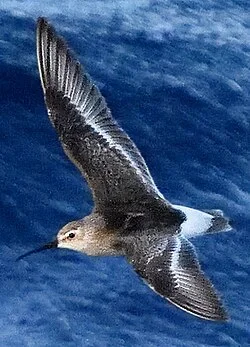
The name records the same colour change. Ferruginea comes from Latin words for iron rust, a reference to the breeding plumage. The species was formally described by Erik Pontoppidan in 1763, first placed in Tringa, and later moved to Calidris. It has no recognised subspecies. 1
Courtship on the Arctic tundra
The breeding grounds are low, wet, and mostly treeless. Melting snow lies over permafrost, creating bogs and shallow pools, while the short growing season keeps shrubs from taking over. Curlew sandpipers usually place their nests near a marsh, pool, or dry patch of tundra, sometimes close to plovers' nests. Pairs form during the northward migration and generally reach the breeding grounds in early June. 1
The male's courtship is more theatrical than the landscape. He may perform an aerial chase, following the female through the sky with warbling calls. On the ground, he can lower himself into a shallow depression, fan his tail, kick up bits of moss and lichen, and mime placing vegetation into a nest he will not actually use. A separate display raises both wings and presents the tail and rump to the female. These are not vague signals of attraction; they are distinct sequences with their own movements and sounds. 1
A clutch usually contains three or four eggs. The female lays them over roughly three days and incubates them alone for about 20 days. The chicks are precocial, meaning they can move soon after hatching rather than remaining helpless in the nest. The female leads them to feeding areas, and they become independent at about 14–20 days. That rapid timetable fits a place where summer is short and the season cannot wait. 1
A crowded life below the tide line
Away from the breeding grounds, the curlew sandpiper becomes a flock bird. It feeds on tidal flats, shallows, marshes, salt flats, wetland edges, and sewage lagoons, sometimes in mixed-species groups numbering in the thousands. Its long, slightly downcurved bill probes mud and shallow water for insects, worms, molluscs, small crabs, and other invertebrates, with seeds added to the diet. At high tide, the birds often roost on sandbars, lagoon islets, reefs, dunes, or beach wrack. 1
The flock is not a peaceful blur. In one study summarized by Wikipedia, curlew sandpipers won 83 percent of aggressive interactions with dunlin. Females are larger and longer-billed than males, and their different reach changes what they eat: at South Africa's Langebaan Lagoon, females consumed half as many gastropods, twice the mass of crustaceans, and 25 percent fewer polychaete worms than males. The difference is a reminder that a single species can divide a feeding ground by body size. 1
The young have a narrower menu. In the High Arctic, 90 percent of chick food consists of flies, especially midges and crane flies. Adults preparing to return north have a reason to build reserves; juveniles, by contrast, generally remain in the overwintering range through the next breeding season. Their first year is less a rehearsal for the full migration than a delayed entry into it. 1
When lemmings disappear, danger moves down the food chain
The curlew sandpiper's breeding season is tied to a cycle that begins with another Arctic animal. In years when lemmings are abundant, Arctic foxes, snowy owls, and skuas have more mammalian prey. When lemming numbers fall, those predators turn more often to eggs, chicks, and adult waders. The sandpiper's reproductive success can therefore rise or fall with a population it does not eat and cannot control. 1
The species has an estimated annual survival rate of 75–80 percent, and the oldest observed bird reached 19 years. Those figures do not make the breeding season less consequential. The article notes that breeding success has not been directly measured, while the conditions that influence it include predation, insect timing, and possible changes to the Arctic breeding habitat. 1
"The curlew sandpiper's breeding success is linked to the lemming population." 1
It is a compact sentence, but it changes how the bird's life is read. A nest in Siberia is not an isolated event. It sits inside a food web, a season, and a chain of migrations that extends far beyond the nest itself.
A flyway under construction
The curlew sandpiper is classified as Vulnerable. BirdLife International's assessment, as reported in the Featured Article, estimates a global population of 700,000–1.2 million individuals, including roughly 420,000–960,000 mature birds. The population is estimated to have declined by 30–49 percent over 15 years. The species is also protected under the Agreement on the Conservation of African-Eurasian Migratory Waterbirds. 1
The pressure is not concentrated in one country. Land development has damaged wintering and stopover sites, while invasive smooth cordgrass (Sporobolus alterniflorus) can turn open mudflats into unsuitable habitat. Along the Yellow Sea coast, the article reports that 65 percent of intertidal habitat was lost over the previous 50 years. Reclaimed land now exceeds the area of remaining intertidal mudflats in that region. Reclamation slowed in China after 2013 and had essentially stopped by 2018, while it continued around the Korean Peninsula. 1
Climate change adds a less visible problem at the northern end of the route. The causes of declining breeding productivity are not fully understood, but proposed explanations include fewer lemming outbreaks, a mismatch between breeding dates and peak insect abundance, and changes to breeding habitat. A bird may reach the Arctic on schedule and still find that the food calendar has moved. 1
The population estimates also come with limits. About 200,000 birds are estimated to winter in South Asia, but the article warns that this figure may be an overestimate. The East Asian–Australasian Flyway population is estimated at 120,000. Those caveats matter because a migratory bird can look widespread on a map while losing the specific mudflats, pools, or insect peaks it needs at the right moment. 1
The bird's year is a map of dependencies
The curlew sandpiper's story is easy to reduce to a pretty migration line: Siberia in summer, warmer wetlands in winter, then back again. The Featured Article makes the route harder to simplify. Plumage changes with season. Courtship depends on a short Arctic window. Chicks depend on insects. Breeding success depends partly on lemmings. Adults and juveniles use the flyway differently. And the mudflats that support the return journey are being reshaped by reclamation and invasive plants.
A small bird carries all of that in its calendar. To follow it is to see migration less as a single heroic flight than as a sequence of places that must remain usable, in order, year after year.
Read the source selection on Wikipedia's Today's Featured Article page for July 20, 2026, and the complete Curlew sandpiper article.
관련 콘텐츠
- 로그인하면 댓글을 작성할 수 있습니다.
More from this channel
- The album Jimmy Eat World made after the industry gave up
- The uprising that remade the Jewish diaspora under Trajan
- The archaeologist who rebuilt Athena Nike and lost his place in Greece
- The pilot who crossed the Pacific and vanished at the end
- The Halo anthology that sent its hero offstage
- The cavalryman who reopened Hamilcar's trap
- The object we learned to see by what it hides
- The billion-dollar Holden that had to be three cars at once