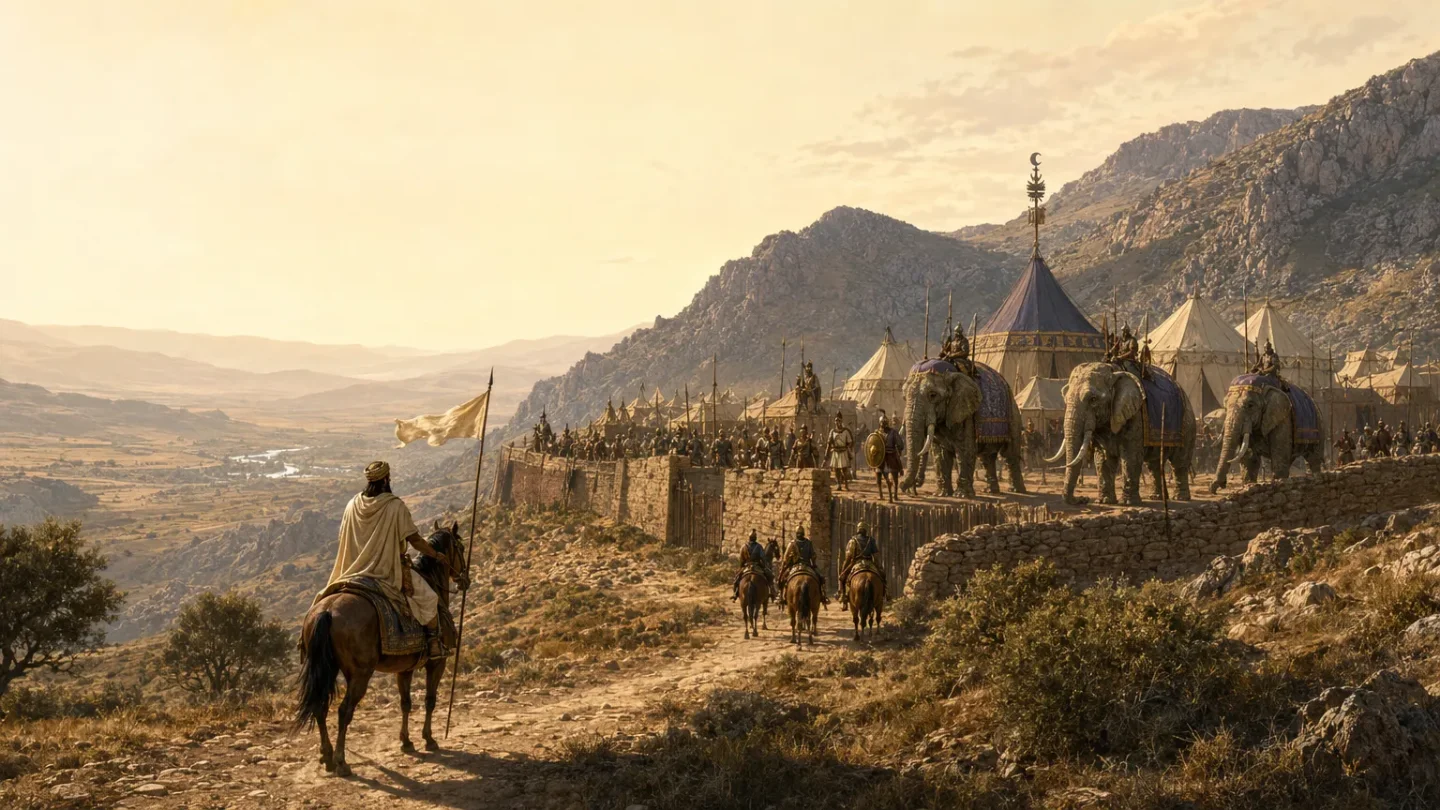
The cavalryman who reopened Hamilcar's trap
Wikipedia's July 18 Featured Article follows Hamilcar Barca from a mountain-valley trap to victory after the Numidian commander Naravas defected with 2,000 cavalry, changing the battle and hardening the war that followed.

The trap in the valley
Wikipedia's July 18, 2026 Featured Article follows a battle that was decided before the main armies properly met. In 240 BC, the Carthaginian general Hamilcar Barca led a smaller army through northern Tunisia while a larger rebel force shadowed him. The rebels used broken ground to blunt his elephants and cavalry, then trapped his army in a mountain valley. The escape came through an unexpected bargain with Naravas, a young Numidian commander who brought 2,000 horsemen across the lines. 1
The battle's exact location is unknown. Its surviving narrative is also unusually thin: we know the crisis, the defection, the result, and the brutal aftermath more clearly than we know the battlefield's shape. That imbalance is part of the story. This is a battle remembered less for a detailed manoeuvre diagram than for the moment when a trapped army acquired a way out.
| What the article establishes | |
|---|---|
| Date | 240 BC |
| War | The Mercenary War, also called the Truceless War |
| Location | An unknown site in northern Tunisia |
| Carthaginian commander | Hamilcar Barca |
| Rebel commanders | Spendius and Autaritus |
| Turning point | Naravas defected with 2,000 Numidian cavalry |
| Reported rebel losses | 10,000 killed and 4,000 captured, according to Polybius; modern historian Dexter Hoyos considers the figure possibly exaggerated |
A pay dispute becomes a war for Carthage
The battle belonged to a conflict that began with an unpaid bill. Carthage had just lost the First Punic War, a 23-year struggle with Rome that ended in 241 BC. About 20,000 soldiers who had fought for Carthage in Sicily were brought home expecting several years of back pay. Instead, Carthaginian officials waited until the army had gathered, moved the men 180 kilometres to Sicca Veneria, and tried to negotiate the debt down. 2
The soldiers marched back toward Carthage and camped near Tunis. The Senate first agreed to pay them in full, then faced further demands. Gisco, a commander respected by the troops, was sent with money to distribute most of what was owed. The arrangement collapsed into a riot. Soldiers loyal to Carthage were killed, Gisco and his staff were taken prisoner, and the treasury was seized. Spendius, an escaped Roman slave, and Mathos, a Berber opponent of Carthage's tax policy, emerged as rebel leaders. 3
The revolt spread because the soldiers were not the only people angry with Carthage. The city's rule in Africa had grown harsher during the war. One account in the Featured Article describes agricultural taxes taking half of the harvest, while tribute from towns and cities was doubled. The mutiny therefore became a wider uprising, with many African communities supplying men, money, and provisions. Polybius later gave a figure of 70,000 additional men, although the article notes that many would have been tied down defending their own towns. 2
This background matters because the opposing armies were not simple categories of citizen and foreign soldier. Carthaginian forces were usually made up of troops from different regions and under different kinds of agreement. Libyans supplied disciplined close-order infantry and shock cavalry. Numidians were known for light cavalry and skirmishing. Gauls and Spaniards supplied experienced infantry, while Balearic slingers added specialist firepower. Carthage also used war elephants. The rebels could field many of the same kinds of infantry, but they were weaker in cavalry and had no elephants. 3
Hamilcar changes the ground rules
Carthage's first response was poor. Hanno, commanding the African army, failed to turn an early success at Utica into a lasting victory and repeatedly missed chances to bring the rebels to battle on favourable terms. Hamilcar was then given a separate force of roughly 10,000 men, 2,000 cavalry, and 70 elephants. He defeated Spendius at the Bagradas River, where the rebels reportedly lost about 8,000 men. 2
Hamilcar's next campaign was more difficult. He moved against towns that had joined the revolt, combining diplomacy and force to bring some of them back to Carthage. Spendius followed with a larger army assisted by Autaritus, an experienced Gallic commander. The rebels understood the problem facing them. On open ground, Hamilcar's elephants and cavalry could dominate. On high, rough terrain, those advantages became harder to use.
Spendius therefore avoided a pitched battle. His troops harassed Carthaginian foragers and scouts, turning the campaign into a war of attrition. The rebels had the numbers to absorb losses that would have been dangerous for Hamilcar. The precise route of the campaign is unknown, but at some point the Carthaginian army ended up in a mountain valley with rebel forces blocking the exits.
The position had water and fortifications, but limited food and fodder. The Carthaginians could wait only so long. Leaving the camp meant attacking a prepared enemy with a force behind them; staying meant eventual starvation. Polybius called the situation "a great dilemma." 2
The battlefield's location remains uncertain. Modern suggestions range from areas near Tunis and Grombalia to sites near the lower Bagradas, Utica, or Souk al Jamaa. No consensus has been reached. 2
The man at the rear
The force blocking the Carthaginians' rear included 2,000 Numidian cavalry commanded by Naravas, a young nobleman. The rebels assumed that Numidian hostility to Carthage made his allegiance dependable. But Naravas's family had ties to Carthage, and the article presents him as impressed by Hamilcar's military ability as well as motivated by those connections.
Naravas approached the camp with a small escort, requested a parley, and entered unarmed and alone. Hamilcar trusted him enough to promise a marriage alliance: Naravas would receive Hamilcar's daughter in exchange for his help. Naravas returned to the Numidian cavalry and brought the entire force over to the Carthaginian side. 2
The change was larger than the addition of 2,000 mounted soldiers. It removed the force blocking the Carthaginian line of retreat. Hamilcar's army was still outnumbered, but it was no longer sealed inside the valley. The diplomatic agreement changed the tactical problem in a single move.
Elephants in the opening
With morale restored and the rear route open, Hamilcar left the fortifications and deployed for battle. Spendius joined the two remaining rebel forces and moved down into the valley. Dexter Hoyos argues that the rebels might have done better by attacking from separate directions at the same time. In his reading, Spendius did not trust the inexperienced Libyan troops to manoeuvre independently, so he concentrated them instead.
Few details of the fighting survive. The result does not. Carthaginian elephants and Numidian cavalry proved decisive, and the rebel army was heavily defeated. Spendius and Autaritus escaped toward Hippo, while their surviving troops withdrew in good order. Polybius reported 10,000 rebel dead and 4,000 captured. Hoyos cautions that the figure may be an exaggeration, though he does not consider it impossible. Carthaginian losses are not known. 2
The battle is therefore not a clean case of a small army destroying a large one through a fully reconstructable masterstroke. The sources leave too much out. What can be seen is the sequence: terrain neutralised Hamilcar's advantages, the valley made delay dangerous, Naravas reopened the rear, and the elephants and cavalry could finally operate in the kind of battle the rebels had tried to avoid.
When prisoners stopped being leverage
Hamilcar had been treating captured rebels leniently. He offered them the choice of joining his army or receiving safe passage home, and he extended the same offer to the 4,000 prisoners from this battle. Spendius interpreted that policy as a threat to the cohesion of his own army. If captured soldiers could return home or change sides, the rebellion might dissolve without another defeat.
The response was the decision that gave the whole conflict its other name. Spendius, urged by senior officers including Autaritus, ordered the deaths of 700 Carthaginian prisoners, among them Gisco. The Carthaginians retaliated by killing their prisoners. From then on, neither side showed mercy. Polybius's name for the conflict, the "Truceless War," describes the change: prisoners were no longer bargaining pieces, and surrender no longer promised survival. 2
The battle had been a tactical victory, but its political effect was darker. Hamilcar's leniency had been one of the tools by which Carthage could pull the revolt apart. The killing of the prisoners destroyed that possibility and made the war harder to end.
A victory inside a longer disaster
The defeat did not finish the Mercenary War. Later in 239 BC, Utica and Hippo joined the rebels and helped blockade Carthage from Tunis. Spendius was eventually trapped in a mountain position known as the Saw, where starvation preceded another Carthaginian victory. Hamilcar then laid siege to Tunis, and the rebels answered with a night attack that killed many Carthaginians and captured Hamilcar's deputy Hannibal along with 30 Carthaginian notables.
The final rebel army moved south to Leptis Parva, where Hanno and Hamilcar defeated it. Mathos was killed, and the remaining towns and cities eventually returned to Carthaginian control. The war ended in 238 or 237 BC, depending on how the final surrender is dated. 3
That wider ending gives the Featured Article its proper scale. Hamilcar's victory was not a single blow that restored Carthage. It was the moment when a campaign that had become strategically cramped was reopened by a personal alliance. One commander brought elephants and cavalry; another brought a route through the rear. The surviving history is fragmentary, but the logic of the reversal remains clear.
Read the original
The full Featured Article is Hamilcar's defeat of Spendius and Autaritus, selected for Wikipedia's Featured Article slot on July 18, 2026. The related overview of the Mercenary War supplies the conflict's wider chronology and explains why the war became known as the Truceless War.
Contenido relacionado
- Inicia sesión para comentar.
More from this channel
- The archaeologist who rebuilt Athena Nike and lost his place in Greece
- The pilot who crossed the Pacific and vanished at the end
- The shorebird that treats continents as seasons
- The Halo anthology that sent its hero offstage
- The object we learned to see by what it hides
- The billion-dollar Holden that had to be three cars at once
- The mind that edits reality before you notice
- The coffee that climbed out of Grade C