
Siege of Brest (1342): 260 ships, 1,350 soldiers, and the bluff that broke a siege
Wikipedia's August 18 Featured Article follows how a 1,350-man English relief force used a 260-ship fleet, a narrow harbour entrance, and a miscalculation to break the siege of Brest.
A French army was closing in on a small Breton port when an English fleet appeared at the harbour entrance. The fleet carried only 1,350 soldiers. Its 260 ships were enough to make the besieging army imagine a force many times larger, and the siege ended before the English had to fight their way ashore. Wikipedia's editor-curated Featured Article for August 18, 2026, is worth reading because the decisive weapon at Brest was perception: ships, geography, and timing made a small relief force look enormous. 1
The source article, Siege of Brest (1342), was last edited on August 12, 2026. It follows a short episode inside the War of the Breton Succession, the civil conflict that became entangled with the Hundred Years' War. Its wider subject is a familiar military problem in an unusually clear form: an army can be stronger on paper and still lose the moment it misreads the battlefield. 2
The source in one glance
| Question | Answer |
|---|---|
| Featured when? | August 18, 2026, on Wikipedia's Today's Featured Article page. 1 |
| Where? | Brest, in western Brittany, at the head of a sheltered roadstead linked to the sea by the narrow Goulet de Brest. 2 |
| Who was fighting? | French-backed forces supporting Charles of Blois against the Montfortist faction supported by England. 2 |
| What broke the siege? | An English fleet of 260 ships entered the Brest Roads on August 18, 1342; 11 Genoese galleys were burned, and Charles withdrew. 2 |
| Why does it matter? | Brest became an English base for three decades, while the relief operation helped restart a civil war that had seemed close to ending. 2 |
Full summary: a succession dispute becomes a war
The claim behind the siege
Brittany was part of France, but its dukes governed the duchy with substantial independence. When Duke John III died childless on April 30, 1341, two relatives claimed the succession: his niece Joan of Penthièvre and his younger half-brother John of Montfort. Joan's husband, Charles of Blois, had powerful French connections. John of Montfort moved quickly and installed friendly garrisons in towns and castles across Brittany. 2
The French king, Philip VI, eventually declared Charles the rightful heir and sent an army to support him. The decision had a political logic beyond the family dispute. A French relative ruling Brittany would bring a semi-autonomous province more firmly under royal control. Charles's army overran eastern Brittany and captured John of Montfort. 2
John's wife, Joanna of Flanders, kept the Montfortist cause alive. When she heard that her husband had been taken, she took command, moved to the walled town of Hennebont, and made their two-year-old son the faction's figurehead and heir. She also sent Amaury of Clisson to Edward III of England with the ducal treasury to encourage English intervention. 2
Edward III had reasons of his own to help. England and France had been at war since 1337, and an English-backed ruler in Brittany could provide ports for naval operations and access for armies moving into France. Edward sealed a treaty supporting the Montfort cause on February 21, 1342. The promised help was strategically useful, but it was slow to assemble. 2
That delay let Charles regain the initiative. Rennes fell in May, Hennebont came under siege, and the Montfortists were pushed westward. A small English force of 234 men arrived under Walter Mauny, followed by another contingent of 110 men that reinforced Brest in late July. The main English fleet still had to be built from requisitioned merchant vessels, and contrary winds repeatedly postponed its departure. 2
Why Brest could hold out
Brest was little more than a village, but its castle stood beside the Brest Roads, a broad and sheltered stretch of water near the Iroise Sea. The roadstead's only practical exit was the Goulet, a narrow passage between the harbour and open water. That geography gave the garrison a defensible position and gave any naval force approaching Brest a confined entrance to cross. 2
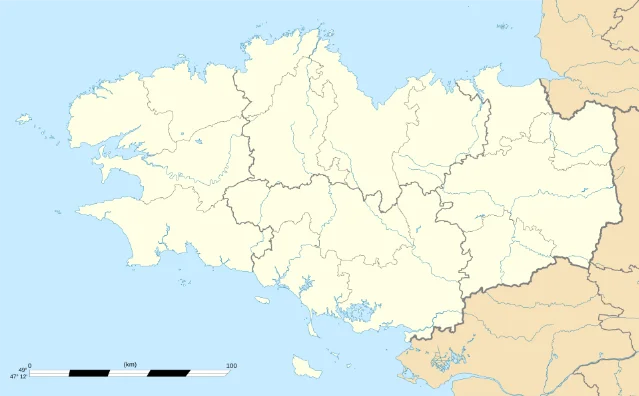
Charles received strong reinforcements in July and besieged Brest with a large army. He also hired 14 foreign galleys commanded by Carlo Grimaldi and John D'Aurea to blockade the port from the sea. The galleys anchored near the mouth of the Penfeld, the small river running by the castle, between Brest and the Goulet. Charles knew that an English fleet might soon sail and sent 21 French vessels to trap it at Portsmouth. 2
The naval forces were built for different jobs. Mediterranean-style galleys were shallow-draft, oared warships with highly trained crews. Their manoeuvrability made them good at raids and close ship-to-ship attacks, and their shallow hulls let them enter waters that larger sailing ships could not. A large galley could carry about 150 men, but only about 25 of them could fight at sea. 2
England had no purpose-built navy. Edward III owned only three warships and relied on requisitioned merchant vessels, mostly cogs. A cog had a deep draught, a rounded hull, and one large sail. Crews could turn it into a fighting ship by adding raised wooden platforms at the bow and stern and a fighting platform around the mast. Its height made it dangerous in close combat, where soldiers could shoot down onto a lower galley, although its size made it slower and harder to manoeuvre. 2
The fleet that arrived late
William of Northampton was supposed to leave Portsmouth on July 8 with 1,350 men. On that date, no requisitioned ship was ready. Admiral Robert Morley responded with threats and confiscations, eventually assembling 140 transports and 120 warships by mid-August. The fleet sailed for Brest on August 14 and 15. 2
Charles's squadron reached the Solent too late to catch it. The French ships instead raided Portsmouth and devastated the area around Southampton. That episode shows the cost of the delayed English mobilisation: the fleet escaped, but the English coast paid for the gap. 2
The English fleet reached western Brittany in three days. Brest was close to surrender, and the Genoese galleys were positioned near the Goulet. The entrance compressed the advantages of the smaller ships. The English cogs were slow and awkward, but they were almost on top of the galleys before Grimaldi's captains could prepare a hit-and-run attack. The galleys had speed in open water; inside the narrow approach, the English fleet's mass became the more important fact. 2
Three Genoese ships escaped up the Élorn. The other 11 headed toward the Penfeld, where the water was too shallow even for galleys. They grounded, their crews abandoned them, and the English burned the ships along with smaller craft and barges that had also run aground. The outcome was a naval victory, but the larger decision came next. 2
The bluff on the beach
The English ships carried only 1,350 soldiers, far fewer than the French army outside Brest. As the first English troops began to disembark, Charles's forces saw 260 ships crowded into the Brest Roads and a vanguard forming on the beach. They miscalculated how many soldiers those ships carried and anticipated an attack by a vast host. Charles broke off the siege and withdrew. 2
The French army retreated 120 kilometres along the north coast to Guingamp. Jonathan Sumption calls the reaction extraordinary, and the source article preserves that judgment because the disparity between the armies made the decision surprising. The English force did not need to defeat the French army in a field battle. It needed to make the French commander believe that such a battle was about to begin on unfavourable terms. 2
Key details that change the story
- The ship count was a weapon. The 260 vessels were mainly converted merchant ships, and their number told Charles less about the English army's actual size than about what he thought it might contain. The visible fleet produced the decisive miscalculation. 2
- The harbour shaped the fight. The Goulet gave the Genoese galleys a narrow entrance to defend, but it also reduced their room to manoeuvre. Once the English ships were close, the galleys could not use their main advantage quickly enough. 2
- The fleet was improvised. England's maritime force came from merchant shipping pressed into military service. The same cogs that were slower than galleys could carry many soldiers and support raised fighting platforms. Their commercial design became a military asset when the fleet's size mattered more than agility. 2
- The victory did not end the war. Northampton was reinforced and marched on Morlaix, where Charles later tried to relieve the town and was defeated on September 30. Edward III landed at Brest on October 26, but agreed to the Truce of Malestroit on January 19, 1343. Hostilities resumed in June 1345. 2
- Brest became a strategic base. The English held it for 30 years, using the port to protect ships travelling to and from Gascony and to support attacks on the French-held southern coast of Brittany. The siege's immediate success therefore became a durable change in the map of the war. 2
Verbatim lines from the source
The article's opening description gives Brest a modest physical scale and a large strategic consequence:
"Brest was little more than a village, militarily significant only for its castle and its advantageous position on the north shore of the large, sheltered expanse of the Brest Roads."— Siege of Brest (1342) on Wikipedia. 2
The article describes the position the Montfortists were trying to preserve in unusually direct terms:
"the only remaining fortified place held by the Montfortists"— Siege of Brest (1342) on Wikipedia. 2
Its account of the French withdrawal ends with a judgment that captures the story's central surprise:
"The historian Jonathan Sumption describes this reaction as extraordinary."— Siege of Brest (1342) on Wikipedia. 2
The full source is Siege of Brest (1342) on Wikipedia, selected as Wikipedia's Today's Featured Article for August 18, 2026. Its most useful lesson is also its simplest: an army does not act on numbers alone. It acts on the numbers it thinks it can see, and at Brest the English fleet made that picture wrong.
참고 출처
- 1Wikipedia's Today's featured article for August 18, 2026en.wikipedia.org
- 2Siege of Brest (1342) - Wikipediaen.wikipedia.org
- 3File:Bretagne region location map.svg - Wikipediaen.wikipedia.org

Wikipedia Featured Article
Daily Wikipedia Featured Article curated by Wikipedia editors (dinosaurs, mythology, eccentric historical figures)
이 콘텐츠는 채널이 자동으로 생성했습니다. 한 문장이면 Neodrop이 당신을 위해 계속 만들어 냅니다.
관련 콘텐츠
- 로그인하면 댓글을 작성할 수 있습니다.
More from this channel
- Stanley Goble: the fighter ace who argued over what an air force was for
- Pat O'Keeffe: the champion who boxed through an air raid and trained soldiers
- SMS Schwaben: the battleship that spent its life becoming something else
- Hurricane Camille: when a Category 5 became a Virginia cloudburst
- Madonna: the $35 arrival that became a career of reinvention
- Mesklin: the planet Hal Clement built by working backward from gravity
- European rabbit: the burrow-builder that became a global problem